
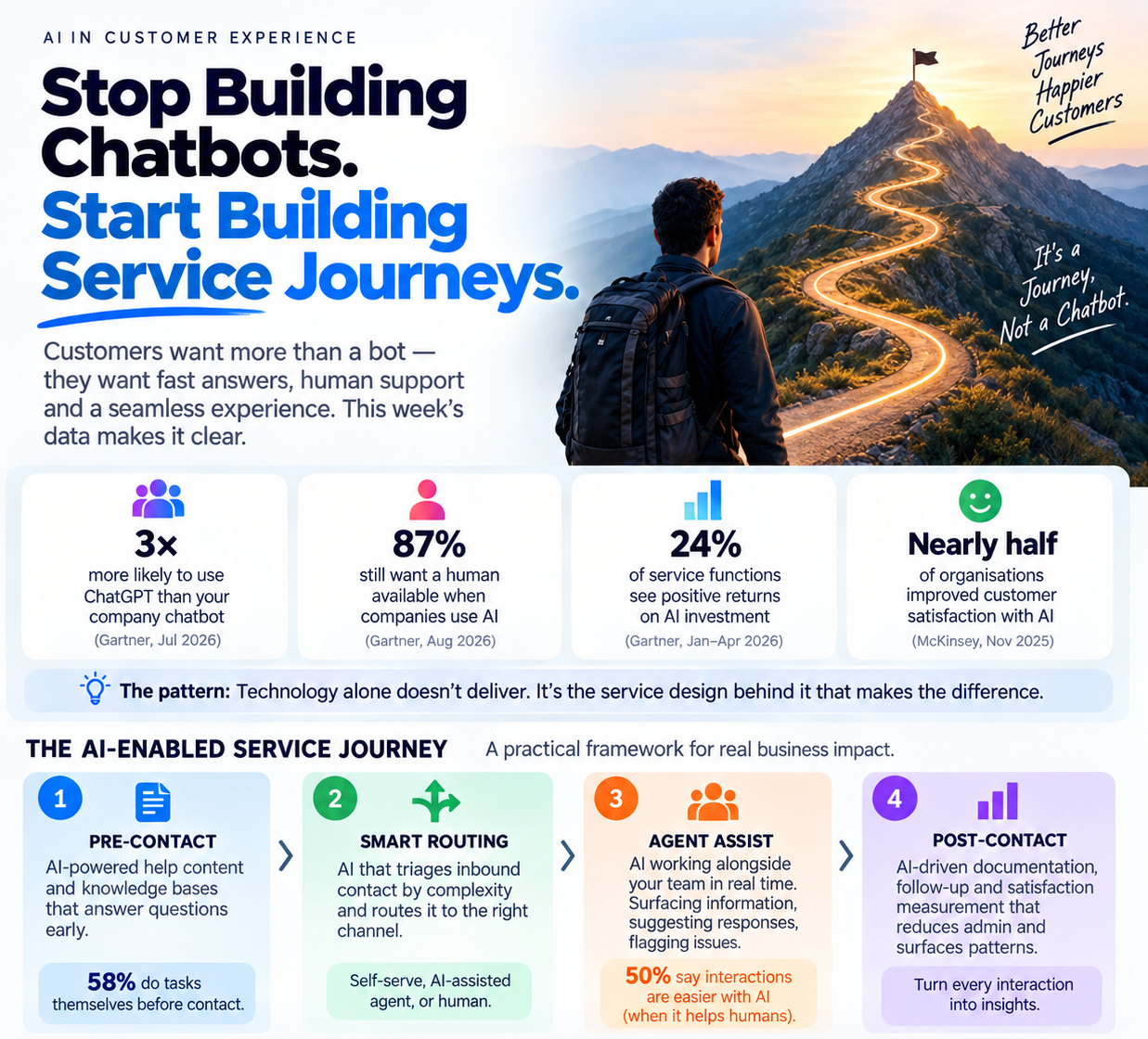
McKinsey’s November 2025 State of AI report surveyed 1,993 business and technology leaders across 105 countries. One of the standout findings: nearly half report improvement in customer satisfaction from AI.
That’s a meaningful number. But it immediately raises the question – what about the other half?
With 88% of the organisations in that same survey using AI in at least one business function, and only 6% qualifying as AI high performers seeing significant business impact, there’s a clear gap between AI deployment and AI outcomes.
The Deployment Gap vs. the Results Gap
The customer satisfaction finding reveals something important: AI can improve customer satisfaction, but doesn’t automatically do so. The same tool deployed in two different organisations produces different outcomes – not because of the tool, but because of the decisions made around it.
The organisations that are improving customer satisfaction with AI tend to share a few characteristics:
They’ve deployed AI where the customer journey actually has friction. Not where AI is easiest to deploy, but where customers are most frustrated. This requires knowing your journey data well enough to identify the bottlenecks – average handle time, first-contact resolution rates, satisfaction scores by contact type and channel.
They’ve maintained human service quality while introducing AI. The Gartner research finding that 87% of customers say human access is essential in an AI environment is borne out in practice: the organisations that cut human capacity as they scaled AI tend to see satisfaction dip, not improve.
They’ve measured outcomes, not activity. Satisfaction improvement is a business metric. Containment rate is an activity metric. Organisations that tracked satisfaction as the primary KPI for their AI investment made different decisions than those tracking automation rates.
Revenue Benefits: Where AI Is Working
McKinsey’s research also found that revenue benefits from AI are most commonly reported in marketing and sales, strategy and corporate finance, and product and service development – with customer service showing positive impact for nearly half who tried it.
This distribution matters for how SMBs think about AI prioritisation. If your primary goal is customer satisfaction improvement, targeted investment in service AI with clear satisfaction KPIs can work – but it requires the business discipline described above. If your primary goal is revenue growth, the data suggests marketing and sales AI may provide more consistent returns at this stage.
What SMBs Can Learn from the ‘Nearly Half’
If you want to be in the half that improves customer satisfaction, the starting point isn’t a tool evaluation. It’s a clear answer to: where do our customers have the worst experience today – and is that friction addressable by AI, by process redesign, or by something else?
The organisations that improve satisfaction with AI are the ones that started there, then found the right capability. They didn’t start with an AI tool and look for satisfaction problems it might solve.
That order of operations – problem first, tool second – is what distinguishes the nearly half from the rest.
Comments are closed