
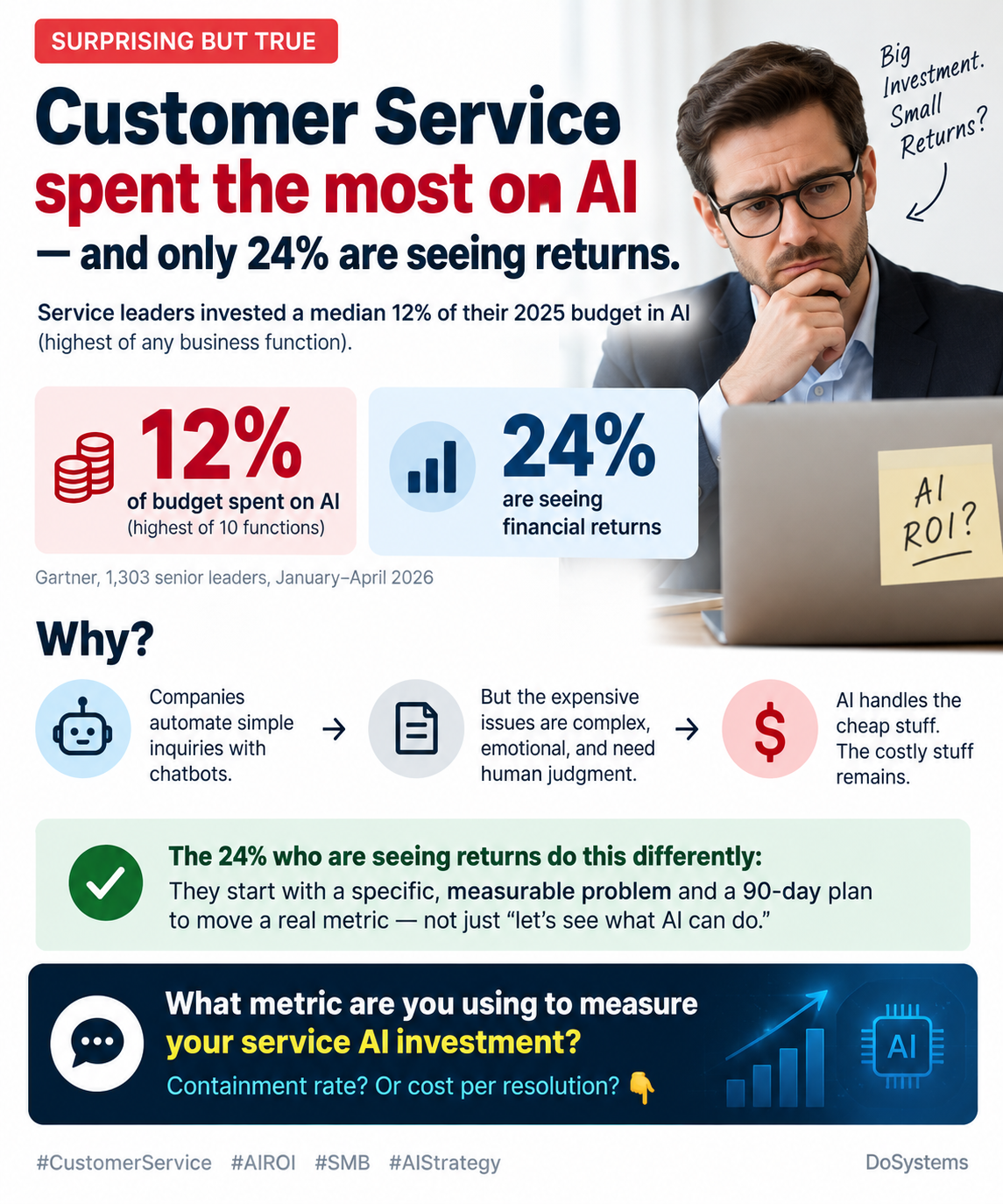
Of all business functions, customer service and support invested the highest share of budget in AI last year.
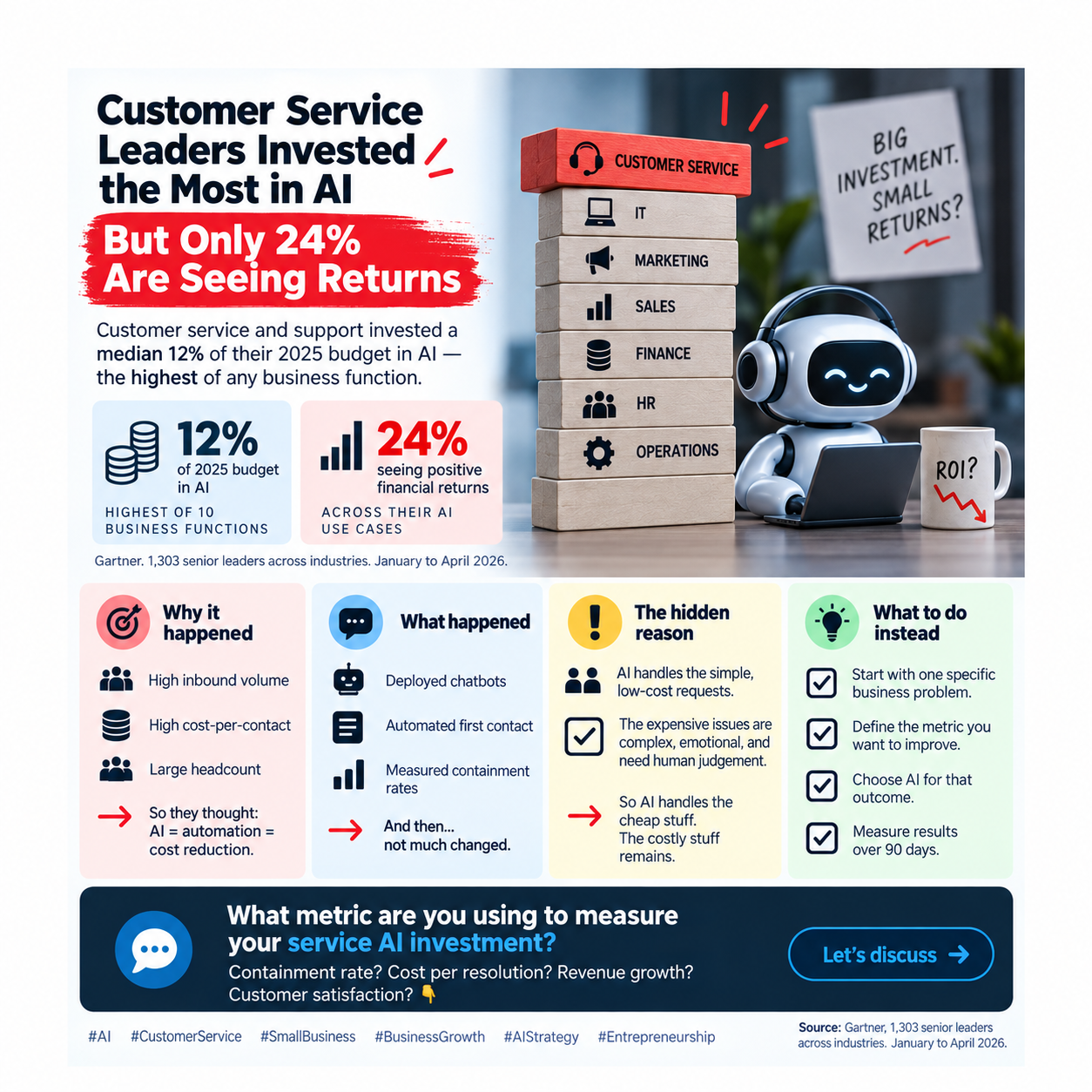
Gartner’s research spanning January to April 2026, covering 1,303 senior leaders across industries, found that service and support leaders invested a median 12% of their 2025 budget in AI – the highest of 10 business functions assessed.
They also have the lowest demonstrated return rate: only 24% of service and support leaders showed positive financial returns across their AI use cases.
That gap – leading investment, lagging return – is not a coincidence. It reflects a structural problem in how most organisations are approaching AI in service.
Why Service Functions Are Over-Investing and Under-Returning
Customer service and support attracted disproportionate AI investment for understandable reasons. High inbound contact volume, high cost-per-contact, large agent headcounts, and years of pressure to reduce cost drove leaders toward AI as the obvious lever.
But the ROI case for service AI is harder to realise than it looks on a spreadsheet. Several dynamics explain the gap:
First, the contact types that AI can fully resolve end-to-end – simple, structured, high-volume queries – are often not the costly contacts. The expensive interactions are the complex, emotionally charged, multi-step issues that still require human judgement. AI can handle the cheap contacts. It often can’t handle the expensive ones.
Second, AI-assisted tools that improve agent productivity require significant change management to deliver their theoretical efficiency gains. Agents need training, processes need updating, and quality checks take time to establish. The investment comes before the return.
Third, many service AI investments are being measured on the wrong metrics: containment rates, contact deflection, automation percentages. These are activity metrics. They don’t measure what business leaders actually care about: cost per resolution, customer satisfaction, and first-contact resolution rates.
The 24% Who Are Seeing Returns
Organisations with positive financial ROI from service AI share a common characteristic: they started with a specific, measurable business problem and chose AI that addressed that specific problem – rather than deploying broad AI capability and hoping returns would follow.
They also tend to have better data infrastructure underpinning their AI. Service AI that routes contacts intelligently, suggests responses accurately, or predicts escalation risk requires clean, connected, real-time data. Organisations that hadn’t invested in data quality before deploying service AI found their tools underperforming against vendor promises.
What SMBs Should Do Before Committing Budget
Before you follow the service function majority into high AI spend, ask three questions:
What specific, measurable outcome am I trying to improve – and does the AI tool I’m evaluating have evidence it moves that metric?
What is the state of my underlying data? If my contact records, CRM data, and knowledge base are incomplete or inconsistent, what will this AI run on?
Am I measuring the right things? If I can only track containment rate, I will optimise for containment rate – and miss what’s actually happening to customer satisfaction and resolution quality.
Service AI can deliver real returns. But the 76% who aren’t seeing them aren’t making a different technology choice – they’re missing the business discipline that turns a tool into a return.
Comments are closed