
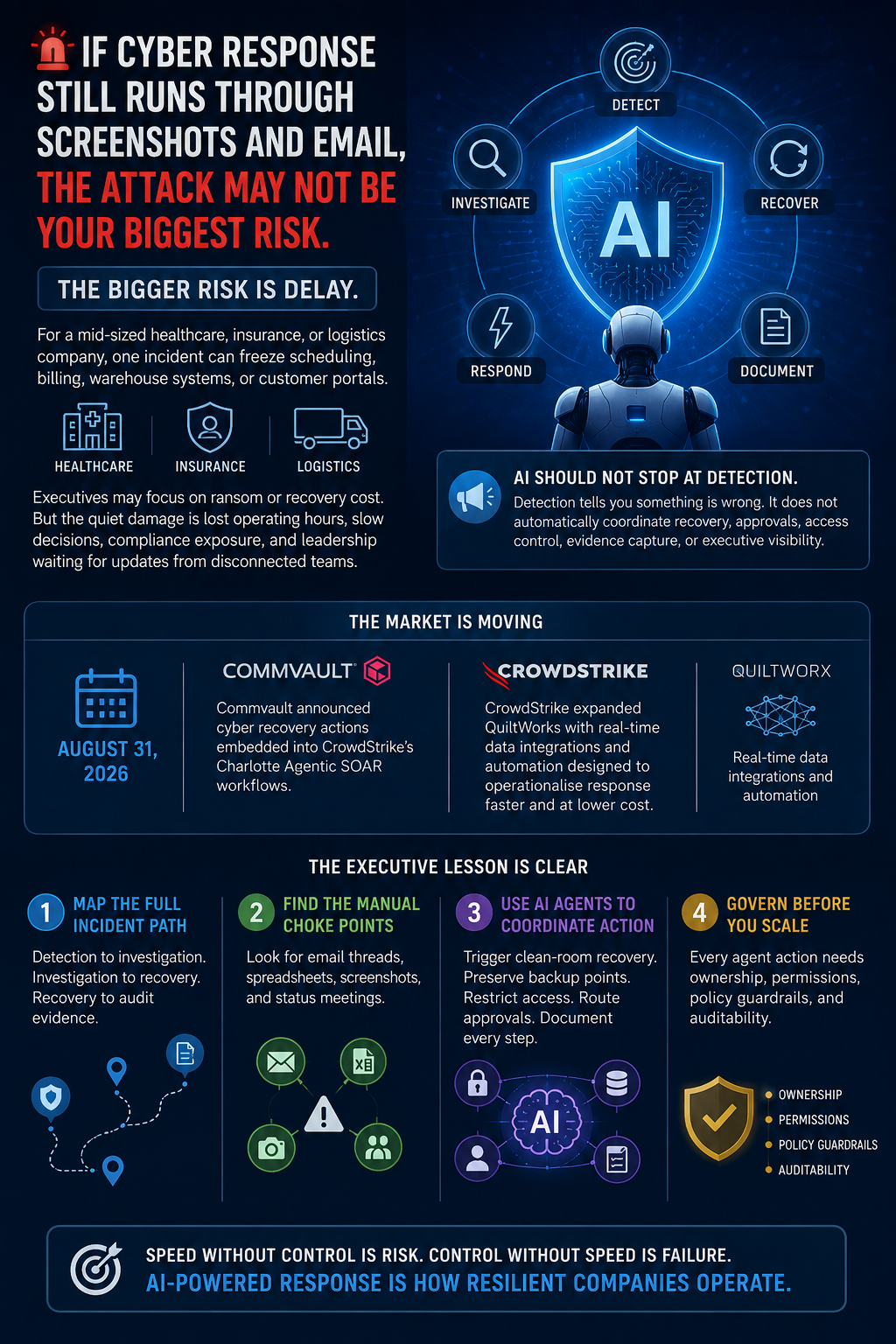
AI incident response matters because many organisations still recover through email, screenshots, and status meetings. That gap turns a cyber incident into an operations problem.
The real cost is not only the attack
For a mid-sized healthcare, insurance, or logistics company, one incident can freeze scheduling, billing, warehouse systems, or customer portals. Leaders often measure the visible recovery cost first.
The hidden cost is slower. It shows up as lost operating hours, delayed decisions, compliance exposure, and executives waiting for updates from disconnected teams.
What the recent market signal shows
On August 31, 2026, Commvault announced cyber recovery actions embedded into CrowdStrike’s Charlotte Agentic SOAR workflows. The stated aim was to accelerate investigation, response, and recovery while reducing manual coordination.
CrowdStrike also expanded QuiltWorks with real-time data integrations and automation. The broader signal is clear: AI is moving from alerting into operational response.
Why AI agents change the workflow
Traditional security tools often detect risk. AI incident response should go further.
From detection to coordination
AI agents can help trigger clean-room recovery, preserve backup points, restrict access, route approvals, and document actions for audit. That matters because the delay often sits between teams, not inside one tool.
From manual evidence to governed records
Compliance teams need proof of who did what, when, and why. Automated workflows can create a clearer record than scattered messages.
That does not remove governance. It makes governance more visible. Every agent action should have permissioning, logging, ownership, and review.
A practical starting point
Do not begin with a large transformation programme. Start with one incident-response workflow map from detection to recovery.
Ask your CIO or COO to identify three handoffs that depend on humans, email, or spreadsheets. Then pilot AI workflow automation where delay is measurable. Track response time, handoff count, approval speed, and audit completeness.
The goal is not to replace judgement. The goal is to remove avoidable delay before downtime spreads.
Frequently Asked Questions
How quickly can a mid-sized business start with AI incident response?
Most organisations can start by mapping one incident-response workflow in a week. The first pilot should focus on three manual handoffs, not a full security transformation.
What is the biggest risk of using AI agents in incident response?
The biggest risk is unmanaged action. Every agent should have clear permissions, logging, ownership, and human review for sensitive steps.
Where should leaders look for the first automation opportunity?
Start where recovery depends on email, screenshots, spreadsheets, or manual approvals. These handoffs often create the longest delays during incidents.
How should ROI be measured?
Measure response time, recovery cycle time, handoff count, delayed operating hours, and audit evidence quality. Compare these before and after the pilot.
Comments are closed