
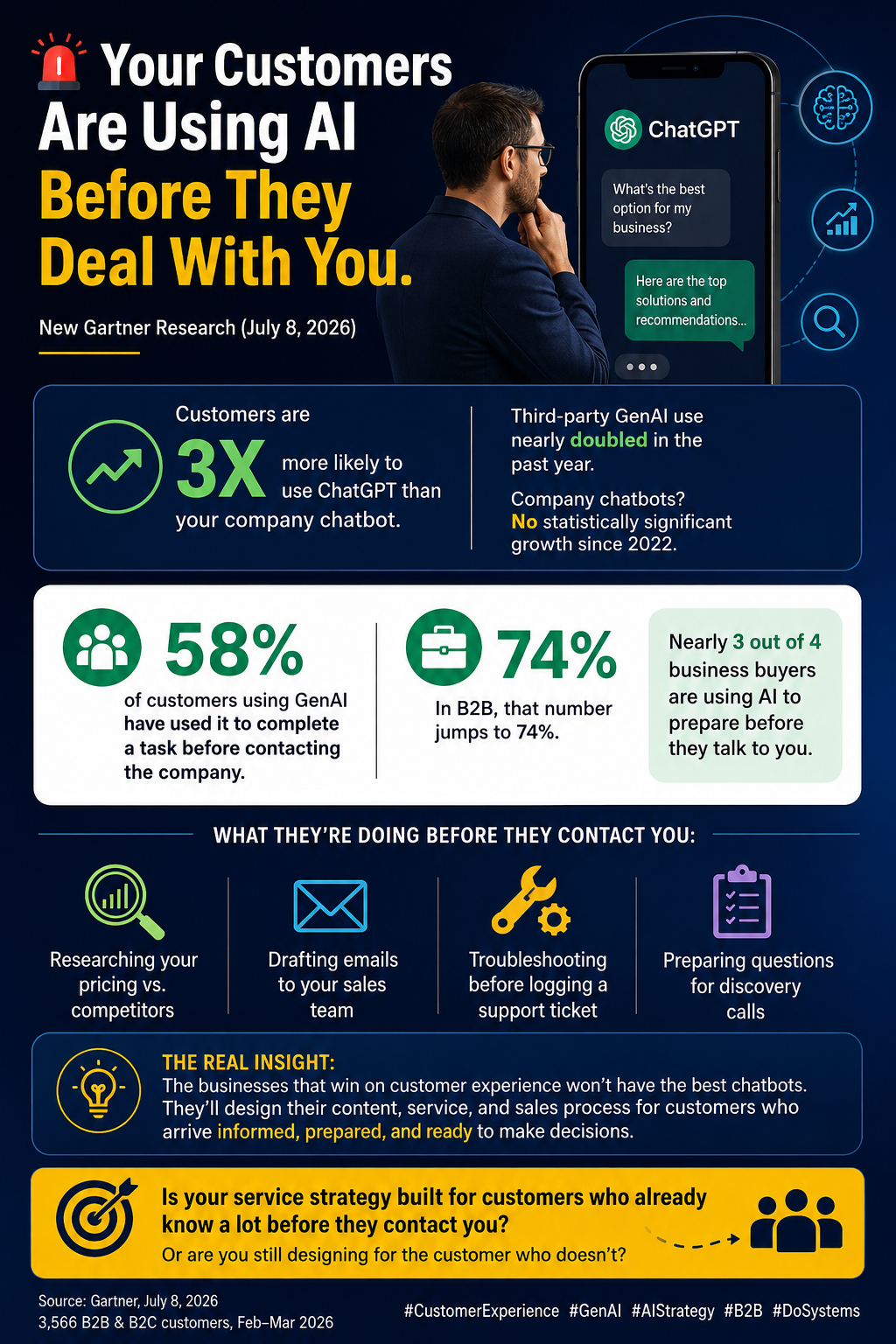
Something shifted in how customers get help – and most businesses haven’t noticed yet.
According to Gartner’s July 2026 research, based on a survey of 3,566 B2B and B2C customers conducted in February and March 2026, customers are approximately 3× more likely to use third-party GenAI tools like ChatGPT than your company’s own chatbot. Use of third-party GenAI nearly doubled in one year. Company-provided chatbots, by contrast, showed no statistically significant growth since 2022.
That’s a significant shift – and it has direct implications for how you think about your customer experience strategy.
What ‘Third-Party GenAI’ Looks Like in Practice
When we say customers are using third-party GenAI, we don’t just mean they’re asking general questions. Gartner found that 58% of customers who use GenAI have used it to complete a task on their behalf – rising to 74% among B2B buyers.
That means a significant portion of your business customers may be using an AI tool to draft an email to you, research your product or service, compare you against competitors, prepare questions for a sales call, or troubleshoot an issue before they ever log a support ticket.
By the time they contact you, they’ve already done work. They’ve already formed views. Your customer experience is starting before the touchpoint you thought it started at.
Why Your Chatbot Isn’t Getting Used
The flat adoption curve for company-provided chatbots is telling. Most businesses have invested in chatbots over the past several years, but the usage has stagnated – not because customers won’t use self-service, but because the experience doesn’t match what customers can now get from general-purpose AI tools.
General-purpose tools like ChatGPT can understand context, handle nuanced questions, and maintain a conversational thread across complex queries. Many company chatbots are still essentially keyword-matching engines that escalate to a human when anything outside their scripted flow comes up.
Customers have experienced what good AI conversation feels like. They’re making comparisons – and the company chatbot is often losing.
What Gartner’s Research Suggests for CX Strategy
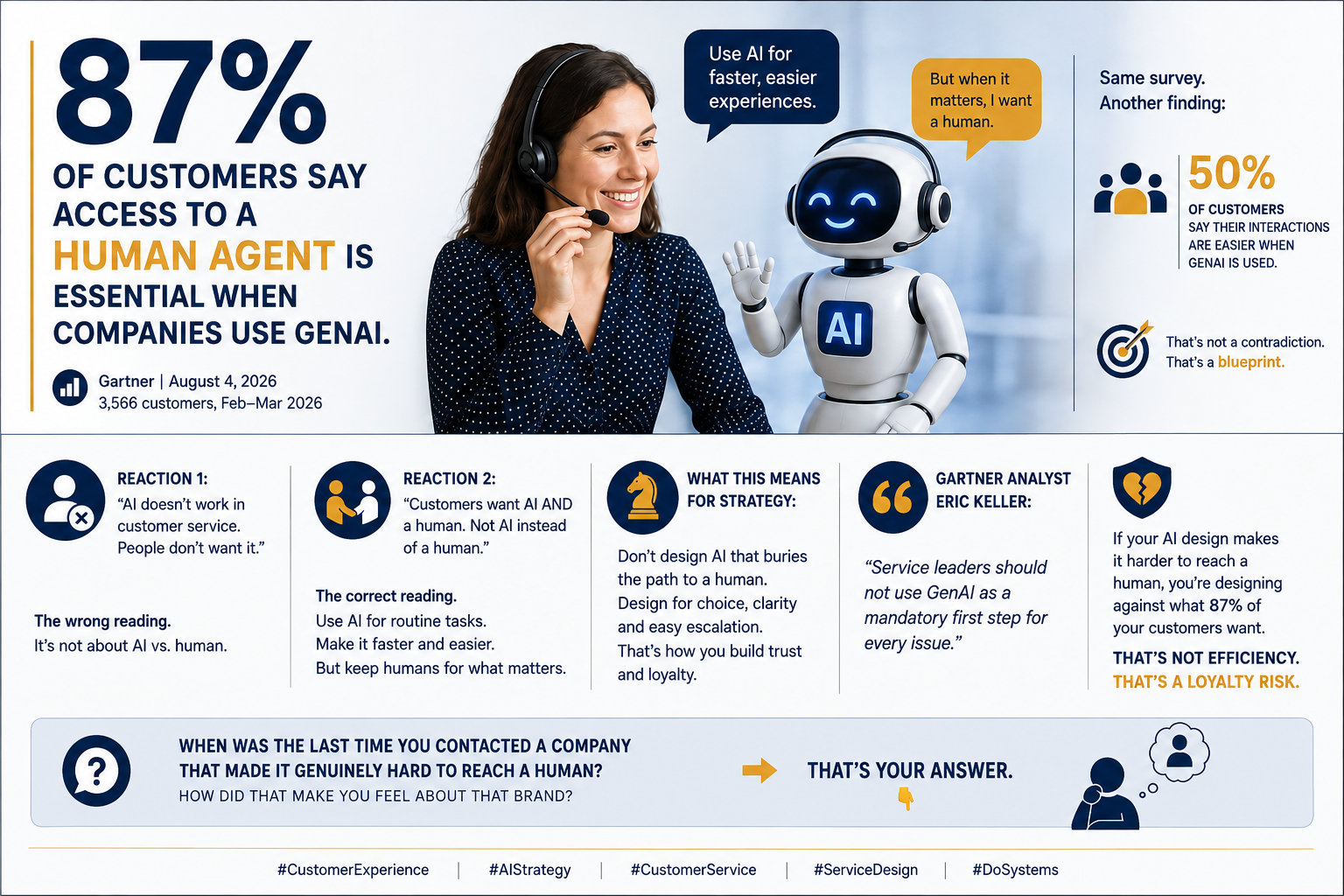
Eric Keller, Senior Director Analyst at Gartner’s Customer Service & Support practice, put it directly: “Rather than investing primarily in standalone chatbots, organisations should focus on AI-enabled service journeys that help customers resolve issues across digital and voice channels.”
That’s the key reframe: from chatbot-as-first-contact to service journey design. Instead of building a better bot for customers to bounce off, the question becomes: how do you build a journey that meets customers wherever they are – including when they arrive already informed by their own AI tools?
Three Things SMBs Can Do Now
1. Audit where your customers actually start their journey. If most of them arrive with prior research, your contact content needs to assume informed customers – not customers discovering you for the first time.
2. Evaluate whether your self-service tools match the quality of what customers can get for free externally. If not, a chatbot refresh is less valuable than improving the information customers can find in your knowledge base, website, and product documentation.
3. Think about how AI-enabled customers behave differently in B2B contexts. With 74% of B2B customers using GenAI to complete tasks on their behalf, your sales and support teams need to be equipped for more-informed, faster-moving buyers.
The businesses that will lead on customer experience in the next two years aren’t the ones with the most sophisticated bots. They’re the ones that understand how AI-enabled customers now move through a buying or support journey – and build their CX strategy around that reality.
Comments are closed