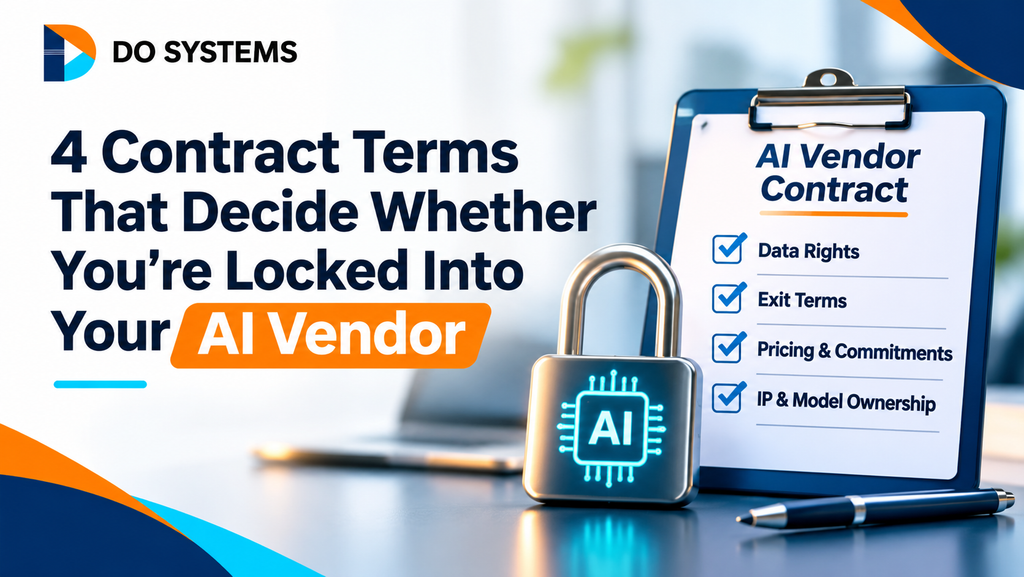
Quick answer: Before signing an AI vendor contract, check four terms: who owns the trained models and prompt libraries, what happens to integration code at contract end, whether you can export your data and logs in a usable format, and what an exit actually involves. These four terms decide whether you can leave.
Table of Contents
The demo looks great. The exit clause decides everything.
A vendor’s AI pilot can hit every capability benchmark and still trap you. Capability and price are the easy parts of a vendor evaluation. A vendor can discuss those parts at length. The terms that determine what happens a year in, when the model needs retraining, the account rep changes, or you simply want a better deal, sit lower in the document, and they deserve the same scrutiny as capability and price. Read it before you sign, not after you’re stuck.
This is a question list to bring into a vendor conversation, including one with DoSystems. It is not legal advice. Take it to your own counsel before you sign anything. What follows are the four terms that decide whether you own your AI deployment or rent it indefinitely from whoever built it.
Term 1: Who owns the trained artifacts and prompt libraries
Ask this directly: when the contract ends, do you keep the trained model, the fine-tuned weights, and the prompt library, or does the vendor keep them?
A trained model built on your data and tuned against your processes is a business asset. Treat it like one in the contract. Demand a clause that states, in plain terms, that artifacts trained on your data belong to you, not to the vendor’s general IP pool. Reject any agreement that is silent on this question. Silence can favor the party holding the infrastructure, which is the vendor.
The same applies to prompt libraries. A prompt library refined over months of production use encodes real operational knowledge: edge cases, exceptions, the phrasing that gets the model to behave. A vendor that walks away with that library while you walk away with nothing is not a neutral outcome. Name this in writing before the work starts, not after it’s built.
Term 2: What happens to the integration code at contract end
The model may not be the hard part to replace. The integration code, the pipes connecting the AI output to your EHR, ERP, CRM, or ticketing system, is where the real cost lives. Ask who owns that code, whether it was built on your infrastructure or the vendor’s, and whether you receive a working copy, documentation, and deployment rights the day the contract ends.
A vendor that builds integration code inside its own proprietary platform, with no portable export, has built a dependency, not a deliverable. Push for integration work to run on your cloud environment or your repositories wherever that’s technically reasonable. When it isn’t, require a documented handoff process as a contract term, not a goodwill gesture promised verbally.
Term 3: Can you export your data and logs in a usable format
Data and logs accumulate fast once an AI system runs in production: inputs, outputs, corrections, overrides, audit trails. That history is valuable for retraining, for compliance review, and for proving the system did what it was supposed to do. Confirm, before signing, that you can export this data on demand, in a format you can actually open and use, not a proprietary dump that requires the vendor’s own tools to read.
State a standard in the contract: structured formats, documented schemas, and an export mechanism that doesn’t depend on the vendor’s continued cooperation. A vendor that can’t commit to this in writing is telling you something about how the relationship ends.
Term 4: What an exit actually involves
Capability and price answer the question “will this work?” Exit terms answer the question “what happens when it doesn’t, or when you want to leave anyway?” Ask the vendor to walk you through the exit process step by step: what gets handed over, in what order, with what support, and what you’re expected to do on your side.
A vendor that can describe this process in specific, sequenced terms has thought about it. A vendor that answers with reassurance instead of a process has not. Write the exit mechanics into the contract itself: data export, code handoff, model artifact transfer, and a defined support window for the transition. Don’t accept a verbal promise that “we’ll work it out when the time comes.” By the time that conversation happens, your negotiating position may be gone.
Bring this list to your own counsel
These four terms are not an exhaustive legal checklist, and this is not legal advice. It’s a set of operational questions a CIO should be able to answer before signing, and that a vendor should be able to answer without flinching. If a vendor hesitates on ownership, goes vague on integration code, can’t commit to a usable data export, or has no concrete exit process, treat that as information about the relationship you’re about to enter, not an oversight to clear up later.
Run this list against your own counsel’s review of the actual contract language. The specific wording matters more than the general principle, and wording is where a vendor builds in the gaps that cost you later.
Before you sign anything
A pilot evaluated only on capability and price gets you excited about what the AI can do. A pilot evaluated on these four terms tells you what happens when the relationship changes, the vendor changes, or you simply want out. Both evaluations matter. Do the second one before you sign.
If you are weighing an AI pilot with a vendor right now, the free 45-minute AI strategy session maps one process worth testing first and gives you a scoped 6-8 week pilot plan. A defined scope is what lets you hold any vendor’s proposal, including ours, to the four terms above.
Free 45-minute AI strategy session
FAQ
Who should own the trained AI model and prompt libraries in a vendor contract?
That is a question for your contract, not an assumption. Ask in writing for ownership of artifacts trained on your data and of the prompt library, and take the wording to your own counsel before the project starts.
What should happen to integration code when an AI vendor contract ends?
You should receive a working copy of the integration code, documentation, and deployment rights at contract end, whether the code ran on your infrastructure or the vendor’s. If it was built inside a proprietary vendor platform, the contract should still require a documented, usable handoff.
Is this checklist legal advice for AI vendor contracts?
No. This is a set of operational questions to bring into a vendor conversation and to your own counsel before signing. It does not describe what any specific law or regulation requires.
Comments are closed