Quick answer: AI governance consulting for public sector agencies begins with five essential requirements before a pilot reaches security or procurement review: one named process and owner, a data classification decision, documented security sign-off requirements, written pass/fail criteria, and an honest build-vs-buy assessment.
These five checks help agencies establish accountability, evaluate risks, and develop a practical pilot scope before beginning procurement.
Bring that scope into your agency’s existing review process instead of starting with a blank RFP.
Table of Contents
A Pilot Can Be Stuck Before Procurement Ever Sees It
A public-sector AI pilot can stall before procurement ever sees it because no one scoped it first.
A proposal with no named owner, no data classification, and no definition of success doesn’t fail because the rules are strict. It fails because there’s nothing in it for the rules to evaluate.
This is where AI governance consulting for public sector agencies becomes valuable. It helps teams establish clear responsibilities, identify risks, and prepare the documentation needed for internal review.
Your agency’s procurement and security review process is not the obstacle here. It’s the test. Your job is to walk in with a scope that passes it. That scope has five parts, and none requires a vendor or an RFP to produce. They require a decision.
Effective AI governance consulting for public sector agencies starts by building the scope before the review, not during it.
1. Name One Process and One Owner
The first requirement in AI governance consulting for public sector agencies is identifying one workflow and one accountable owner.
Pick one workflow: permitting intake, case assignment, or document routing. Not a portfolio of ideas, but one process with a clear start and end point and a manager who already owns it.
Reject any pilot proposal that names a department instead of a person. “IT and Permitting are exploring AI” is not a scope. “The permitting intake coordinator owns this pilot and reports on it weekly” is.
State the value in one sentence with a number attached: hours saved on a specific task, a backlog measured in cases, or an error rate you can already see in your current data.
If you can’t write that sentence today, you don’t have a pilot yet. You have an interest.
A clearly defined owner also creates accountability for decisions, monitoring, and reporting throughout the pilot.
For this reason, AI governance consulting for public sector agencies should establish ownership before evaluating technology or selecting vendors.
2. Classify the Data Before Anyone Asks You To
Data classification is another essential part of AI governance consulting for public sector agencies. Security and compliance review will ask what data the AI touches and where it goes. Answer that before you’re asked.
Classify the data this one process uses:
- What information is publicly available?
- What data is sensitive or regulated?
- Who currently has access?
- Where is the information stored?
- Will the pilot require external data transfers?
Name the systems that data lives in and whether they expose an integration path or require manual export.
A team that waits for the security office to raise these questions has handed that office work it should have done itself. A team that brings a data classification decision to the first meeting has turned a review into a confirmation.
Data scattered across inboxes, shared drives, and personal spreadsheets is not a problem you should attempt to solve during the pilot. It may be a reason the pilot is not ready yet.
AI governance consulting for public sector agencies helps identify these limitations early, allowing teams to address data readiness before implementation.
3. Document Security Sign-Off Requirements
A critical element of AI governance consulting for public sector agencies is identifying exactly what the security team must review and approve.
Before approaching procurement, document the security requirements that apply to the proposed pilot. These may include:
- Access controls and user permissions.
- Data storage and retention requirements.
- Encryption and information protection.
- Vendor security documentation.
- Logging, monitoring, and audit requirements.
- Applicable agency policies and regulatory obligations.
The goal is not to replace the security review. It is to prepare for it.
A useful reference is the NIST AI Risk Management Framework, which provides guidance for managing risks associated with AI systems.
Public-sector organizations can use relevant elements of this framework alongside their own established governance and security requirements.
AI governance consulting for public sector agencies should help translate these considerations into practical review questions and documented responsibilities.
When security requirements are understood early, the pilot team can make informed decisions about architecture, data access, and vendor involvement.
4. Write Pass/Fail Criteria Before You Write Code
AI governance consulting for public sector agencies must also establish measurable success criteria before development begins.
A pilot without a defined pass/fail threshold is not a pilot. It’s a demonstration that ends when the demo looks good enough to someone in the room. That is not a standard your security and compliance reviewers can evaluate, and it should not be a standard you accept from a vendor.
Set four things before starting:
- Target metric: What operational improvement are you measuring?
- Success threshold: What result qualifies as success?
- Review date: When will the outcome be evaluated?
- Next action: Will the agency scale, improve, or stop the pilot?
For example, an agency testing document-routing automation might measure processing time, routing accuracy, and the number of cases requiring manual intervention.
The target should reflect the agency’s existing performance baseline and operational priorities.
Write these expectations down before the pilot starts, not after the results come in.
A review board can evaluate a scope with clear success criteria. It cannot meaningfully evaluate a promise to figure out success later.
This is why AI governance consulting for public sector agencies should focus on measurable outcomes rather than technology demonstrations alone.
5. Build, Buy, or Partner: Count Who Runs It in Month Six
The fifth requirement in AI governance consulting for public sector agencies is evaluating whether to build internally, purchase an existing solution, or work with an implementation partner.
A team that defaults to “we can build this” without counting the maintenance load after launch is making a staffing decision, not a scoping decision.
A pilot that launches still needs someone to monitor it, fix it, and answer for it in month six. A pilot with no owner, no monitoring, and no fix path in month six is not a success. Plan for month six before you plan the launch.
Be honest about internal skills versus the time-to-value of bringing in help for activities your team doesn’t perform every day. These may include model integration, security hardening for a public-sector environment, and rollout support that keeps a pilot from becoming shelfware.
AI governance consulting for public sector agencies should make these operational responsibilities visible before procurement begins.
This is a scoping decision, not a loyalty test. Decide it before you write the request, not after a vendor shows up with an answer already picked.
What Actually Drives the Cost of a Public-Sector AI Pilot
Cost evaluation is an important consideration in AI governance consulting for public sector agencies.
A vendor who quotes a number before seeing your scope hasn’t seen your environment. What drives cost is knowable without a price tag attached to it.
Key factors include:
- The number of systems requiring integration.
- The complexity of data classification and compliance review.
- The quality and accessibility of existing data.
- The level of training and rollout support required.
- Ongoing maintenance, monitoring, and security responsibilities.
A process with one system, clean data, and a narrow use case is generally simpler to scope than a process spanning three departments with data in six formats.
That’s not a pricing claim. It’s a scoping consideration your own IT staff can verify before a vendor conversation happens.
Effective AI governance consulting for public sector agencies helps identify these cost drivers before organizations commit to implementation.
This allows leadership teams to evaluate realistic resource requirements and establish a more defensible business case.
What This Process Actually Produces
How Agencies Can Prepare for a Successful AI Pilot
Preparing for an AI pilot requires more than choosing the right technology. Public-sector agencies must establish clear expectations, involve the right stakeholders, and understand how proposed solutions will affect existing workflows.
This is where AI governance consulting for public sector agencies can help connect technical planning with operational priorities.
Before moving forward, agency leaders should review three important areas.
Operational readiness: Determine whether employees understand the proposed workflow changes and whether existing processes are documented clearly enough to support automation. Identify potential challenges that could affect adoption or create additional work.
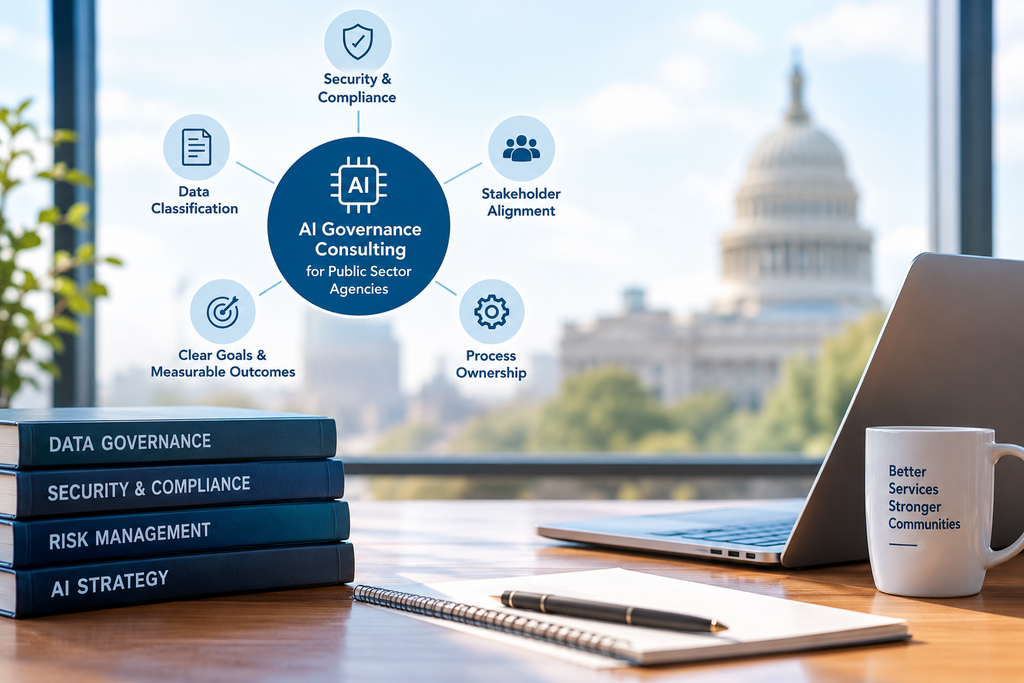
Stakeholder alignment: Involve representatives from operations, IT, security, and procurement early in the planning process. Each team should understand its responsibilities, required approvals, and the decisions it must make before implementation begins.
Long-term accountability: Establish who will monitor performance after deployment, review exceptions, address system failures, and decide whether the solution should expand beyond the initial pilot.
AI governance consulting for public sector agencies should also help organizations document these responsibilities so that decisions remain transparent and measurable.
A successful pilot is not simply one that demonstrates technical capability. It is one that delivers a measurable operational improvement while maintaining security, accountability, and compliance with existing agency requirements.
By addressing these considerations early, public-sector leaders can reduce unnecessary delays and make more informed decisions about AI adoption.
The purpose of AI governance consulting for public sector agencies is not to bypass procurement rules or replace internal security reviews.
It is to produce the documentation those processes need to evaluate a proposed AI pilot.
A properly scoped pilot should include:
- One clearly defined process.
- One accountable owner.
- A documented data classification decision.
- Security review and sign-off requirements.
- Written pass/fail criteria.
- A realistic build-vs-buy assessment.
These elements help distinguish a review board evaluating a real proposal from one trying to evaluate an idea.
Your procurement and security rules will set the process from here. That’s not something a vendor changes, and it’s not something worth arguing with. What you control is what you bring to that process.
AI governance consulting for public sector agencies provides a practical way to prepare that scope while maintaining existing accountability and oversight.
Start With One Process, Not a Blank RFP
A successful AI pilot begins with a clearly defined operational problem.
Before investing in technology or beginning procurement, agencies should understand the workflow, identify the accountable owner, classify the data, and document the conditions for success.
AI governance consulting for public sector agencies helps bring these decisions together into a scope that leadership, security, and procurement teams can evaluate.
A free 45-minute AI strategy session is where that scope gets built.
The session focuses on identifying one high-ROI process in your environment and developing a practical pilot scope that can inform your agency’s existing review and procurement process.
Instead of guessing what belongs in an RFP, start with a documented business problem and measurable success criteria.
Book Your Free 45-Minute AI Strategy Session
Frequently Asked Questions
What does a public-sector agency need before starting an AI pilot?
An agency needs one named process and owner, a data classification decision, documented security sign-off requirements, written pass/fail criteria, and an honest build-vs-buy assessment.
These five elements provide a practical foundation for internal review.
AI governance consulting for public sector agencies can help organize these requirements into a documented pilot scope.
What does AI governance consulting for public sector agencies actually produce?
AI governance consulting for public sector agencies produces a structured scope that supports security, leadership, and procurement evaluation.
This includes defined responsibilities, data requirements, security considerations, measurable outcomes, and an implementation approach.
It does not change or bypass an agency’s existing procurement or compliance requirements.
Should we build an AI pilot in-house or bring in outside help?
Count the maintenance load after launch before deciding.
A team that builds without a monitoring plan, a fix path, and an owner for month six is making a staffing decision, not a scoping decision.
Weigh internal skills honestly against the time-to-value of bringing in help for integration, security, and compliance-specific work.
AI governance consulting for public sector agencies can support this assessment by clarifying the responsibilities and resources needed beyond the initial pilot.
Comments are closed