
Quick answer: AI pilot scope creep happens when a team keeps adding ‘while we’re at it’ requests to a live pilot until the original process and metric disappear. The fix is operational discipline: lock one use case and one pass/fail date before launch, and route every new request to a separate backlog for the next pilot.
The Request That Kills the Pilot
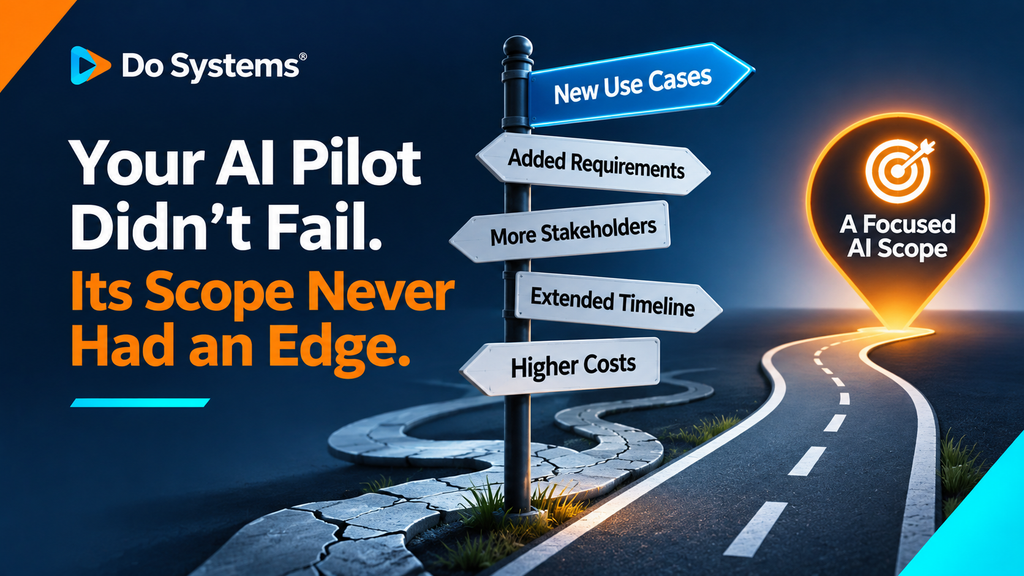
A pilot can fail on the request that arrives after launch, not on the technology. Illustrative example, not a real client: imagine a pilot built to triage support tickets. Once it is running, someone asks if it can also flag duplicate invoices. Someone else asks if it can also check scheduling conflicts. Each request sounds small. Each one is reasonable on its own. None of them were in the plan, and none of them get judged against a metric, because the metric was written for a narrower job than the one the pilot now does.
This is scope creep after launch, and it is different from picking the wrong process to start with. The process was right. The team named one owner and one workflow. Then the pilot became useful, and more requests followed. Soon the pilot touches multiple processes, reports to more than one department, and the metric that was supposed to score it was built for a job the pilot stopped doing a while back.
Name what is happening when it happens: this is not an extension of pilot one. It is the start of pilot two, requested before pilot one has been scored.
Why “While We’re At It” Is the Real Risk
A team that just solved one problem well with a pilot can expect the next request to land fast. The instinct behind the request is not wrong, the tool clearly works, so why not point it at the next thing. The timing is wrong. A new ask arriving mid-review competes with the one question the pilot exists to answer: did it hit its number.
An unscoped addition to a live pilot carries a cost no one budgeted for in the original timeline: new data sources to validate, new edge cases to test, new stakeholders who now expect a say in what “done” means. The pilot does not get faster because it is already running. It gets slower, because it is now running two jobs on scaffolding built for one.
When the metric was written for a narrower job than the one the pilot now does, the team can no longer score the result honestly. Was the original process fixed. Was a second, unscored process bolted on. A review meeting at that point produces an argument about scope, not a decision about pass, fix, or stop.
Two Checklist Points That Hold the Line
The AI Readiness Checklist has ten points. Two of them exist specifically to stop this pattern, and they only work if a team enforces them after launch, not just before it.
Point 2, one high-value use case, does not expire at kickoff. Keep the original process named and keep it singular. If the pilot was built to triage support tickets, it stays built to triage support tickets. A request to also summarize ticket sentiment is a different use case. Write it down. Do not fold it in.
Point 8, success criteria for the pilot, is the harder discipline to hold, because it requires a decision date that was fixed before anyone saw results. Target metric. Minimum threshold. Review date. What happens if it misses: scale, fix, or stop. A pilot that keeps absorbing new scope may not reach its review date with a clean answer, because the metric it was supposed to hit is no longer the thing it is doing.
Hold both points as fixed references, not aspirations. When a new request arrives, check it against the named process and the named metric. If it does not fit either, it does not belong in this pilot. That check takes one conversation. Skipping it costs time later, when the team can no longer agree what the pilot was supposed to prove.
Build the Backlog, Not the Platform
The fix is not to refuse every new idea. When operators pay attention to a tool that is working, good ideas surface alongside it, and some of them are worth building next. The fix is to give those ideas a home that is not this pilot.
Create a backlog for pilot two before pilot one is finished. Every “while we’re at it” request gets logged there: the process, the requester, the rough value, the date it was raised. Nothing in that backlog gets built until pilot one has hit its review date and been scored pass, fix, or stop.
This does two things at once. It keeps pilot one judgeable, because its scope and metric never moved. It also keeps the organization from losing good ideas, because they are captured instead of either jammed in or waved off. A request that gets written down and scheduled carries more weight than one that gets silently folded into a project no one can measure anymore.
Name an owner for this backlog. It should be the same accountable business owner the checklist calls for in point 6, not a shared inbox. An owner with a name attached will defend the line better than a process that depends on everyone remembering it on their own.
What Holding the Line Actually Looks Like
Reject any pilot without a pass/fail threshold. Reject any addition to a running pilot that does not have one either. Name one owner for the original pilot and one for the backlog, even if it is the same person wearing two hats on two different clocks. Put the review date on a calendar, not in a goal statement, and treat that date as the moment the pilot gets scored, not the moment it gets extended by default.
When the review date arrives, score against the original metric only. A pilot that hit its threshold on the original process is a success, independent of how many adjacent requests piled up in the backlog. A pilot that missed its threshold because it quietly expanded into several processes is not a partial success. It is a pilot that was never properly scoped a second time, and the fix is to scope pilot two properly, not to keep stretching pilot one.
This is the discipline that separates a pilot that reaches a real decision from one that becomes a permanent, unexamined project. Defend the scope.
The AI Readiness Checklist walks through all ten points, including the two used here: naming one use case and locking success criteria before you start. Run your current pilot against it before the next “while we’re at it” request arrives, and get a clear read on where the line should hold.
AI Readiness Checklist (10 points)
FAQ
What is AI pilot scope creep?
It is the pattern where a running AI pilot keeps absorbing new requests, ‘while we’re at it, can it also…’, until the original process, metric, and decision date are no longer clearly defined. The pilot keeps running, but it can no longer be scored.
How do you stop scope creep in an AI pilot after it has already started?
Hold the line on two things: the one named use case the pilot was built for, and the pass/fail success criteria and review date set before launch. Route any new request to a separate backlog for the next pilot instead of adding it to the current one.
Should a team reject every new idea that comes up during a pilot?
No. Log every idea in a backlog with the process, requester, and date. Score the current pilot on its original metric first, then decide which backlog items become the next pilot.
Comments are closed