Quick answer: An AI readiness assessment for manufacturing quality control checks whether defect data, machine logs, and inspector notes are accessible, owned, and governed before any model touches them. Score data access, security sign-off, and ownership first. A vision-inspection pilot can fail on disconnected data, not only on algorithm choice.
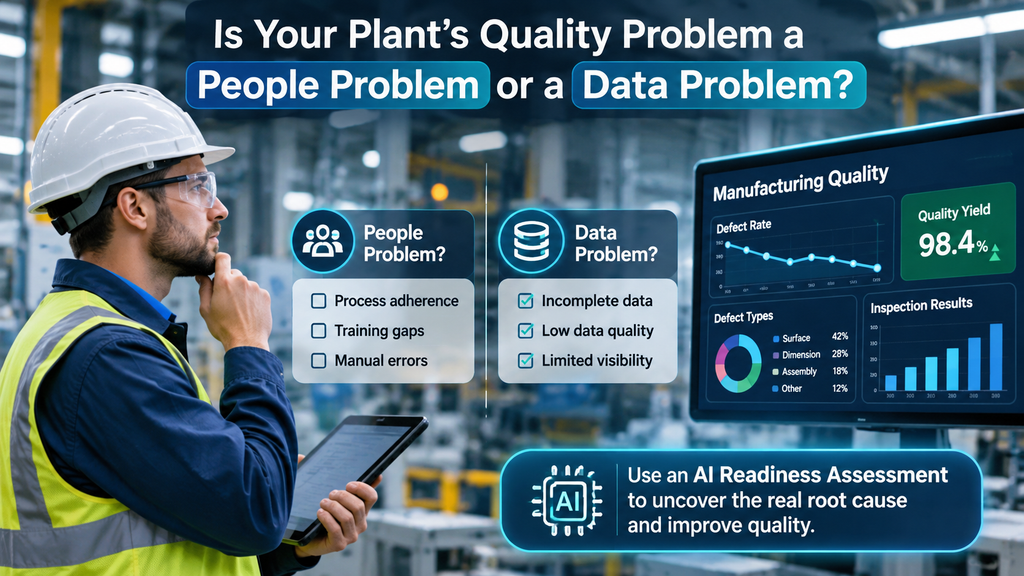
The real question isn’t vision inspection
A camera catching a scratch in real time is the easy part to demonstrate. Here is the question it never answers: can you trace that scratch to a machine, a shift, a supplier lot, and an inspector’s note today, within the same shift it happened? That is not a vision problem. That is a data problem, and it has to be answered before a model can learn anything from your floor.
Do not evaluate another vendor demo until you can answer that question in plain terms, with your own data, on your own timeline.
Where does your defect data actually live
Name the one place your defect data lives. If you cannot name one place, it isn’t one place.
Answer these for your own plant, not for a plant in general. Where do your SPC charts sit — in a dedicated tool, or in a spreadsheet someone built a few years ago and never retired? Where do inspector notes go — typed into a system of record, or handwritten on a traveler that gets filed and never searched again? Who last pulled an export from your machine historian, and when? Where do rework tickets live, and does one person maintain that list as a side task on top of their real job?
If defect data, machine logs, and inspector notes sit across four systems with four different owners, no model can learn from any of it until someone unifies it first. That unification is a data project. It comes before the AI project, not during it. Write down where your defect data, machine logs, and inspector notes live today. If you cannot answer with certainty, the gap is not the algorithm.
Inspector notes are the hardest data you have
Inspector notes deserve their own line item. A handwritten comment on a traveler, a shorthand phrase in a shift log, a verbal call passed from one inspector to the next — none of that is structured, and none of it will plug into a model as it stands. Before any AI pilot touches quality control, decide how inspector judgment gets captured in a form a system can use: a required defect-category field, a short structured note tied to a part number and timestamp, a dropdown instead of free text. Skipping this step does not make inspector judgment disappear from the process. It keeps that judgment outside whatever system you are trying to build.
The three questions that block everything else
A full readiness check runs to ten questions, but three of them act as a gate. Score a zero on any one of these and the rest of the checklist doesn’t matter yet:
– Data access. Can the team pull the defect data, machine logs, and inspector notes this process needs within a week, without a data project first?
– Security and compliance. Has someone signed off on what data may leave your environment, including anything embedded in defect records from suppliers or customers?
– Ownership. Is there one accountable owner on the plant floor, with a technical counterpart, instead of a project that belongs to IT alone?
Name one owner before you start. Reject any proposal that can’t name a technical counterpart on day one. Without a floor-side owner, a bad root-cause call has no one positioned to catch it before it reaches the line.
What a ready pilot looks like on the floor
Ready looks like one named process, one metric, and a baseline measured today. Not a goal for next year. A baseline.
Pick one line. Pick one defect type. State the current scrap rate, rework hours, or time-to-root-cause in a number you can defend in a meeting. A pilot scoped to a single line and a single defect type is easier to evaluate than a plant-wide inspection rollout proposed for phase one. Broad scope feels ambitious. It also means more departments have to agree before anything starts, and that approval runs on its own timeline, separate from the technical work.
Reject any pilot proposal that opens with a portfolio of use cases instead of one.
Build the pass/fail line before you build anything else
Define pass and fail before the pilot starts, not after the demo looks good.
Set a target metric, a minimum threshold, and a review date in writing before any vendor touches your line. State what happens if the pilot misses the threshold: scale it, fix it, or stop it. A pilot without that line in writing gets judged on how the demo felt in the room, not on the metric. That is not a decision process a plant manager can defend to a CFO.
The same discipline applies to budget. A pilot scoped to weeks needs a funding path for the rollout stage before it starts, not after it succeeds. When a pilot is funded but its rollout isn’t, the project can stall at the exact point it should be scaling.
Build, buy, or bring in help
Get honest about three things before signing with a vendor or assigning the work internally: the skills your team has today, the maintenance load after launch, and how long each path takes to reach value.
Building in-house keeps control over the data pipeline and the model logic, but someone has to monitor it, retrain it, and fix it when a new defect type shows up or a supplier changes a material spec. Buying a packaged vision-inspection tool can reach a working pilot faster, but ties you to whatever integration path the vendor supports, and that path has to match the systems you named under the systems-and-integration question: your MES, your quality system, your historian. Bringing in outside help to build something tailored to your line sits between the two, so weigh the cost structure of each.
None of these three options is wrong on its own. Defaulting to “we can build it” without naming who runs the system in month six is not a decision. It’s a deferral, and it can show up later as a tool that quietly stops getting updated.
Score your plant before you take another demo
None of this requires buying anything. It requires ten honest answers about data, ownership, and what counts as success, scored against the plant floor you already run.
Take the AI Readiness Checklist and score your plant against all ten points, including the three that block everything else. It names exactly which gap to close first, before any vendor sets foot on your floor.
AI Readiness Checklist (10 points)
FAQ
What is an AI readiness assessment for manufacturing quality control?
It’s a structured check of whether your defect data, machine logs, and inspector notes are accessible, governed, and owned well enough for an AI pilot to learn from them, before you evaluate any vision-inspection or defect-prediction tool.
Why do quality-control AI pilots stall after a good demo?
A demo can run on clean, prepared data. A pilot runs on whatever data a plant actually has, scattered across SPC tools, paper notes, and machine historians. The gap between the two is a data and ownership problem, not a model problem.
Which readiness gaps block a quality AI pilot on their own?
Three: data access to defect records and machine logs within about a week, security and compliance sign-off on what data can leave your environment, and a named business owner with a technical counterpart. A zero on any one of these stops the project regardless of the rest of the scorecard.
Comments are closed