A strategy session can fail before it starts when the buyer walks in with a budget and no process.
The Session Is Not a Demo
Do not treat the free 45-minute AI strategy session as a product pitch. It exists to map one high-ROI process in your business and hand you a 6-8 week pilot scope. The output is a mapped process and a scope you can evaluate.
Scope-first beats tool-first because a tool bought before a process is named has nothing specific to fit. A team that names the process first can select the tool, the integration path, and the rollout plan around what the process actually needs. Build the session around that order: process, then scope, then tool. Reverse it, and the time goes to software instead of the problem.
Bring One Process, Not a Portfolio
Arrive with exactly one candidate process. Not a list of fifteen ideas. Not “we want to use AI in operations.” One process, repetitive, high-volume, with clear inputs and outputs, owned by a named manager.
Write down what the process does today, start to finish. Write down the metric it affects: hours spent, dollar cost, days to complete, error rate. State the baseline number you have today, even if it’s an estimate. A vague sense that the process is slow is not a baseline. A number is.
If you arrive with a portfolio of ideas instead of one process, session time goes to narrowing the list instead of scoping a pilot. Narrow it yourself before the call.
Name the Owner Before You Name the Tool
Each process needs one accountable business owner and, ideally, a technical counterpart. Name both before the call. The business owner is the person who runs the process today and will answer for its outcome. The technical counterpart is whoever can speak to the systems involved.
Reject any session, any vendor, any pilot plan that treats the project as belonging to “IT” or “innovation” alone. A pilot without an operations owner is a pilot without an adoption plan, and a pilot without an adoption plan may not survive contact with the people who have to use it. When the frontline team that runs the process has not been asked whether they want the pilot, the rollout is at risk regardless of how well the tool performs.
Bring the owner to the call if possible. If the owner can’t attend, bring their answers in writing.
Map the Systems and the Data
Before the call, answer two questions in writing: which systems does this process touch, and where does its data live.
Name the systems: the EHR, the ERP, the CRM, the ticketing system, whatever applies. State whether each one exposes an API or a supported integration path. A pilot that outputs results into a separate chat window staff must copy and paste from is not a pilot worth scoping. The output has to land back inside the systems people already use.
Then locate the data. State who owns it and whether your team can pull it within a week, without a data project first. Data scattered across PDFs, inboxes, and personal spreadsheets is easier to address before the strategy session than during it. Bring a clear answer, not a hope that the data exists somewhere.
Define Pass or Fail Before You Walk In
Decide, in advance, what success looks like for the pilot: the target metric, the minimum threshold, and the review date. Decide what happens if it misses the threshold: scale it, fix it, or stop it.
A pilot that ends when “the demo looks good” is not a pilot; it is a sales presentation with extra steps. Reject any plan that leaves success undefined until after the results are in. The threshold has to exist before the pilot starts, or the project has no way to fail and no way to prove it worked.
Bring calendar time and a funding path for both the pilot and the rollout that follows it. A pilot funded with no budget reserved for rollout is one reason a working pilot goes nowhere after it succeeds. Fund both stages before you fund either one.
What You Leave With
The session maps the process you bring against the systems, data, and owner you name, and produces a 6-8 week pilot scope. It is a planning session, not a build or a guarantee. The scope gives you something concrete to evaluate and decide on.
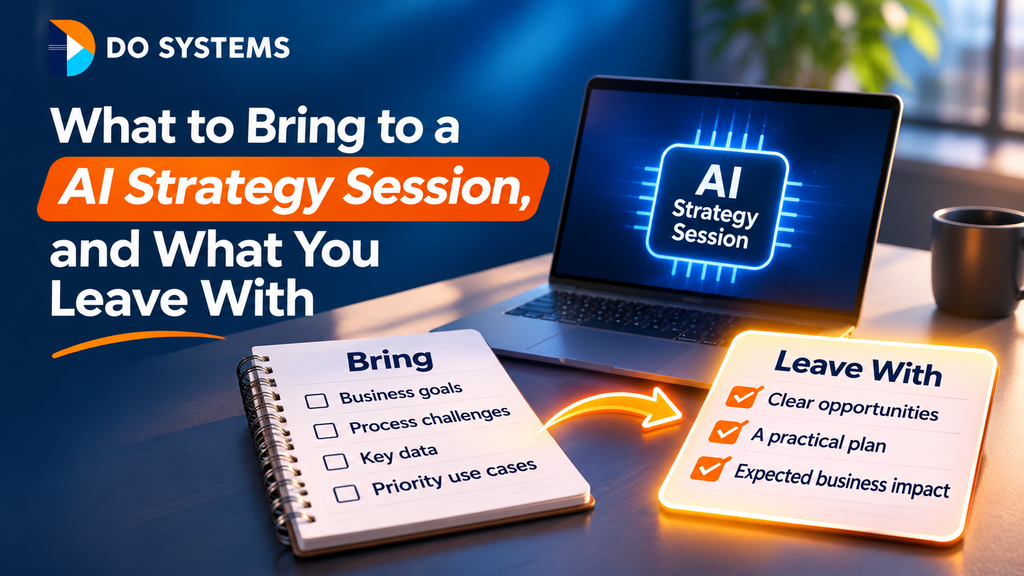
Come with one process, one owner, a system map, a data answer, and a pass/fail threshold, and the 45 minutes goes toward scoping. Come without them, and the 45 minutes goes toward gathering what you could have brought in the first place.
Bring the process. Bring the owner. Bring the number you’re trying to move. The free 45-minute AI strategy session turns that into a 6-8 week pilot scope you can evaluate.
Free 45-minute AI strategy session
FAQ
What happens during a free AI strategy session?
The session maps one high-ROI process in your business against its owner, systems, and data, and produces a 6-8 week pilot scope. It runs 45 minutes and is free.
How long does an AI strategy session take?
The session is 45 minutes. It is structured to map a single process and produce a 6-8 week pilot scope, not to cover a portfolio of ideas.
What should I prepare before an AI strategy session?
Bring one candidate process with a named owner, the systems it touches, where its data lives, and a defined pass/fail threshold for the pilot.
Comments are closed