
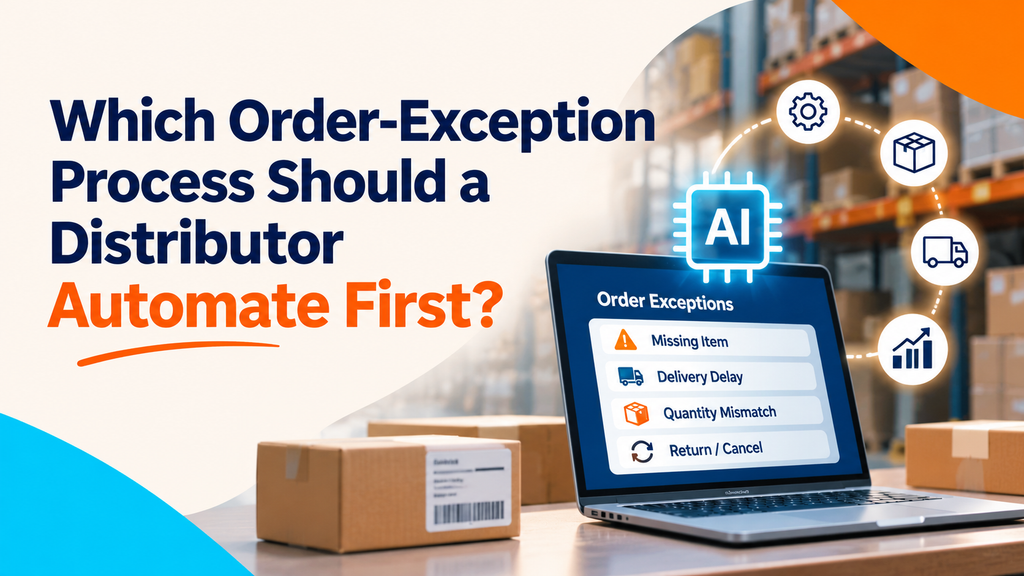
“Order Exceptions” Is Not a Process
AI for distribution order exceptions starts with choosing one exception type. Pricing mismatches, backorders, address errors, and unit-of-measure errors can be worked by hand across inbox, ERP, and spreadsheet. In a planning meeting these four can get collapsed into one line item: “automate order exceptions.” That line item is the problem. Each exception type can have a different owner, a different data trail, and a different definition of done. A pilot built to cover all four from day one is not a pilot. It is a program with no scope and no accountable owner.
Name one exception type before you write a single requirement. Reject any plan that starts with “order management automation” instead of naming the specific exception it targets. The AI Readiness Checklist calls this out directly: one high-value use case, not a portfolio. A repetitive, high-volume process with clear inputs and outputs, owned by a named manager. That standard rules out “order exceptions” as a starting point on its own.
Compare the Four Types Before You Pick
Check each type against how your own operation handles it. Pricing mismatches can be the cleanest case. If one analyst already works the reconciliation list against a price book, ownership is clear and the inputs are narrow: order line, contract price, system price. That narrowness is an advantage, not a limitation.
Backorders need a harder look. A backorder triggers both a customer-facing message and an internal hold on the order, so ownership can split across inventory and customer service until someone is named to run the workflow end to end. Two departments sharing a process without a named owner is a weaker starting point than one department holding the whole thing.
Address errors are a timing problem. An error caught only at the carrier stage, after the order has shipped, is caught late. That narrows the window for a pilot to intervene before the cost is already incurred.
Unit-of-measure errors lean on SKU master data that order entry and the warehouse both touch. Check whether that data sits in a defined set of tables rather than scattered across inbox threads: a defined set of tables makes the access question easier to answer.
Each type can bring its own owner and its own data path. Picking one means picking that owner and data path along with it.
Score the Candidate Against Three Checklist Points
Run each exception type through three points from the ten-point AI Readiness Checklist before you pick one. Do this with the operations lead and IT lead in the same room.
Ownership. Name one accountable business owner with time set aside each week, plus a technical counterpart. A pricing mismatch queue that one analyst owns outright is a stronger candidate than a backorder process split across two departments with no single name attached.
Data access. The team must be able to pull the data this process needs within a week, without a data project first. Know where the data lives, who owns it, and whether it is complete enough for this one process today. A unit-of-measure fix that lives entirely inside the order entry and SKU master tables beats an address-error fix scattered across inbox threads and a carrier portal.
Success criteria. Define pass or fail before the pilot starts. A target metric, a minimum threshold, a review date, and what happens if it misses: scale, fix, or stop. “Fewer pricing mismatches reach the invoice” is not a success criterion. A target mismatch rate against a baseline, with a review date, is.
Any exception type that fails ownership or data access outright is not ready. Set it aside and score the next one.
What a Red Flag Looks Like
A red flag on ownership: the project belongs to “IT” or “operations” in general, with no single name attached, and the frontline team that works the exceptions today has not been asked about the workflow.
A red flag on data access: the exception data lives in forwarded emails, personal spreadsheets, and a shared inbox, and no one can say with confidence who has permission to pull it.
A red flag on success criteria: the pilot ends when the demo looks good, and the team decides afterward whether it counts as a win. That is not a pass/fail threshold. That is a story told after the fact.
Any one of these on its own is reason enough to pick a different exception type, not to push the current one forward and hope the gaps close mid-pilot.
Pick the One That Scores Highest, Not the One That Hurts Worst
The exception type that generates the highest volume of complaints is not automatically the one to automate first. Backorders may carry the highest cost in customer goodwill and still be the worst pilot candidate, when the ownership is split and the data touches several systems instead of one. Pricing mismatches may feel smaller and still be the strongest candidate, when one person already owns the full workflow by hand.
Score first. Score every candidate exception type against ownership, data access, and success criteria before ranking them by how much they hurt. The exception type with the highest score is the one to scope as a pilot. The rest stay on the list for later, once the first one is in production and the owner, the data path, and the success metric have already been proven to work together.
This is the same discipline the full ten-point checklist applies to any AI pilot: one use case, one owner, one measurable outcome, scored before a single requirement gets written.
Use the AI Readiness Checklist to score your top candidate exception type against all ten points, not just the three covered here, before you bring a vendor into the conversation.
AI Readiness Checklist (10 points)
FAQ
Should a distributor automate all order-exception types in one pilot?
No. Pricing mismatches, backorders, address errors, and unit-of-measure errors each have a different owner and data path. The AI Readiness Checklist calls for one high-value use case, not a portfolio. Pick one exception type and prove it before adding the next.
Which order-exception type should a distributor automate first?
Score each candidate against three checklist points: a named owner with time set aside, data the team can already pull within a week without a separate data project, and a pass/fail threshold defined before the pilot starts. The exception type with the highest score goes first, regardless of which one causes the highest volume of complaints.
What causes an order-exception pilot to stall?
Two gaps can: missing ownership or an undefined success measure. A pilot assigned to “IT” or “operations” in general, with no named owner, or one that lacks a pass/fail threshold set in advance, has no way to prove it worked or to decide what happens next.
Comments are closed