Most businesses have more assets than they can effectively track. Equipment on a factory floor. Vehicles across a logistics network. Medical devices across a hospital. IT infrastructure spread across multiple sites.
Traditionally, the way you knew what was happening to those assets was either through scheduled inspections – someone physically checking on things at regular intervals – or through incident reports, meaning you found out something had gone wrong because it stopped working.
Both approaches have the same fundamental problem: they’re retrospective. By the time you have information, something has already happened.
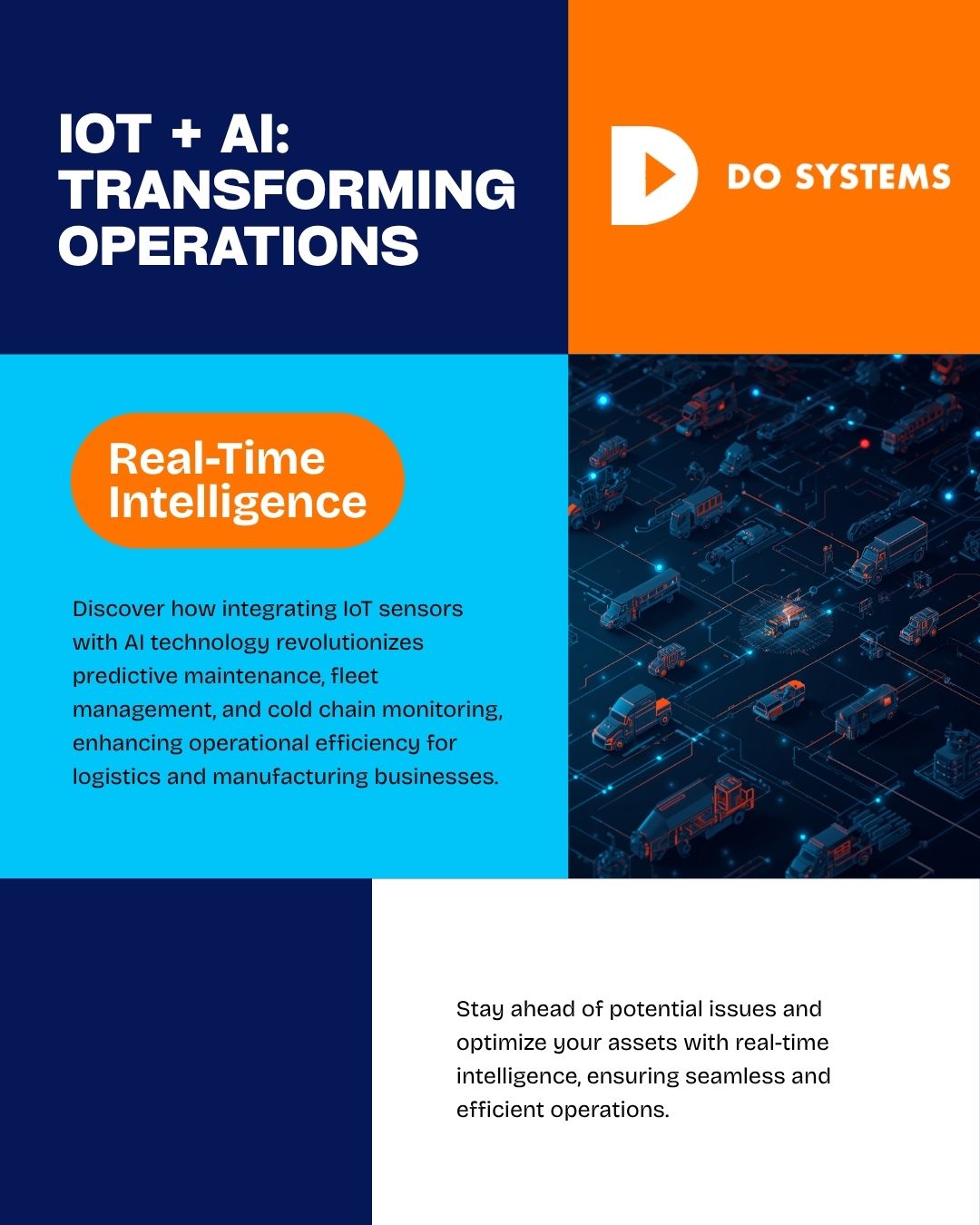
IoT – the network of connected sensors and devices that feed real-time data from physical assets into digital systems – changes the information model. And when you layer AI on top of that real-time data, the operational possibilities shift significantly.
What IoT Actually Looks Like in Practice
I want to ground this in specifics, because IoT is one of those terms that gets applied to everything from smart fridges to industrial sensor networks, and the range makes it hard to understand what it actually delivers in a business context.
At its core, an IoT deployment in an operational setting involves attaching sensors to physical assets – equipment, vehicles, environmental systems, infrastructure – that continuously capture data about the asset’s condition, location, or activity. That data is transmitted in real time to a central platform where it can be monitored, analysed, and acted upon.
What the sensors capture depends entirely on the use case. Temperature and humidity sensors in a cold chain logistics operation. Vibration and acoustic sensors on industrial machinery. GPS and telematics units on a fleet. Power consumption monitors on critical IT infrastructure. Pressure and flow sensors in a manufacturing process.
The data itself isn’t particularly useful in raw form – a stream of sensor readings is just numbers. What makes it useful is the analysis layer, and this is where AI becomes the difference between a monitoring system and an intelligence system.
Where AI Changes the Equation
A basic IoT deployment without AI gives you visibility. You can see what your assets are doing in real time. That’s genuinely valuable – much better than the alternative – but it still requires humans to watch dashboards and interpret what they’re seeing.
AI changes this in two important ways.
The first is anomaly detection. Rather than requiring an engineer to spot an unusual reading on a dashboard, an AI model trained on your asset data establishes what normal looks like – for each individual asset, across different operating conditions – and automatically flags deviations. Not just threshold breaches, but pattern changes that indicate something is developing before it becomes a threshold breach.
The second is predictive capability. The sensor data from an asset contains leading indicators of future failure – subtle changes in vibration patterns that precede a bearing failure, gradual shifts in power consumption that indicate component degradation, temperature variance patterns that signal cooling system inefficiency. These patterns are often invisible to human analysts but detectable by machine learning models trained on historical data from similar assets.
We built an IoT and AI system for a logistics client managing a fleet of refrigerated vehicles. The brief was straightforward: reduce the cold chain failures that were causing product losses and customer compensation claims.
The solution involved GPS and telematics units combined with temperature sensors throughout each vehicle, feeding into a central platform with an AI layer that modelled normal operating patterns for each vehicle under different load and route conditions.
Within the first six months, the system had flagged four vehicles with developing refrigeration unit issues before any failure occurred – giving the operations team time to schedule maintenance during non-operational hours. It also identified a route and loading pattern that was consistently generating temperature variance, which turned out to be a dispatch process issue rather than an equipment issue.
Product loss incidents dropped by 73% in the first year. More importantly, the operations team shifted from responding to cold chain failures to preventing them.
The Industries Where This Is Having the Most Impact
Manufacturing is the most mature IoT and AI deployment environment. Predictive maintenance on production equipment has a well-established ROI case – unplanned downtime in manufacturing is extraordinarily expensive, and the combination of sensor data and machine learning can predict a high proportion of equipment failures days or weeks in advance.
Logistics and transportation is where we’re seeing the most rapid growth in new deployments. Fleet telematics combined with AI is delivering measurable improvements in maintenance costs, fuel efficiency, driver behaviour, and delivery reliability – often simultaneously from the same data infrastructure.
Healthcare is an area of significant growth, particularly around medical device monitoring, facility environmental controls, and equipment utilisation. Hospitals have large numbers of high-value assets that are simultaneously critical to patient care and expensive to maintain reactively.
Real estate and facilities management is another area where IoT and AI is delivering clear value – building management systems that continuously optimise energy consumption, HVAC performance, and maintenance scheduling based on actual usage patterns rather than fixed schedules.
What a Deployment Actually Requires
The most important thing I can tell you about IoT and AI deployments is that the technology is the straightforward part. The harder work is clarity about what problem you’re actually solving, and what decisions the system needs to inform.
The deployments that work are the ones where the business outcome is defined first – reduce unplanned downtime by X%, reduce cold chain failures to below Y per month – and the sensor and AI infrastructure is designed to produce the specific data and insights needed to drive that outcome.
The deployments that struggle are the ones that start with “let’s connect our assets” without a clear picture of what they’re going to do with the data once it’s flowing.
At Do Systems, our IoT projects start with a use case and outcome definition workshop before any hardware is specified or software is architected. The question isn’t what we can connect – it’s what decisions need to be made better, and what data is needed to make them. If you’re operating assets at scale and still relying on scheduled inspections and incident reports to know what’s happening, it’s worth understanding what a real-time intelligence layer would look like in your specific environment.
Comments are closed