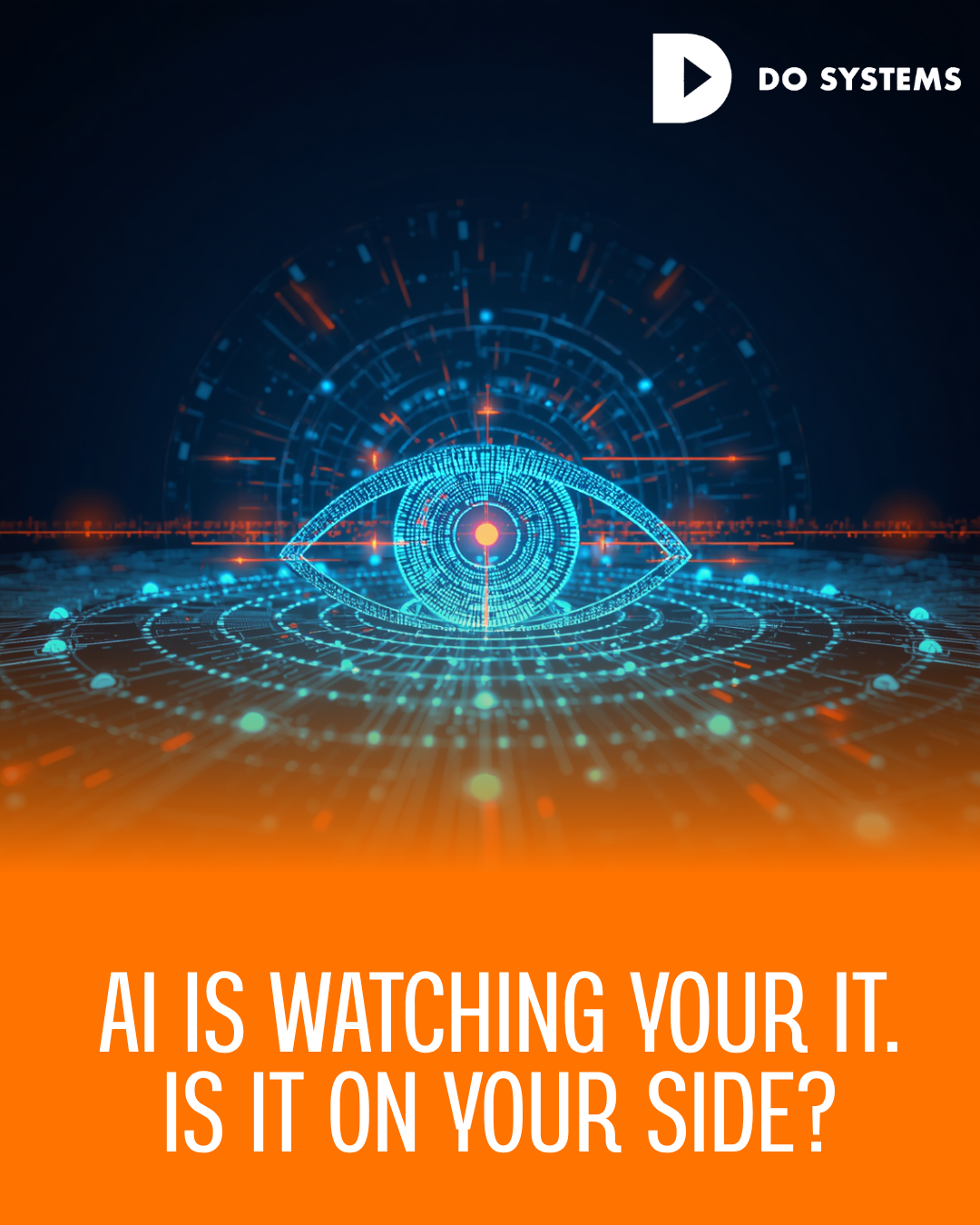
Late on a Thursday evening last year, an alert fired inside our monitoring platform. Not a critical alarm — just a subtle pattern anomaly. Network traffic on a client’s system was behaving slightly differently than it had over the previous 14 days. Different enough that the AI flagged it. Not different enough that a human watching a dashboard would have noticed.
We investigated. Turns out an employee’s credentials had been compromised in a third-party data breach weeks earlier. Someone had been quietly probing the network, looking for a way in. Because we caught it at the reconnaissance stage — before any real access was established — we were able to lock down the account, reset credentials, and brief the client before a single file was touched.
No downtime. No data loss. No ransom demand. This is what AI-powered IT monitoring looks like in practice. And if your IT provider isn’t using it, your competitors’ might be.
The Limit of Traditional IT Monitoring
For most of the history of IT support, monitoring worked like this: you set thresholds, and alerts fired when those thresholds were crossed. CPU above 90%? Alert. Disk space below 10%? Alert. Service goes offline? Alert.
That model is fine for catching obvious problems. It’s useless for catching sophisticated ones.
Modern cyber threats don’t announce themselves. They move slowly and carefully, mimicking normal behaviour, staying below the thresholds that trigger traditional alerts. A credential stuffing attack that runs one login attempt every 90 seconds will never trip a brute-force detection rule. Ransomware that encrypts files gradually over 48 hours before activating won’t look unusual until it’s too late. Traditional monitoring tells you when something broke. AI monitoring tells you what’s about to break — and why.
What AI Actually Does Differently
I want to be specific here, because AI gets thrown around so loosely that it’s lost most of its meaning. When I talk about AI-powered IT monitoring, I’m not talking about a chatbot or a marketing gimmick. I’m talking about machine learning models trained on billions of data points that establish a dynamic baseline of normal behaviour for your specific environment — and flag deviations from that baseline in real time. What that looks like practically: the system learns that your accounts payable manager logs in from Sydney between 8am and 6pm, accesses specific finance folders, and downloads files under a certain size. If that account suddenly logs in from a different country at 2am and starts bulk-downloading files — even if the password is correct — the system flags it immediately as anomalous.
Traditional monitoring tells you when something broke. AI monitoring tells you what’s about to break — and why.
It also does this across your entire environment simultaneously. Network traffic patterns. User behaviour. Application performance. Hardware health signals. Log data. Every data point feeds the model, and the model gets smarter over time as it learns your specific patterns. The result is detection that’s genuinely faster and more accurate than any human team watching dashboards could achieve — and earlier intervention that catches problems at the stage where they’re still manageable.
The Predictive Maintenance Side People Don’t Talk About
Cybersecurity gets most of the attention when people talk about AI in IT. But some of our most impactful AI work at Do Systems has been on the infrastructure side — specifically, predictive hardware maintenance.
Hard drives fail. Servers overheat. Network components degrade. These aren’t random events — they follow patterns. A drive that’s heading toward failure starts behaving differently weeks or months before it dies. Read times increase slightly. Error correction events happen more frequently. Performance curves shift in subtle ways.
Traditional monitoring catches these things only after they’ve become obvious. AI-powered monitoring catches them when they first start to deviate. We’ve been able to schedule hardware replacements for clients during planned maintenance windows, weeks before failures would have occurred, simply because the system spotted the early warning signals. For a business running on that hardware, the difference is enormous. Planned downtime of two hours on a Saturday versus unplanned downtime of two days at the worst possible moment.
What This Means for Your Business
If you’re working with an IT provider that still relies purely on threshold-based monitoring and manual reviews, you have a visibility gap. Not necessarily because they’re doing a bad job — but because the threat landscape and the infrastructure complexity of modern SMBs has outpaced what manual monitoring can realistically cover.
AI doesn’t replace the engineers and technicians who respond to incidents and manage your environment. It gives them dramatically better information, earlier, so they can act before problems escalate.
At Do Systems, we’ve integrated AI-powered monitoring into our core managed services offering. Every client environment gets continuous behavioral analysis — across security, infrastructure, and application performance. Our team reviews the AI’s findings, investigates anomalies, and acts on early warnings before they become crises.
The client whose credentials were compromised? They’ve since referred three other businesses to us. Not because of what we fixed. Because of what we prevented. That’s the real value of AI in IT. Not the technology itself. The outcomes it makes possible.
Want AI working for your business — not against it? Visit www.dosystemsinc.com
Comments are closed