Sales has always been about working smarter, not just harder. AI makes that possible at scale.
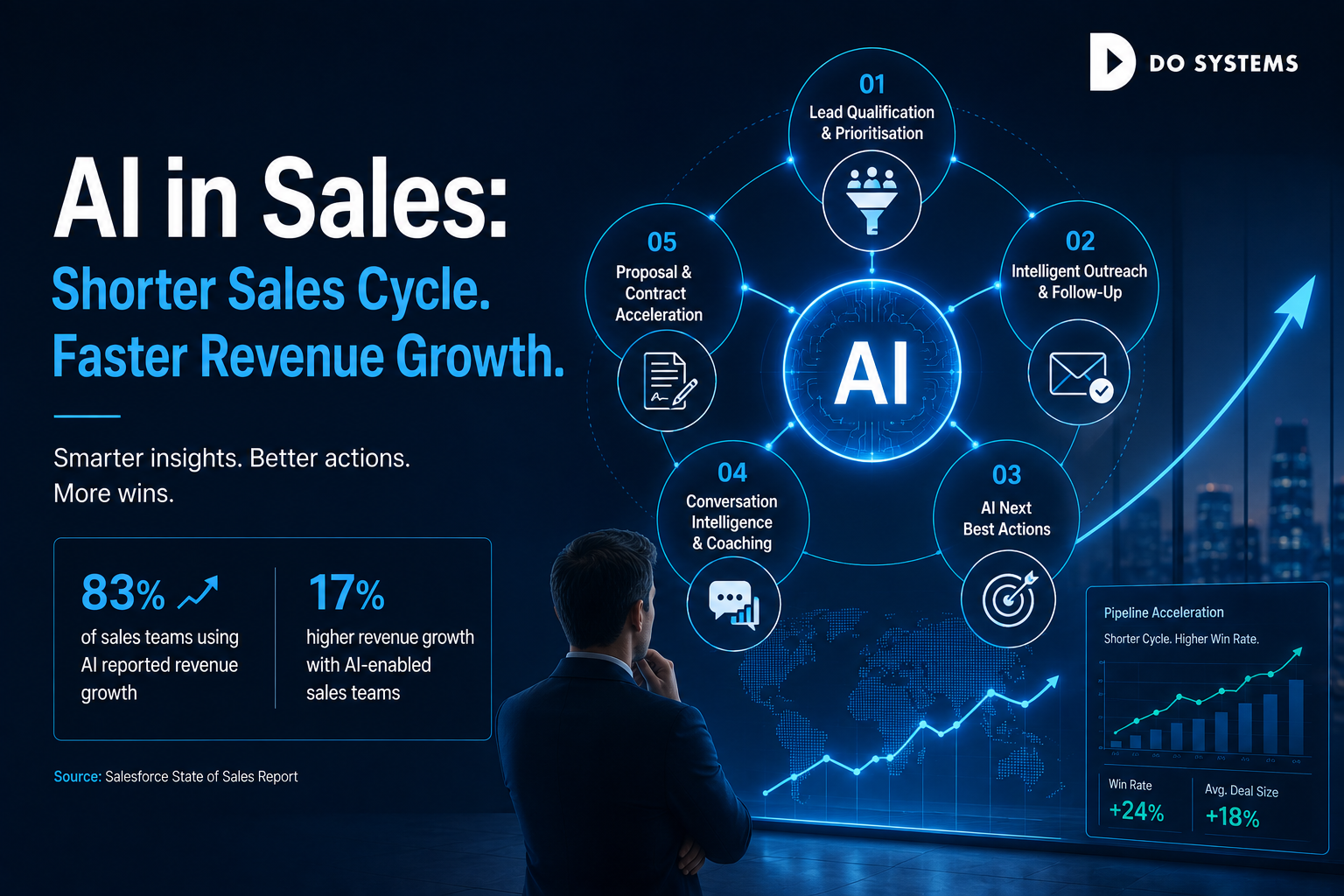
According to Salesforce’s State of Sales report, 81% of sales teams are now using or actively experimenting with AI tools. The gap between AI-enabled and non-AI-enabled sales teams is already measurable: 83% of sales teams using AI reported revenue growth, compared with 66% of teams that are not using AI – a 17-percentage-point difference that compounds over time.
But the bigger story isn’t adoption rates. It’s what AI actually does to the sales process – and why businesses that implement it well are winning deals that their competitors are losing.
Where AI Creates Value in the Sales Cycle
1. Lead Qualification and Prioritisation
The single biggest time-waster in sales is working the wrong leads. The average sales representative spends a significant portion of their week on prospects who will never buy – and meanwhile, high-intent buyers are waiting for follow-up.
AI qualification systems analyse dozens of signals – engagement patterns, company size, budget indicators, technology stack, previous purchase behaviour – and score every lead against your ideal customer profile in real time. Sales representatives wake up each morning with a clear, data-ranked priority list rather than a flat CRM of equal-looking contacts.
The result is not just time savings. It is a fundamentally different approach to pipeline management: working fewer leads with higher conversion rates rather than more leads with the same low close rate.
2. Intelligent Outreach and Follow-Up
Timing in sales is everything, and most teams get it wrong – not because they don’t care, but because they can’t monitor hundreds of accounts at once. AI can.
Modern AI sales tools monitor buying signals continuously: a prospect downloads a pricing guide, a company posts a job listing for a role your product serves, a contact changes companies. The AI surfaces these signals the moment they appear and prompts the appropriate response, keeping your team relevant and responsive without constant manual monitoring.
Follow-up automation handles the routine touches – the day-two email after a demo, the week-three check-in, the 90-day re-engagement – so representatives can focus their energy on the conversations that actually move deals forward.
3. AI Next Best Actions
Next best action technology is where AI moves from administrative support to active deal guidance. Instead of relying on a representative’s memory and instinct to decide what to do with each deal, AI analyses the current state of every opportunity in the pipeline and recommends the highest-probability next step.
Gartner’s May 2026 research, based on a survey of 227 Chief Sales Officers conducted in August and September 2025, found that organisations deploying AI next best actions are 2.6 times more likely to achieve commercial growth than peers who have not. A separate Gartner study from September 2024, surveying 1,026 sellers between January and March 2024, found that sales representatives who partner with AI are 3.7 times more likely to meet their quota.
These are not incremental improvements to an existing process. They represent a step change in what a well-supported sales team can achieve.
4. Conversation Intelligence and Coaching
AI conversation intelligence tools analyse recorded sales calls and meetings in real time, flagging moments where talk time is imbalanced, pricing or competitor objections are raised, or prospects signal hesitation. Managers get structured coaching insights without sitting in on every call. Representatives get immediate feedback rather than waiting for a quarterly review.
The compound effect is a faster skill development curve across the team. Junior representatives learn best practices from AI analysis of what your top performers do differently. Senior representatives catch their own blind spots before they cost them deals.
5. Proposal and Contract Acceleration
Proposal generation is one of the highest-ROI applications of AI in sales because it sits at a critical late-stage moment in the buying process. Buyers who request a proposal are serious – and slow proposals lose deals.
AI proposal tools pull product data, pricing, relevant case studies, and compliance language together in minutes rather than hours. Representatives review, customise, and send. The process that used to take a full day now takes 20 minutes, and the output is more consistent and better aligned with what buyers actually ask for.
Implementation: Where to Start
The most common mistake businesses make when adding AI to their sales process is starting with the wrong tool. Lead scoring, outreach automation, conversation intelligence, and proposal generation all have clear ROI – but only in the right order for your specific business.
For most SMBs, the highest-value starting point is lead qualification. The reason is simple: every other part of the sales process runs better with better leads going into it. Fix the top of the funnel first, then automate the follow-through.
The second priority should be AI next best actions, because this is where the sales representative’s judgement is most frequently wrong. Representatives are optimistic by nature – they hold deals that should be closed out and underinvest in deals that are ready to close. AI provides the objective data to course-correct.
What Sales Leaders Need to Know
AI does not replace sales. It removes the friction that stops good salespeople from doing what they are best at: building relationships, understanding problems, and helping buyers make confident decisions.
The teams that win with AI are not the ones who hand everything to automation. They are the ones who use AI to free up maximum time for human-to-human selling – the conversations that close complex deals, navigate procurement, and build the trust that generates referrals and renewals.
McKinsey’s research on AI high performers consistently shows that the companies generating the strongest AI-driven revenue gains are those that redesign their sales process around AI capabilities rather than simply adding tools to an existing process.
Frequently Asked Questions
Will AI replace sales representatives?
No. AI automates administrative tasks, surfaces data, and guides prioritization – but buyers still buy from people they trust. The evidence consistently shows that AI-partnered representatives outperform both non-AI representatives and fully automated outreach. The Gartner finding that AI-partnered reps are 3.7 times more likely to meet quota supports a human-plus-AI model, not a human-replaced-by-AI model.
How much does an AI sales stack cost for an SMB?
The range is wide – from a few hundred pounds per month for a focused tool (such as lead scoring integrated with your CRM) to several thousand for a full conversation intelligence and next best action platform. ROI tends to be fastest in businesses where the average deal value is high enough that winning one extra deal per month covers the technology cost many times over.
How do I measure the impact of AI on my sales cycle?
Track three metrics before and after implementation: average days from first contact to close (cycle length), conversion rate from qualified lead to close (win rate), and average deal size. A well-implemented AI sales stack should improve all three within the first two quarters of operation.
Comments are closed