
AI Agents Won’t Fix Your Incident Response Alone — But Enrichment Might
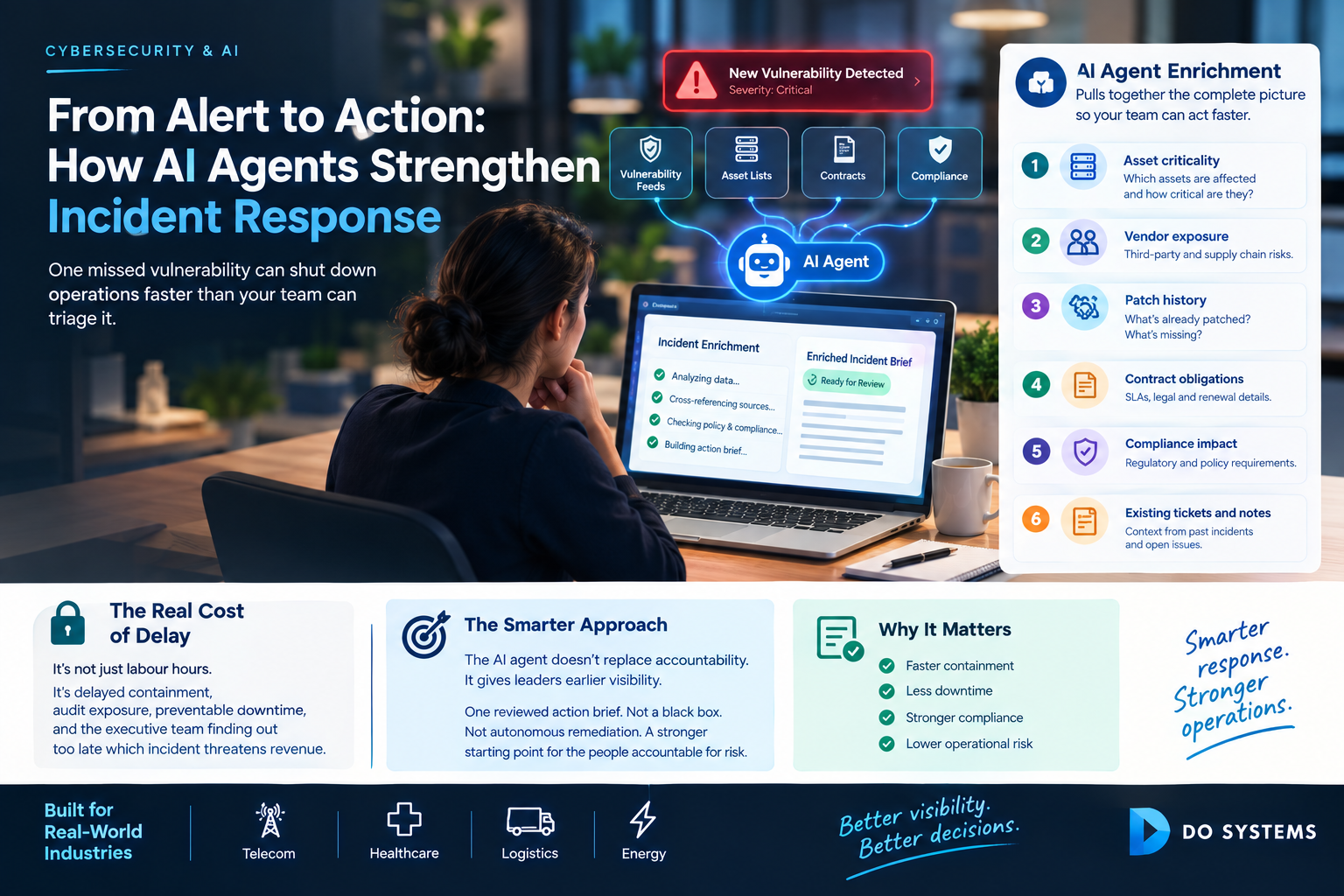
A missed vulnerability can shut down operations faster than most security teams can triage it. For mid-sized telecom, healthcare, logistics, and energy companies, that risk is compounded by a problem that rarely makes it into the postmortem: incident response still runs on manual research.
When an alert fires, the security team checks vulnerability feeds. Operations checks asset lists. Legal checks contracts. Compliance checks obligations. Someone, usually under pressure and often without full visibility into the other three functions, tries to stitch it all together into a decision.
That stitching-together is the hidden cost of incident response. It rarely shows up as a line item, but it shows up everywhere else: in delayed containment, in audit exposure, in downtime that could have been prevented, and in executives learning too late which incident actually threatened revenue and which was noise.
What most teams get wrong about AI agents here
The instinct, once a company decides to bring AI into security operations, is to reach for automation that resolves incidents on its own. That instinct is usually premature, and often the wrong target altogether.
A more practical role for AI agents in incident response is enrichment, not resolution. Instead of asking an agent to decide what to do about a vulnerability, ask it to assemble everything a human would otherwise have to go find themselves: asset criticality, vendor exposure, patch history, contract obligations, compliance impact, and existing tickets or notes tied to the same asset or vendor.
The output isn’t an autonomous action. It’s a single, reviewed action brief that puts a stronger starting point in front of the person who is accountable for the decision. The human still decides. The agent just removes the twenty minutes to an hour of cross-checking that used to happen before the decision could even be made.
Why this distinction matters
This is a governance point as much as a technical one. A black-box system that resolves incidents autonomously creates a new kind of risk: nobody can fully explain why an action was taken, and accountability becomes diffuse right when regulators and boards are asking for the opposite. An enrichment agent keeps the decision with a named, accountable person while still compressing the research phase that used to eat most of the response window.
This also lines up with where the industry is actually moving. NIST recently hosted a session focused on AI agent enrichment workflows for the National Vulnerability Database, a signal that even at the infrastructure level, enrichment is being treated as the near-term, defensible use case for AI in vulnerability management. Microsoft has separately noted that enterprise agents are expanding beyond productivity tasks into operational domains like security, reinforcing that this shift isn’t isolated to one vendor’s roadmap.
What a practical enrichment agent actually pulls together
For a mid-sized operator in telecom, healthcare, logistics, or energy, a workable incident-response agent should be able to surface, in one place, before a human is asked to act:
Asset criticality, so the team knows immediately whether this is a core system or a peripheral one. Vendor exposure, so the team knows whether the vulnerability sits with an internal system or a third party under contract. Patch history, so the team isn’t rediscovering whether this was already flagged and deferred. Contract obligations, so legal doesn’t get looped in after the decision is made instead of before it. Compliance impact, so audit exposure is visible at the moment of triage, not three weeks later. Existing tickets and notes, so institutional memory isn’t lost every time a different analyst picks up the incident.
None of this requires the agent to be right about what to do. It only requires the agent to be thorough about what’s relevant, and fast about surfacing it.
The real payoff
The organizations that get this right aren’t necessarily the ones with the most advanced AI. They’re the ones that correctly scoped what the agent should own. Enrichment is a well-bounded, auditable task. Remediation decisions are not something most companies should hand off yet, and arguably shouldn’t hand off at all without a much longer track record of trust and testing.
Getting the scope right is also what makes the business case easy to defend internally. It’s not “we automated security.” It’s “we cut the time between alert and informed decision,” which is a claim compliance, legal, and the executive team can all get behind, because the human accountability chain never actually changes.
For companies weighing where to start, the honest advice is: don’t start with autonomy. Start with enrichment. Build the one workflow that pulls asset, vendor, contract, and compliance data into a single brief, measure how much time it saves your team on real incidents, and only then decide whether there’s a case for anything more autonomous.
Comments are closed