You Do Not Need a 12-Month Roadmap to Start
One of the most common mistakes small businesses make with AI is waiting until they have a comprehensive strategy before doing anything. The businesses seeing the most value from AI did not start with a roadmap. They started with one well-chosen use case, implemented it properly, and built from there.
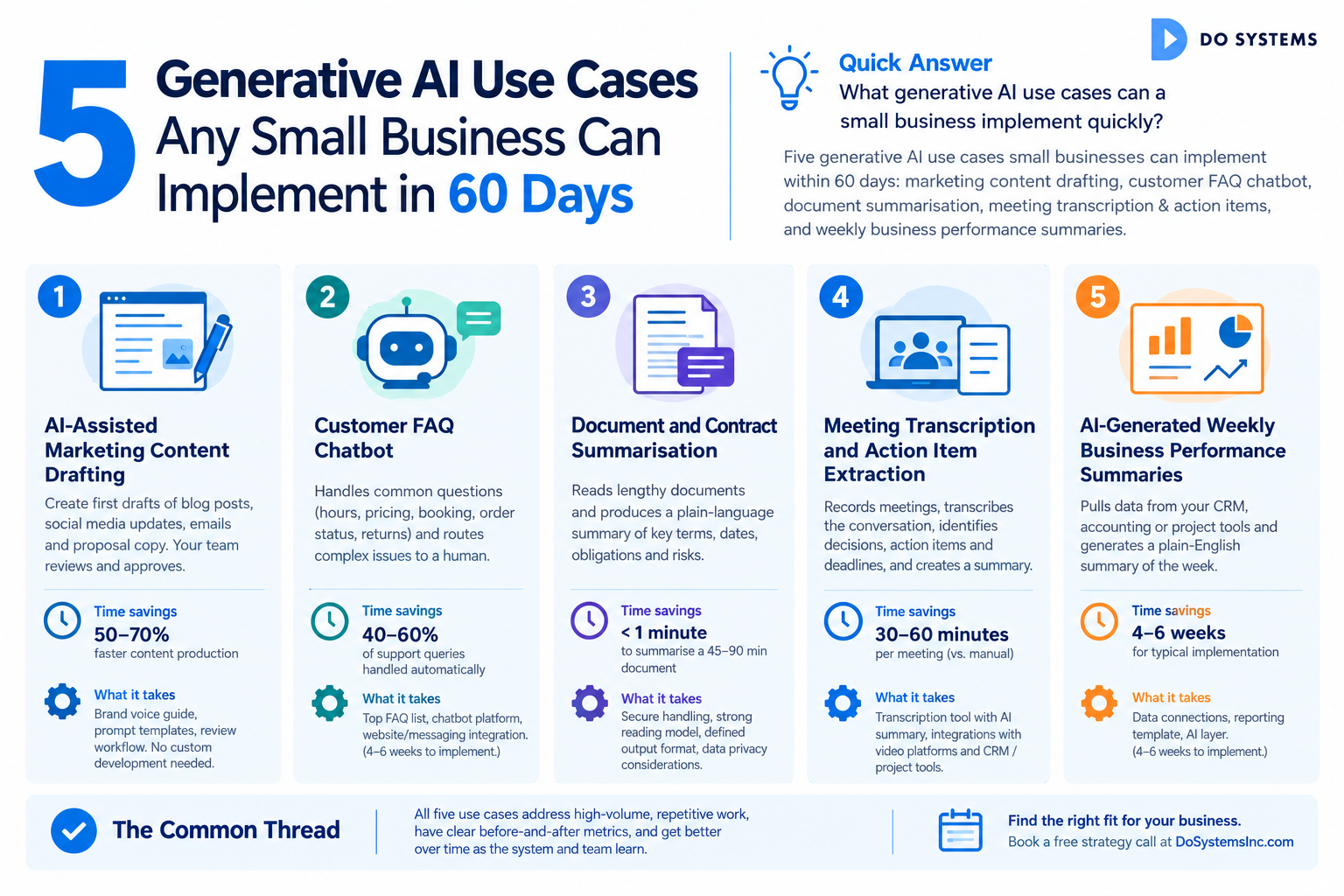
The five use cases below are not theoretical. They are the most commonly implemented first projects for small businesses, and all five can be designed, built, and operational within 60 days. The US Chamber of Commerce’s 2025 report on small business technology found that 58% of small businesses now use generative AI, with marketing and content creation as the most common entry point.
1. AI-Assisted Marketing Content Drafting
What it does: AI produces first drafts of blog posts, social media updates, email campaigns, and proposal copy based on your brief, brand voice, and topic guidance. A team member reviews and approves.
Time savings: For a business publishing weekly blog content and daily social posts, AI drafting typically reduces content production time by 50–70%, freeing the equivalent of half a day per week for a single marketing resource.
What it takes to implement: A defined brand voice document, prompt templates for each content type, and a review workflow. No custom development required for most businesses starting with off-the-shelf tools; custom integration makes sense once volume and consistency requirements grow.
2. Customer FAQ Chatbot
What it does: An AI chatbot handles your most common customer questions – hours, pricing, appointment booking, order status, returns policy – without requiring a team member to respond. Complex or escalated conversations route to a human.
Time savings: Businesses that have implemented FAQ chatbots typically report that 40–60% of incoming support queries are handled without human involvement, freeing significant staff time for higher-value customer interactions.
What it takes to implement: A list of your top 20–30 frequently asked questions with approved answers, a chatbot platform, and integration with your website or messaging channel. A well-scoped implementation takes 4–6 weeks.
3. Document and Contract Summarisation
What it does: AI reads lengthy documents – vendor contracts, insurance policies, legal filings, compliance documents – and produces a plain-language summary of the key terms, dates, obligations, and risks. The human reviews the summary and the original document for final decisions.
Time savings: A document that takes 45–90 minutes to read carefully can be summarised in under a minute. For businesses in legal, real estate, healthcare, and insurance where document review is a core operational activity, this compounds quickly.
What it takes to implement: Secure document handling, an AI model with strong reading comprehension, and a defined output format for the summary. Data privacy and confidentiality requirements vary by industry and must be addressed in the implementation design.
4. Meeting Transcription and Action Item Extraction
What it does: AI joins or records meetings, transcribes the conversation, identifies decisions made, action items assigned, and deadlines committed to, and produces a structured summary within minutes of the meeting ending.
Time savings: The average knowledge worker spends 4–6 hours per week in meetings. AI transcription eliminates the time spent taking notes during meetings and writing summaries afterward – often 30–60 minutes per meeting for the person who would otherwise do it manually.
What it takes to implement: A meeting transcription tool with AI summary capabilities. Several off-the-shelf solutions integrate directly with video conferencing platforms. Custom integration with CRM or project management systems extends the value further.
5. AI-Generated Weekly Business Performance Summaries
What it does: AI pulls data from your CRM, accounting platform, or project management system and generates a plain-English summary of the week: revenue, pipeline movement, outstanding items, and flagged anomalies. Leadership gets a clear picture of what happened without a team member compiling a report.
Time savings: McKinsey’s November 2025 State of AI survey found that revenue increases from AI are most commonly reported in marketing and sales and strategy functions – areas where better, faster information directly improves decision quality. For small businesses, automated reporting is often the first time leadership has weekly visibility into the business without waiting for month-end.
What it takes to implement: Data connections to the source systems (CRM, accounting, project tools), a reporting template defining what leadership needs to see, and an AI layer to generate the plain-language narrative. A typical implementation takes 4–6 weeks.
The Common Thread
All five of these use cases share three characteristics: they address high-volume, repetitive work; they have clear before-and-after metrics; and they improve in value over time as the system and the team learn. Any of them can serve as a first project. The right choice depends on where the biggest time drain is in your specific business.
DoSystems has implemented all five of these for growing businesses across Florida and beyond. Book a free strategy call at DoSystemsInc.com to identify which fits your business first.
Comments are closed