
In 2026, the dominant model for AI in customer service is still: build a chatbot, put it on the website, measure containment.
Gartner’s latest customer research suggests this model is increasingly disconnected from how customers actually behave.
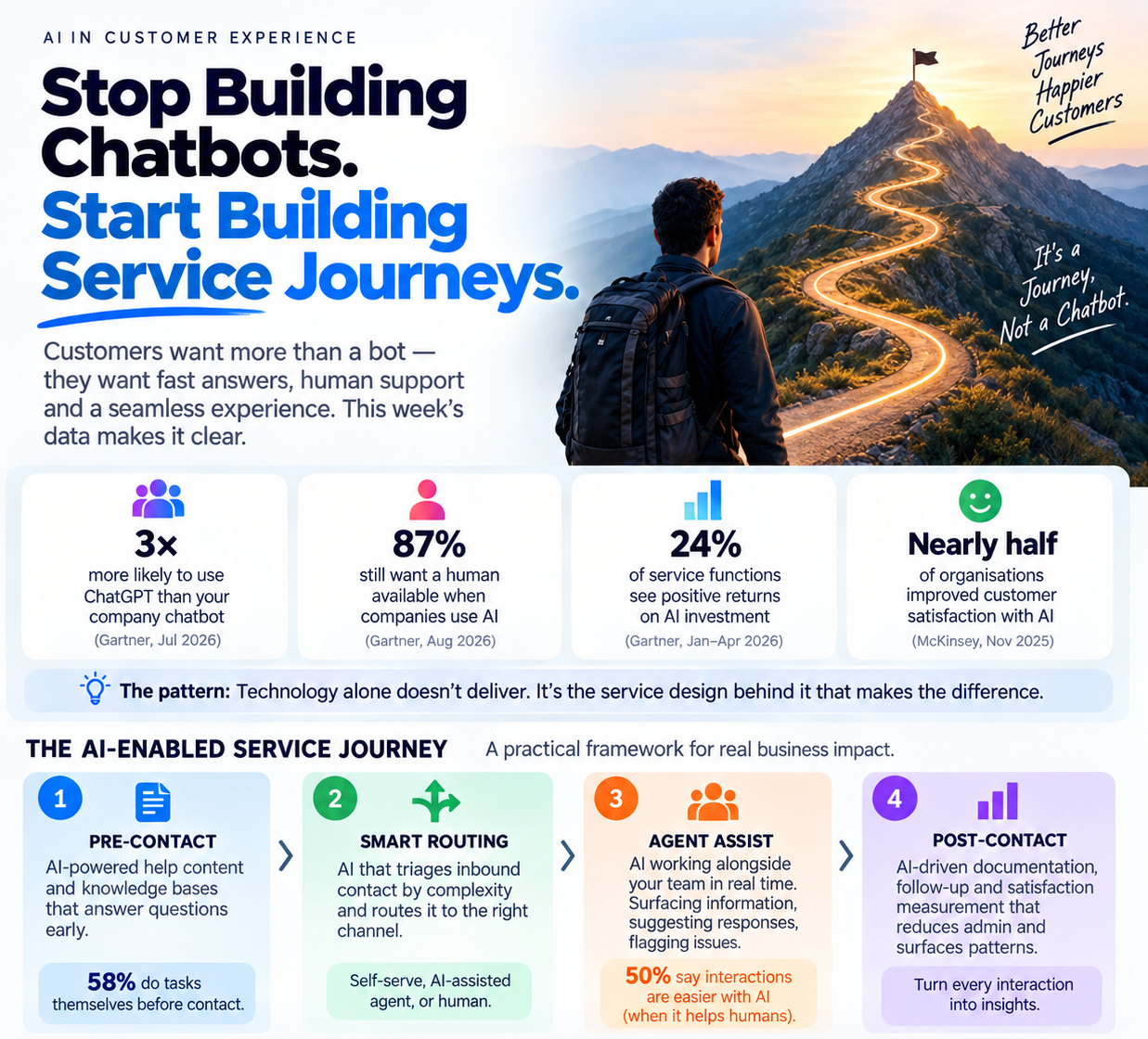
The data, from a survey of 3,566 B2B and B2C customers conducted in February and March 2026, shows customers are approximately 3× more likely to use third-party GenAI tools than your company chatbot. Chatbot adoption has shown no statistically significant growth since 2022. Meanwhile, use of third-party GenAI by customers nearly doubled in the past year.
Customers aren’t abandoning self-service. They’re upgrading it. The question for businesses is: what does your service model look like when customers arrive already informed, already having tried to resolve things themselves?
The ‘Mandatory First Step’ Trap
The most common chatbot design mistake is what Gartner’s Eric Keller describes as the ‘mandatory first step’ pattern: customers are required to interact with the bot before they can reach a human or alternative support channel.
Keller’s direct guidance: “Service leaders should not use GenAI as a mandatory first step for every issue.”
The data explains why. Gartner found that 87% of customers say access to a human agent is essential when companies use GenAI. If your AI design makes human access difficult or requires going through a bot first, you’re designing against what 87% of your customers want. That’s a loyalty and satisfaction risk, not a cost-reduction win.
What an AI-Enabled Service Journey Looks Like
Instead of a single bot handling first contact, you design the entire service journey with AI embedded at multiple points:
Pre-contact: AI-powered knowledge bases and help content that answers common questions before customers need to contact you at all. This is where 58% of GenAI-using customers are operating – completing tasks using AI before they contact a company.
Contact routing: AI that assesses the nature and complexity of an inbound contact and routes it intelligently – to self-service, to an AI-assisted agent, or directly to a specialist human – based on what the contact actually needs.
Agent assistance: AI working alongside human agents in real time – surfacing relevant information, suggesting responses, flagging sentiment, drafting follow-up communications. This is where the ‘50% say interactions are easier with AI’ finding comes from: AI helping humans deliver better service.
Post-contact: AI-driven follow-up, satisfaction measurement, and case documentation that reduces agent admin time and surfaces patterns for service improvement.
The SMB Opportunity
SMBs don’t need enterprise-scale infrastructure to build AI-enabled service journeys. The practical starting point:
Identify the three or four contact types that make up the majority of your inbound volume. For each one, ask: where in this journey could AI make the customer’s experience better or faster – and where do they need a human?
Build AI into the easy parts first. Good knowledge base content, AI-assisted email response, smart routing. These deliver value without the chatbot-as-gatekeeper design trap.
Measure satisfaction by contact type and channel. This gives you the data to know where AI is helping and where it isn’t – and to make adjustments before problems compound.
The businesses that will get this right aren’t the ones with the most sophisticated AI. They’re the ones that start with how customers actually want to be served – and build backward from there.
Comments are closed