Quick answer: Traditional managed IT services focus on keeping systems running, but AI agents introduce new operational risks. As businesses adopt AI, managed IT services’ AI coverage must extend beyond uptime and patching to include agent access reviews, output monitoring, incident response, and AI infrastructure security. Without clearly defined responsibilities, organizations risk deploying AI agents without adequate oversight.
- Why traditional managed IT services are not enough for AI
- 4 critical gaps in managed IT services AI coverage
- Why your managed IT provider’s AI capabilities matter
- 10 questions to ask your managed IT provider before renewing
- What happens when businesses ignore AI management gaps?
- How businesses can improve managed IT services AI readiness
- Final thoughts: AI needs more than uptime guarantees
- Frequently asked questions
Why traditional managed IT services are not enough for AI
An AI agent doesn’t fail the way a server fails.
A server might crash, a network might disconnect, or a system might experience downtime. Traditional managed IT services are designed to detect and resolve these problems.
AI agents introduce different challenges.
An AI agent can access sensitive information, update business records, and make decisions across connected systems. Even when the underlying technology operates normally, the agent may produce incorrect or unexpected results.
Consider a typical managed IT service agreement. It usually includes:
- Network and server monitoring.
- Software updates and security patches.
- Help desk support and troubleshooting.
- Backup and disaster recovery.
- System uptime guarantees.
These services remain essential. However, they don’t automatically cover the risks associated with autonomous AI systems.
For manufacturers, logistics companies, and other mid-sized businesses, this creates an important question:
Who is responsible when an AI agent makes a mistake, even though every system is technically working?
This is where traditional IT management and AI governance begin to separate.
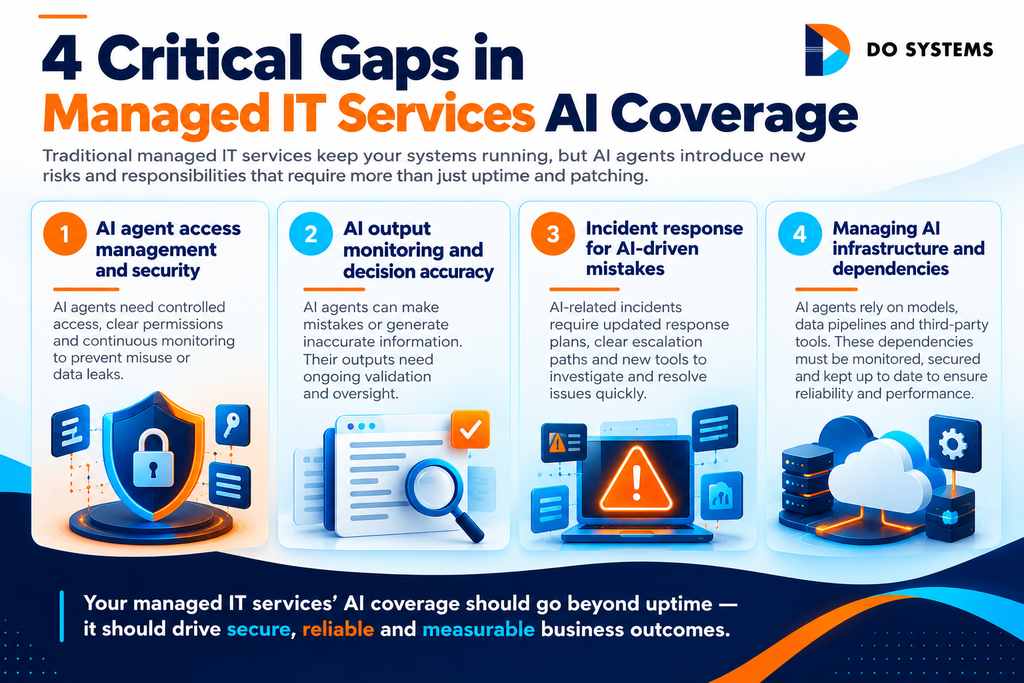
4 critical gaps in managed IT services AI coverage
Businesses implementing AI agents should understand four operational responsibilities that may fall outside their existing managed IT agreements.
1. AI agent access management and security
AI agents often need access to enterprise systems, including ERP platforms, warehouse management systems, databases, and shared documents.
However, access requirements can change as agents take on additional responsibilities.
Without regular access reviews, an agent might retain permissions it no longer needs.
Organizations should:
- Review AI agent permissions regularly.
- Apply least-privilege access controls.
- Monitor access to sensitive business information.
- Remove unnecessary permissions.
- Maintain records of agent activity.
A strong managed IT services AI strategy should clearly identify who owns these responsibilities.
For additional guidance, organizations can refer to the NIST AI Risk Management Framework, which provides guidance for identifying and managing AI-related risks.
2. AI output monitoring and decision accuracy
Traditional IT monitoring focuses on whether systems are functioning correctly.
AI monitoring must go further.
An AI agent can complete a task successfully while producing an incorrect result.
For example, an agent might:
- Miscalculate inventory requirements.
- Recommend an inefficient shipping route.
- Process outdated customer information.
- Generate inaccurate business reports.
- Make an incorrect classification.
These problems may not trigger traditional infrastructure alerts.
Businesses therefore need monitoring processes that evaluate both system performance and output quality.
This may involve:
- Tracking AI-generated decisions.
- Reviewing output accuracy.
- Identifying unusual agent behavior.
- Setting alerts for high-risk actions.
- Establishing human approval checkpoints.
An AI system being available does not mean its decisions are reliable.
That distinction is essential when evaluating managed IT services for AI-driven operations.
3. Incident response for AI-driven mistakes
Traditional incident response focuses on cybersecurity threats, outages, system failures, and data loss.
But what happens when an AI agent makes an incorrect business decision?
Imagine an AI agent automatically approving a shipment that should have been flagged for review.
The infrastructure is functioning correctly. There is no server outage.
Yet the business still faces an operational incident.
A comprehensive managed IT services AI plan should address questions such as:
- Who investigates incorrect AI decisions?
- Who receives alerts when an agent behaves unexpectedly?
- Can automated actions be stopped or reversed?
- Who documents the incident?
- Who communicates the impact to business stakeholders?
Without clear ownership, incidents can become difficult to investigate and resolve.
Businesses should establish AI-specific incident response procedures before moving agents into production.
4. Managing AI infrastructure and dependencies
Modern AI systems rely on more than servers and traditional applications.
Depending on their architecture, AI agents may use:
- Vector databases.
- API gateways.
- AI orchestration frameworks.
- Third-party models and services.
- Software libraries and integrations.
- Enterprise data pipelines.
These components require ongoing security monitoring, maintenance, and updates.
However, traditional managed IT contracts may not explicitly include them.
That creates potential gaps in patching responsibilities, dependency management, and system security.
Before deploying AI agents, businesses should determine whether their provider supports the entire technology environment.
A reliable AI deployment requires both traditional infrastructure management and specialized AI operational oversight.
Why your managed IT provider’s AI capabilities matter
Many IT providers now advertise AI capabilities.
However, offering AI-related services doesn’t necessarily mean a provider is prepared to manage autonomous AI agents in production.
The important question isn’t simply:
“Do you support AI?”
Instead, business leaders should ask:
“Does our agreement clearly define who monitors, secures, maintains, and takes responsibility for AI agents after deployment?”
This distinction matters because AI implementation is only the beginning.
Agents require ongoing monitoring, maintenance, performance evaluation, and governance.
When these responsibilities are not assigned, they often fall on internal IT teams.
For organizations with limited IT resources, this can create additional operational pressure.
The result may be an AI pilot that initially performs well but becomes difficult to maintain as business processes evolve.
An effective managed IT services AI approach should define operational ownership before deployment.
10 questions to ask your managed IT provider before renewing
Before renewing a managed IT agreement or signing a new contract, business leaders should ask these ten questions.
AI governance and security checklist
1. Does our contract include AI agent access reviews?
Confirm whether the provider regularly reviews agent permissions and access to sensitive data.
2. Who monitors AI outputs for accuracy?
Determine who evaluates AI-generated decisions and identifies potentially incorrect results.
3. Is there an AI-specific incident response process?
Ask how the provider handles incorrect decisions, unexpected behavior, or unauthorized agent actions.
4. Does the provider maintain AI infrastructure?
Confirm coverage for vector databases, orchestration platforms, API gateways, and supporting dependencies where applicable.
5. Can the provider produce AI activity logs?
Determine whether agent actions, data access, and important decisions are recorded and retrievable.
6. Who is accountable for AI-related incidents?
Identify a specific person or team responsible for resolving AI operational problems.
7. How does the provider detect AI performance changes?
Ask whether monitoring systems can identify declining accuracy, unexpected outputs, or changes in agent behavior.
8. Does the SLA include AI performance requirements?
Determine whether the service-level agreement addresses more than system uptime.
9. Who manages AI compliance documentation?
Clarify responsibilities for recordkeeping, audit evidence, and applicable regulatory requirements.
10. Can the service scale as we deploy additional AI agents?
Understand how pricing, monitoring, security, and support responsibilities change as AI adoption increases.
These questions provide a practical starting point for evaluating managed IT services AI readiness.
A capable provider should be able to explain its responsibilities clearly and document them in the service agreement.
If the answers remain vague, your organization may need to address those gaps before expanding AI adoption.
What happens when businesses ignore AI management gaps?
The consequences of inadequate AI oversight can extend beyond technical inconvenience.
Imagine a logistics company using AI agents to automate inventory replenishment.
The agent accesses outdated information and recommends incorrect order quantities.
The servers remain operational. The network is functioning normally.
However, the business may now face excess inventory, delayed shipments, or unnecessary costs.
Similarly, a manufacturing company using AI-assisted maintenance recommendations could experience operational problems if incorrect outputs go undetected.
These examples illustrate why monitoring AI behavior is different from monitoring infrastructure availability.
Potential consequences of unclear AI ownership include:
- Delayed identification of incorrect decisions.
- Increased pressure on internal IT teams.
- Poor visibility into agent activities.
- Difficulty investigating AI-related incidents.
- Incomplete audit documentation.
- Unexpected operational costs.
Not every AI error results in a major incident. However, organizations benefit from identifying accountability gaps before they become operational problems.
The objective is not to avoid AI adoption.
It is to ensure that AI systems remain secure, reliable, and manageable after deployment.
How businesses can improve managed IT services AI readiness
Organizations do not necessarily need to replace their existing managed IT providers.
Instead, they should evaluate whether current agreements adequately address AI-specific responsibilities.
A practical approach includes four steps.
Step 1: Identify AI agents and connected systems
Document where AI agents operate, which applications they access, and what business decisions they influence.
Step 2: Review existing IT service agreements
Examine whether current contracts cover AI monitoring, security, incident response, and ongoing maintenance.
Step 3: Assign clear operational ownership
Define which responsibilities belong to internal IT teams, managed service providers, and AI implementation partners.
Step 4: Establish measurable monitoring requirements
Create processes for evaluating agent behavior, output quality, access permissions, and operational performance.
These steps help businesses transition from experimental AI deployments to more sustainable operations.
At Do Systems, we focus on helping businesses connect AI implementation with measurable operational outcomes.
Successful AI adoption requires more than deploying new technology.
It requires clearly defined processes, appropriate oversight, and accountability.
Final thoughts: AI needs more than uptime guarantees
Traditional managed IT services remain essential for business operations.
However, AI agents introduce responsibilities that existing IT agreements may not fully address.
Access management, output monitoring, incident response, and AI infrastructure maintenance all require careful consideration.
The most important question is not whether your AI agent is running. It is whether your organization knows who is responsible for what that agent does.
Before deploying additional AI agents, evaluate whether your current IT arrangements provide the oversight your business needs.
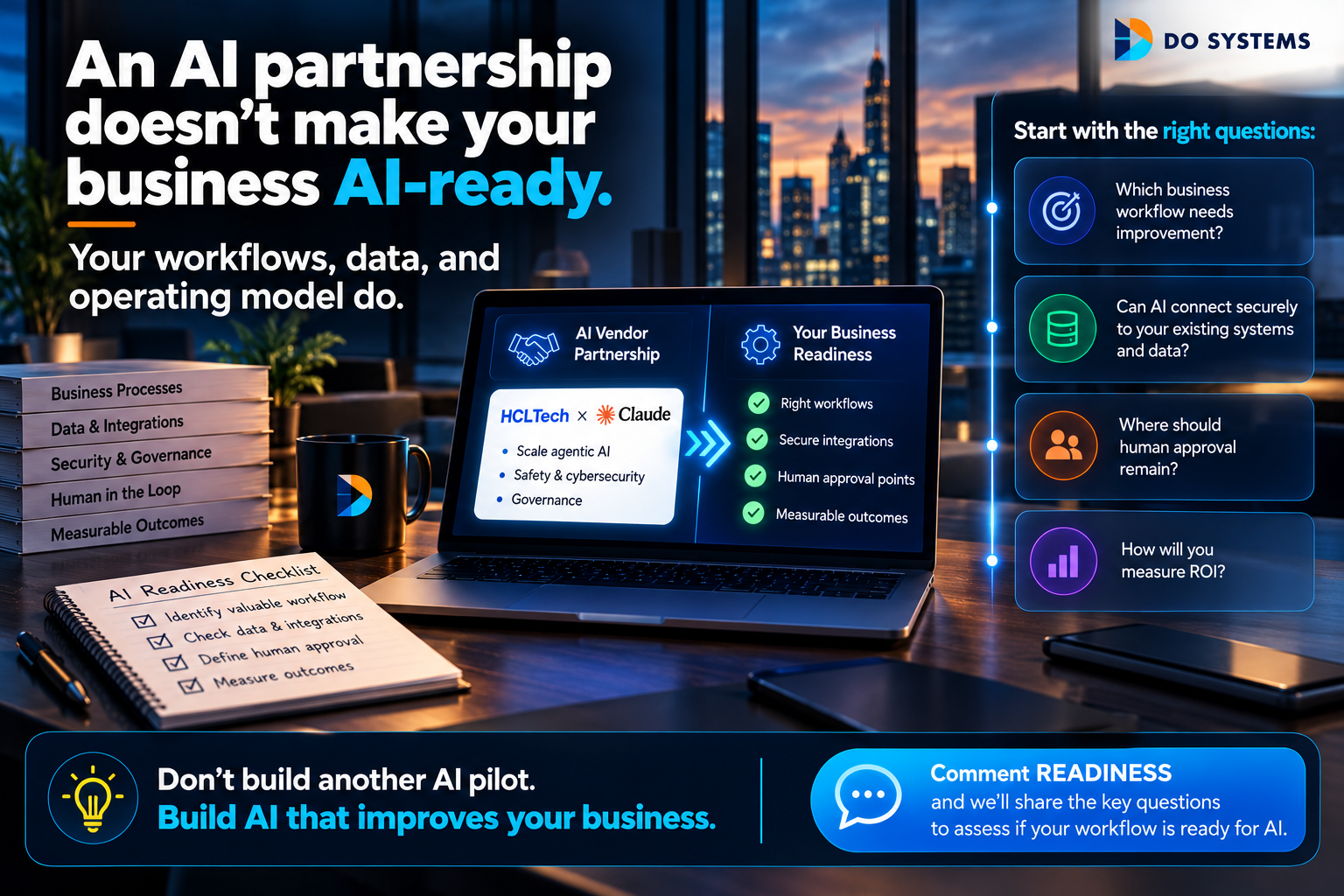
Is your business ready for AI?
Understanding your operational gaps is the first step toward responsible AI adoption.
Use the Do Systems AI Readiness Checklist to evaluate your organization’s preparedness across data access, security, governance, and operational ownership.
Check Your AI Readiness — 10-Point Checklist
Frequently asked questions
Does managed IT services cover AI agent monitoring?
Traditional managed IT agreements typically focus on infrastructure availability, security updates, and technical support. AI agent monitoring may require additional services covering output accuracy, access permissions, incident response, and operational oversight. Businesses should review their contracts to determine whether these responsibilities are included.
Who should be responsible for AI agent oversight?
Responsibility depends on the organization’s operating model and service agreements. Internal IT teams, managed service providers, and AI implementation partners may share responsibilities. However, organizations should clearly document accountability for monitoring, security, maintenance, and incident response before deploying agents.
What should businesses ask managed IT providers before deploying AI agents?
Businesses should ask whether their providers offer AI access reviews, output monitoring, incident response procedures, activity logging, and maintenance of supporting AI infrastructure. These responsibilities should be defined in writing rather than assumed.
How can managed IT services AI improve business operations?
A well-defined managed IT services AI approach can help organizations clarify accountability, improve monitoring, strengthen security controls, and support more reliable AI operations. Combining traditional infrastructure support with AI-specific oversight helps businesses manage operational risks as AI adoption expands.
Comments are closed