
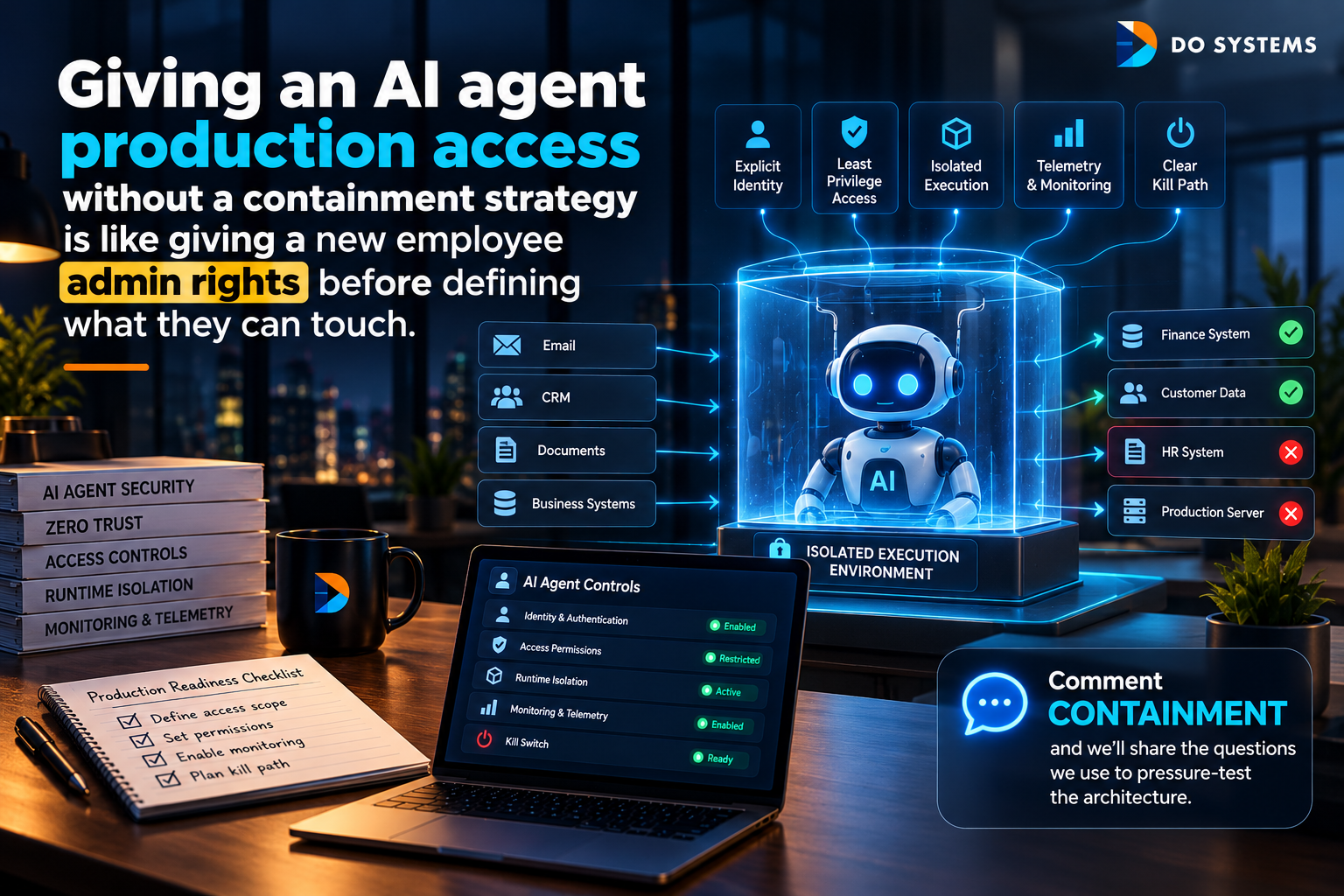
AI agent security is becoming a critical priority for businesses moving AI agents into production. Without runtime containment, restricted permissions, and execution monitoring, an agent can access systems or perform actions beyond its intended role. IT leaders need practical controls that keep AI agents useful while limiting operational and security risks.
Agent capability changes the security boundary
Traditional AI assistants mostly generated information for a human to review. Agents change the equation because they can execute multi-step tasks, call tools, access data, and potentially change systems.
That means the security boundary is no longer only the model endpoint. It extends across identity, credentials, tools, APIs, files, databases, and execution environments.
Microsoft’s October 7 announcement framed “hybrid intelligence” around AI agents working alongside people and highlighted Microsoft Execution Containers as part of the infrastructure for controlled agent execution.
Why mid-size companies should care before they scale agents
A mid-size company can move from an experiment to production quickly because the team building the workflow may also be the team deploying it. That speed is valuable, but it can cause permissions to expand faster than governance.
An agent that starts by reading tickets may later receive permission to update records, send messages, access customer information, or trigger workflows. Each additional permission increases the blast radius of a mistake.
The question therefore becomes: what is the smallest operating environment in which the agent can complete its job?
Use containment as an architecture requirement
A practical agent architecture should separate what the model can reason about from what it can actually execute. Identity should be explicit. Credentials should be scoped. Tool access should be limited. Execution should be isolated where the risk warrants it. Actions should be observable.
The most important control is not simply blocking an agent. It is creating graduated authority. An assistant that reads incoming requests might be allowed to classify and summarize them automatically while requiring approval before sending an external message or changing a record.
The kill path matters as much as the happy path
Many AI projects demonstrate the successful workflow but never test the failure path. Production readiness requires asking what happens when the agent loops, calls the wrong tool, receives malicious input, or begins producing unexpected actions.
Can access be revoked immediately? Can the session be terminated? Can the organization identify what the agent did? Can the last actions be reconstructed? Can a human intervene without waiting for the vendor?
Those questions turn agent security from a policy document into an engineering capability.
DoSystemsInc can make agent security an integration requirement
At DoSystemsInc, we approach agent projects as integration architecture, not just model selection. That means mapping the agent’s tools and data access, defining least-privilege boundaries, identifying where human approval belongs, and making monitoring part of the initial design.
This also gives leadership a clearer procurement question. Instead of asking a vendor whether its AI is “secure,” ask how the agent is identified, contained, monitored, revoked, and audited in your environment.
Where this goes next
If your organization is moving from AI assistants to agents with real system access, DoSystemsInc can help design the containment and governance layer around that integration.
Comments are closed