
The Demo Lied to You
Your AI pilot hit every benchmark in the demo room. Accuracy targets: met. Speed: better than the manual process. The steering committee nodded. Then you tried to move it into the ICU workflow, the ED intake process, or the discharge planning system, and it stalled.
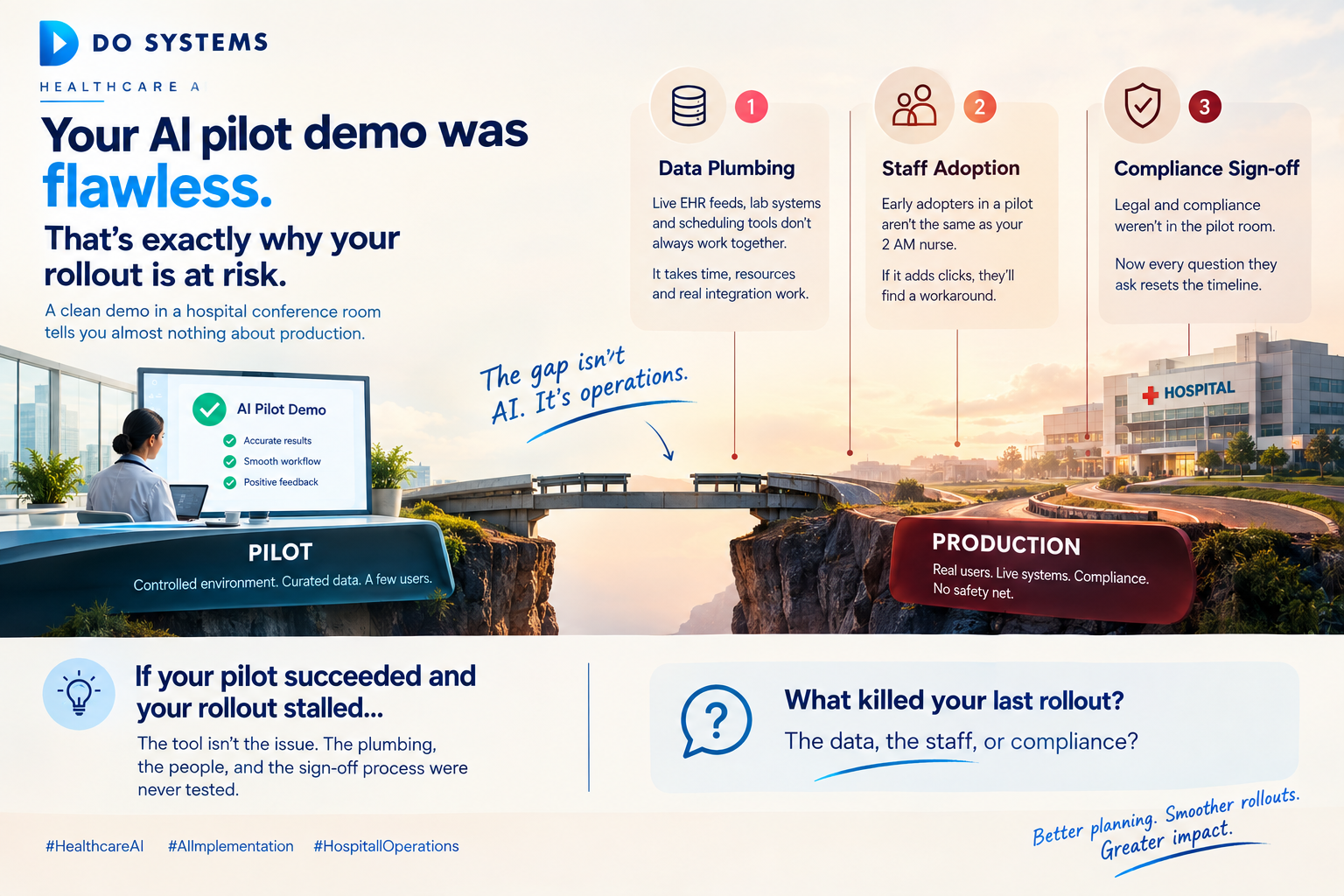
This isn’t a fluke. A pilot demo and a production rollout in a hospital are two different tests. The demo tests whether the model works on clean, curated data in a controlled room. Production tests whether the model survives contact with your actual EHR, your actual nursing shifts, and your actual compliance office. Those are not the same test, and treating them as if they were is why so many pilots stall before go-live.
The numbers point the same way, though not for hospitals specifically. In S&P Global Market Intelligence’s 2025 survey of more than 1,000 respondents in North America and Europe, the average organization scrapped 46% of its AI proofs of concept before they reached production, and 42% of companies abandoned most of their AI initiatives, up from 17% the year before (as reported by CIO Dive).
If you run operations at a hospital or health system, you’ve probably seen this pattern once already. The vendor or internal team declares “success” at the pilot stage, then rollout planning starts from scratch, because nobody mapped the three gaps that actually kill production: data plumbing, staff adoption, and compliance sign-off. None of these show up in a demo. All three show up in week one of rollout.
Gap 1: Data Plumbing
Pilots run on a data sample someone cleaned by hand. Production runs on whatever your EHR, your lab system, and your scheduling tool actually produce, in real time, with real gaps.
In a hospital setting, that means: HL7 feeds that drop fields, ADT messages that arrive late, lab results that live in a different system than the one the pilot was tested against, and manual workarounds nursing staff built years ago that nobody documented. The pilot didn’t touch any of this because someone built a clean extract for the demo.
Before you scale a pilot, you need answers to specific questions: Which system is the source of truth for this data field? What happens when that feed is down for four hours? Who owns data quality when the model starts producing wrong outputs because an upstream field changed format? If nobody on your team can answer these in one sentence, your data plumbing isn’t ready, no matter how good the demo looked.
Gap 2: Staff Adoption
A pilot usually runs with a small, motivated group, often the people who asked for it in the first place. Production runs with everyone on every shift, including the ones who weren’t in the room when it was pitched.
The gap here isn’t technical. It’s operational. A nurse manager doesn’t need to understand the model. She needs to know: what happens when it’s wrong, who she calls, and whether it adds steps to a shift that’s already short-staffed. If the tool changes a workflow without changing the incentive or the training, staff will route around it, quietly, and permanently. This is the objection every COO hears eventually: “will operators actually use it?” The honest answer is no, unless adoption is planned with the same rigor as the model.
Adoption planning means naming the specific role that owns the new step in the workflow, building the escalation path before go-live instead of after the first complaint, and running the change through the people who’ll use it daily, not just the department head who approved the budget.
Gap 3: Compliance Sign-Off
This is the gap that stops rollouts cold in healthcare specifically. A pilot can run under a research exemption, a limited data set, or a sandbox environment. Production touches PHI, live clinical decisions, and audit trails that HIPAA and your compliance office will scrutinize.
Compliance sign-off isn’t a formality you get after the pilot succeeds, it’s a parallel track that should start on day one. That means documenting where the data goes, who can access it, how the model’s decisions are logged and reviewable, and what your BAAs with any AI vendor actually cover. If your compliance or clinical governance lead wasn’t in the room when the pilot was scoped, expect a delay at rollout that has nothing to do with the technology and everything to do with the fact that nobody built the paper trail alongside the model.
What This Means for Your Rollout Plan
None of these three gaps are exotic. They’re the same three gaps that stop most enterprise AI rollouts, and healthcare operations feels them hardest because the data is messier, the staff are stretched thinner, and the compliance bar is higher than almost any other industry.
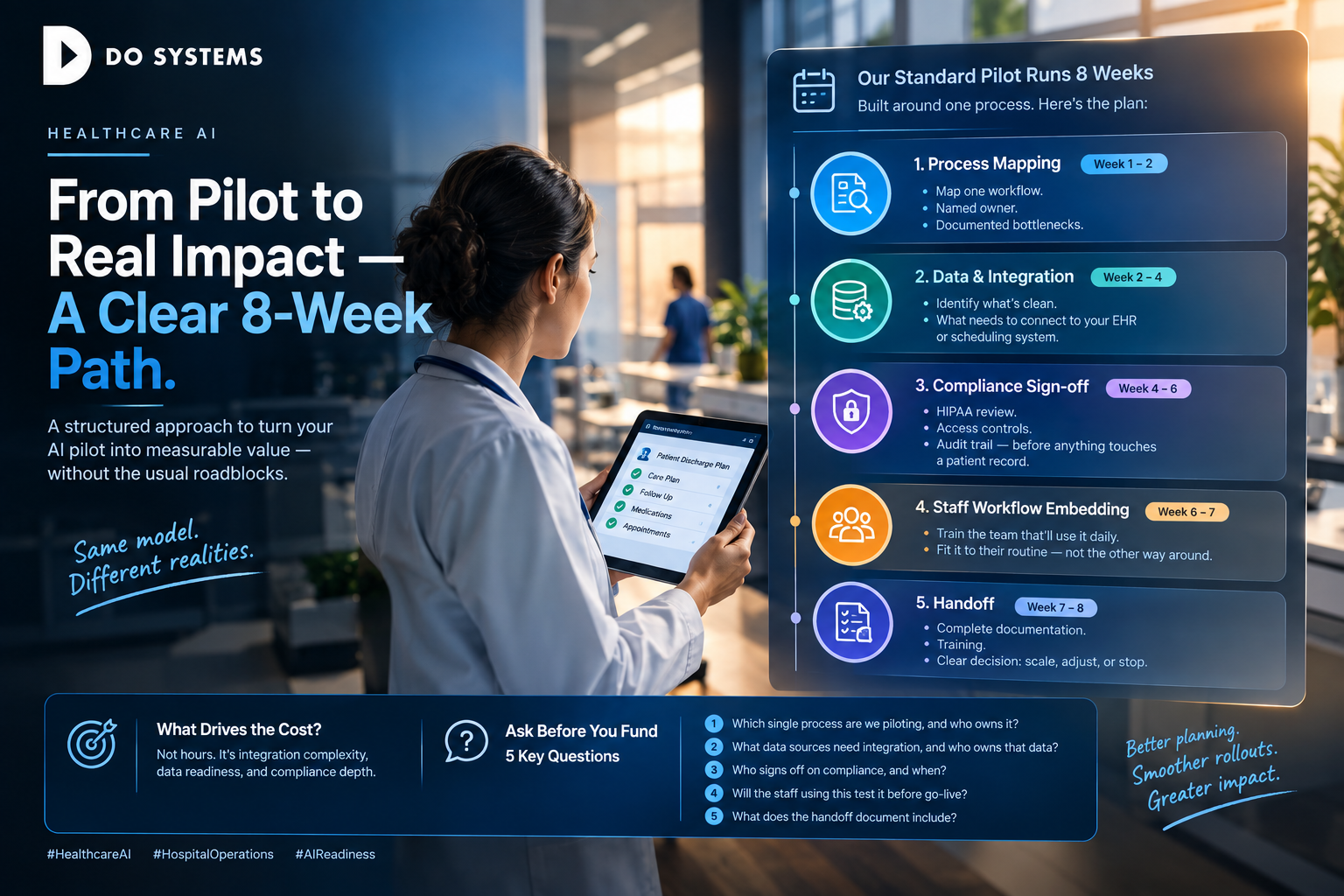
The fix isn’t a bigger pilot. It’s sequencing production readiness, data plumbing, an adoption plan, and compliance sign-off, before you scale, not after the demo goes well. A pilot that works and a rollout that survives contact with your hospital’s real operations are answering two different questions. Plan for both from the start, and the “successful pilot that never launched” stops being your story.
If you want a straight answer on whether your organization is actually ready to move past pilot stage, run through the AI Readiness Checklist. It walks through the same gaps covered here, data, staff, and compliance, so you can see exactly where your rollout is exposed before you commit more budget to it. Grab the checklist and score your own pilot before your next steering committee meeting.
AI Readiness Checklist (10 points)
FAQ
Why do AI pilots succeed in healthcare but fail to reach production?
Because pilots test a model on curated data in a controlled setting, not on live EHR feeds, real staff workflows, or a compliance review. The three gaps that stop rollout are data plumbing, staff adoption, and compliance sign-off, none of which a demo tests.
What is the biggest blocker to scaling an AI pilot in a hospital?
Compliance sign-off is usually the hardest to fix late, because PHI handling, audit trails, and vendor BAAs need to be documented before go-live, not after a pilot proves the model works.
How do we know if our organization is ready to move past pilot stage?
Check whether you can answer basic questions about data ownership, staff escalation paths, and compliance documentation for the specific workflow you’re automating. If those answers don’t exist yet, use a structured readiness check like the AI Readiness Checklist before scaling further.
Comments are closed