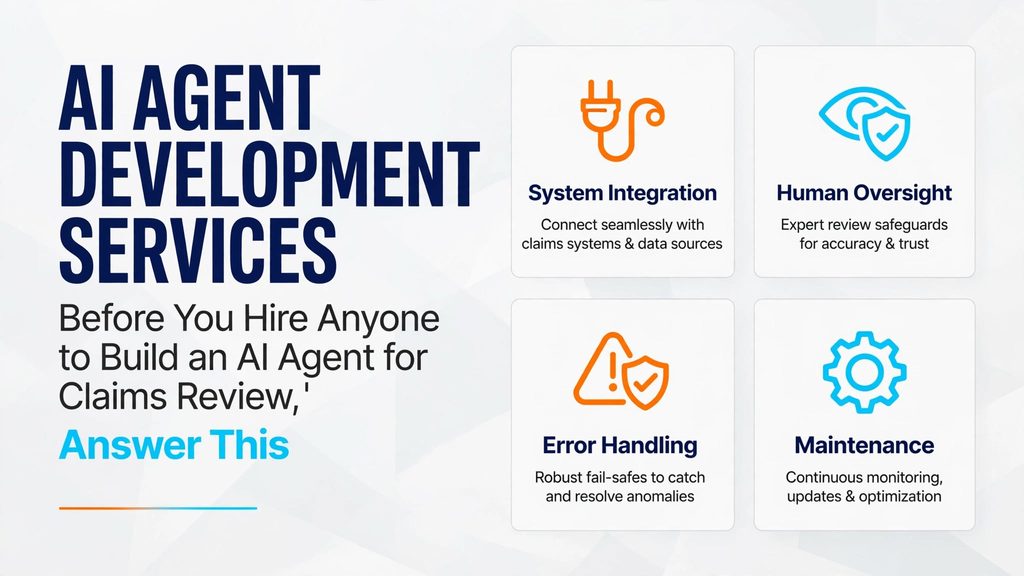
Quick answer: Before hiring a company offering AI agent development services for insurance claims review, ask four essential questions: What system will the agent integrate with? Who reviews its decisions? What happens when it makes a mistake? And who maintains it after launch? These questions help businesses avoid costly implementation mistakes and choose an AI development partner that understands their operational needs.
- Why Choosing the Right AI Agent Development Services Matters
- 1. What System Will the AI Agent Integrate With?
- 2. Who Reviews AI Decisions Before They Affect a Claim?
- 3. What Happens When the AI Agent Makes a Mistake?
- 4. Who Maintains the AI Agent After Launch?
- Why These 4 Questions Matter More Than an AI Demo
- How to Evaluate AI Agent Development Services Before Hiring
- Is Your Business Ready for AI Agent Development Services?
- Frequently Asked Questions
- Final Thoughts: Choose AI That Works Beyond the Demo
Why Choosing the Right AI Agent Development Services Matters
Imagine a vendor demonstrating an AI-powered claims review agent to your team.
The agent reads a first-notice-of-loss form, retrieves policy details, identifies inconsistencies, and drafts a recommendation in under two minutes.
Everyone in the room is impressed.
Then someone asks a simple question:
What happens after those two minutes?
Suddenly, the conversation becomes more complicated.
This is where many AI projects face their biggest challenges. A successful demonstration does not guarantee successful implementation.
Businesses investing in AI agent development services need more than impressive technology. They need solutions that integrate with existing systems, support employees, manage risks, and deliver measurable operational improvements.
An AI agent that works perfectly during a demonstration might struggle when introduced to real claims data, complex workflows, and regulatory requirements.
The real challenge is finding AI agent development services that address these practical concerns rather than simply showcasing impressive technical capabilities.
Before signing a contract with an AI development vendor, business leaders should ask four critical questions.
The answers can help determine whether the vendor is ready to deliver a reliable solution or has simply built an impressive demonstration.
1. What System Will the AI Agent Integrate With?
One of the most important considerations when evaluating AI agent development services is system integration.
An AI claims review agent that produces recommendations in a separate chat window is not necessarily integrated into your workflow.
Your adjusters may still need to copy information, switch applications, and manually update claim records.
Instead of eliminating repetitive tasks, the technology creates additional work.
When comparing AI agent development services, consider how easily the solution fits into the tools your employees already use. The goal should be to reduce unnecessary steps, not introduce more of them.
A reliable AI development partner should explain exactly how the agent interacts with your existing claims management platform, policy administration system, and document management tools.
Questions to Ask About AI Integration
Before hiring a vendor, ask:
- What existing systems will the AI agent connect with?
- Can it retrieve and update claim information through supported APIs?
- Will recommendations appear directly in our claims management platform?
- Can adjusters review AI-generated outputs without switching applications?
- How will integration failures be identified and resolved?
For example, an AI agent might review submitted documents, identify missing information, and attach its recommendation directly to the relevant claim file.
An adjuster can then review the findings within the system they already use.
This approach makes AI part of the existing workflow rather than another tool employees must remember to open.
Key takeaway: Effective AI agent development services should simplify your existing processes, not introduce additional operational complexity.
2. Who Reviews AI Decisions Before They Affect a Claim?
Human oversight is another critical factor when selecting AI agent development services for insurance claims processing.
An AI claims review agent may identify inconsistencies, flag suspicious information, or recommend changes to a claim.
However, these recommendations can influence financial decisions, customer experiences, and regulatory obligations.
The important question is not whether AI can make mistakes.
It can.
The question is who reviews its recommendations before they affect a claimant or an important business decision.
Some vendors develop agents capable of automating low-complexity tasks with minimal human intervention.
Others design agents that prepare recommendations for adjusters to approve, modify, or reject.
Neither approach is automatically suitable for every organization.
When evaluating AI agent development services, businesses should consider how much control their claims teams retain over important decisions. Automation should support employees without removing necessary accountability.
The appropriate level of automation depends on the claim category, organizational risk tolerance, and applicable regulatory requirements.
Questions to Ask About Human Oversight
Ask the vendor:
- Which claim categories can the AI agent process automatically?
- Which decisions require approval from an adjuster?
- Who is responsible for reviewing AI-generated recommendations?
- Can employees override incorrect recommendations?
- Are approval decisions documented for compliance purposes?
A trustworthy vendor should be able to explain how these controls work within your actual claims process.
Why Human Oversight Is Essential
Consider an AI agent that identifies a mismatch between a submitted claim and the policy details.
Without appropriate controls, an incorrect interpretation could lead to an inappropriate recommendation.
A better-designed workflow can flag the inconsistency and route the case to an adjuster for investigation.
The adjuster reviews the evidence and determines the appropriate next step.
This allows organizations to benefit from automation while maintaining accountability.
Companies offering AI agent development services should be able to demonstrate these review processes using examples relevant to your organization.
Key takeaway: AI should support claims professionals. Decision-making authority, approval requirements, and accountability must be established before deployment.
3. What Happens When the AI Agent Makes a Mistake?
Every claims operation has procedures for identifying and correcting errors.
Supervisors review questionable decisions. Auditors investigate inconsistencies. Claimants may dispute decisions and request reconsideration.
AI agents need equally clear procedures.
When evaluating AI agent development services, businesses should understand how the technology identifies, records, escalates, and corrects errors.
A vendor claiming that its AI agent rarely makes mistakes is not providing a complete answer.
Even an infrequent error can lead to reopened claims, customer complaints, additional administrative work, or compliance concerns.
A reliable provider of AI agent development services should explain what happens when the technology produces an incorrect recommendation. Ask to see how the system handles mistakes, not just successful claims reviews.
Questions to Ask About AI Error Management
Ask the vendor:
- How does the agent identify uncertain or potentially incorrect recommendations?
- Are low-confidence cases automatically escalated for human review?
- Is there an audit trail showing the information used by the agent?
- Can supervisors review and correct AI-generated recommendations?
- Can the system identify patterns of repeated errors?
- Can we generate reports showing which claims the AI agent reviewed and which recommendations were overridden?
The vendor should demonstrate how these processes work in practice.
For example, imagine an AI agent incorrectly interpreting a policy exclusion.
A properly designed system should allow an adjuster to identify the issue, review the supporting documentation, and correct the recommendation.
The organization should also be able to investigate whether similar mistakes occurred in other claims.
Why Audit Trails Matter in AI Claims Review
Insurance claims processing requires transparency and accountability.
Organizations need to understand how recommendations were generated and whether appropriate controls were followed.
An effective audit trail can record the information the agent accessed, the recommendation it produced, the actions taken, and any subsequent human corrections.
These records can support internal reviews and help organizations respond to audit or compliance questions.
Businesses evaluating AI-related risks can also refer to the NIST AI Risk Management Framework, which provides guidance for managing risks associated with AI systems.
When choosing AI agent development services, confirm that the proposed solution includes appropriate auditing and reporting capabilities.
Key takeaway: Reliable AI agent development services must include clearly defined error-handling, escalation, and auditing processes.
4. Who Maintains the AI Agent After Launch?
Many organizations focus heavily on development and deployment while overlooking long-term maintenance.
However, launching an AI agent is not the end of the project.
Claims data changes.
Insurance policies are updated.
Regulatory requirements evolve.
Business processes become more complex.
An AI agent that performs well during its initial deployment may require adjustments as these conditions change.
Businesses investing in AI agent development services should think about what happens after implementation. A solution that works well initially still needs monitoring, technical support, and occasional updates to remain effective.
That is why ongoing maintenance should be discussed before hiring an AI development vendor.
Questions to Ask About AI Maintenance
Before signing a contract, ask:
- Who monitors the AI agent’s performance after deployment?
- Who investigates errors or unexpected behavior?
- How are changes in policies and regulations incorporated?
- Who handles integration failures and technical issues?
- Does the vendor provide ongoing maintenance and support?
- What happens if the agent stops functioning correctly outside regular business hours?
These responsibilities should be clearly documented.
Without defined ownership, an AI solution can become an operational burden instead of a long-term business asset.
Establish Clear Ownership Before Deployment
Successful AI implementations require accountability from both business and technical teams.
Organizations should consider assigning three responsibilities.
Business owner: A claims operations leader who ensures the AI agent continues supporting operational goals and business requirements.
Technical owner: An IT representative responsible for system integrations, technical reliability, and coordination with the vendor.
Vendor support: A clearly identified support team responsible for agreed maintenance, troubleshooting, and system improvements.
When selecting AI agent development services, businesses should confirm that these responsibilities are understood before implementation begins.
Clear ownership also makes it easier to respond when problems arise. Your employees should know who to contact and what to expect from the vendor.
Key takeaway: AI implementation does not end at deployment. Long-term monitoring, maintenance, and ownership are essential for sustainable results.
Why These 4 Questions Matter More Than an AI Demo
An AI demonstration shows what the technology can accomplish under favorable conditions.
Real business operations are more complicated.
Insurance companies manage different claim types, existing software platforms, compliance requirements, and established approval processes.
An effective AI solution must operate within these constraints.
That is why businesses evaluating AI agent development services should focus on operational readiness rather than impressive features alone.
The four questions address the areas that determine whether an AI agent can become part of daily operations:
- System integration: Can the agent work within existing business systems?
- Human oversight: Who reviews and approves important recommendations?
- Error management: What happens when the agent produces an incorrect result?
- Long-term maintenance: Who remains responsible for the system after deployment?
A vendor who answers these questions with specific operational details is better positioned to demonstrate an understanding of your implementation requirements.
The right AI agent development services should address your organization’s actual challenges, not simply offer the latest technology.
A vendor who provides vague assurances may not have adequately scoped the work.
How to Evaluate AI Agent Development Services Before Hiring
Choosing the right AI development partner requires a structured evaluation process.
Before entering a vendor agreement, review the following checklist.
AI Agent Development Vendor Evaluation Checklist
1. Integration readiness
- Confirm compatibility with existing claims management systems.
- Identify the APIs and data sources required.
- Understand how recommendations will enter the current workflow.
2. Human oversight
- Define which decisions require human approval.
- Establish clear review and escalation responsibilities.
- Confirm that employees can override AI recommendations.
3. Error handling and compliance
- Review the vendor’s error detection procedures.
- Confirm that appropriate audit records are maintained.
- Understand how mistakes are corrected and investigated.
4. Maintenance and accountability
- Identify the business and technical owners.
- Confirm ongoing monitoring and support arrangements.
- Establish responsibilities for future system changes.
This checklist helps organizations compare vendors based on operational requirements rather than demonstrations alone.
When evaluating different AI agent development services, use the same criteria for every provider. This makes it easier to identify meaningful differences in capabilities, support, and implementation approaches.
However, vendor selection is only one part of successful AI implementation.
Your organization must also be prepared to support the technology.
Is Your Business Ready for AI Agent Development Services?
Even the right AI development vendor cannot compensate for unclear processes, incomplete information, or missing internal ownership.
Before launching an AI claims review pilot, organizations should evaluate their own readiness.
Before investing in AI agent development services, identify the parts of your claims workflow that create the most delays or require the most manual effort.
Start by asking:
- Are our claims workflows clearly documented?
- Is our policy and claims data accessible and reliable?
- Can our existing systems support AI integration?
- Do we have employees responsible for reviewing AI recommendations?
- Are our compliance and escalation procedures clearly defined?
- Have we identified measurable business outcomes for the pilot?
These questions help reveal operational gaps before they become expensive implementation problems.
For example, if your claims data is scattered across disconnected systems, an AI agent may struggle to retrieve the information it needs.
Similarly, if no business leader is responsible for monitoring outcomes, the organization may find it difficult to measure whether automation is delivering meaningful improvements.
Choosing AI agent development services should begin with a clear understanding of your business requirements and the specific problems you want to solve.
The goal is not simply to deploy AI.
The goal is to implement technology that improves the way your business operates.
Start With an AI Readiness Assessment
Before investing in AI agent development services, take time to understand whether your systems, processes, and teams are prepared.
At Do Systems, we focus on helping organizations move beyond AI demonstrations and toward practical solutions that address real operational challenges.
Our AI Readiness Checklist helps businesses evaluate the systems, data, ownership, and operational requirements that influence successful AI adoption.
AI Readiness Checklist (10 Points)
Use this checklist before your next vendor discussion to identify potential gaps and determine which questions deserve closer attention.
Frequently Asked Questions
1. What Are AI Agent Development Services?
AI agent development services involve designing, building, integrating, and maintaining AI-powered agents that perform tasks or support business workflows. In insurance claims review, these agents may analyze documents, retrieve policy information, identify inconsistencies, and prepare recommendations for adjusters.
2. What Should I Ask an AI Agent Vendor Before Hiring?
Ask four important questions: What systems will the agent integrate with? Who reviews its decisions? How are errors identified and corrected? And who maintains the technology after deployment? Clear answers help determine whether the vendor understands your operational requirements.
3. Does an AI Claims Review Agent Need to Integrate With Existing Systems?
Integration is strongly recommended for effective workflow automation. An AI agent that operates separately may create additional manual work, while an integrated system can deliver recommendations directly within existing claims management processes.
4. Can AI Agents Make Insurance Claims Decisions Automatically?
AI agents can automate certain claims-related tasks. However, decisions affecting claimants may require human oversight depending on the claim type, organizational policies, and applicable regulations. Businesses should establish appropriate controls before allowing automated actions.
5. Who Should Own an AI Claims Review Pilot?
A claims operations leader should serve as the business owner, supported by a technical representative from IT. The selected AI development vendor should also have clearly defined responsibilities for implementation, maintenance, and support.
6. How Do I Choose the Right AI Agent Development Services?
Evaluate vendors based on integration capabilities, industry understanding, security practices, human oversight, error management, and ongoing support. Request workflow-specific demonstrations that show how the technology will operate within your existing business environment.
The best AI agent development services should offer solutions tailored to your business processes rather than expecting your team to adapt to unnecessary complexity.
Final Thoughts: Choose AI That Works Beyond the Demo
Hiring a company that provides AI agent development services is not simply about choosing advanced technology.
It is about selecting a partner who understands your business processes, operational challenges, and long-term objectives.
Before signing a contract, make sure you can answer four questions:
- Where will the AI agent operate?
- Who will review its decisions?
- How will mistakes be corrected?
- Who will maintain it after launch?
Clear answers help reduce implementation risks and create a stronger foundation for successful AI adoption.
An impressive AI demonstration might win attention. A reliable, integrated solution is what delivers lasting business value.
Choosing the right AI agent development services starts with knowing whether your business is prepared to support the technology.
The value of AI isn’t in the technology. It’s in the outcome.
Before moving forward with your next AI initiative, explore the Do Systems AI Readiness Checklist to evaluate your organization’s readiness.
Comments are closed