
Quick answer: Slow onboarding is often a handoff and ownership problem, not a missing-automation problem. If HR, IT and managers each own one slice of the process and no one owns the whole journey, adding a chatbot or form tool just moves the same delay faster.
Effective HR onboarding automation starts with fixing ownership, choosing one specific use case, and confirming data access before automating anything.
Table of Contents
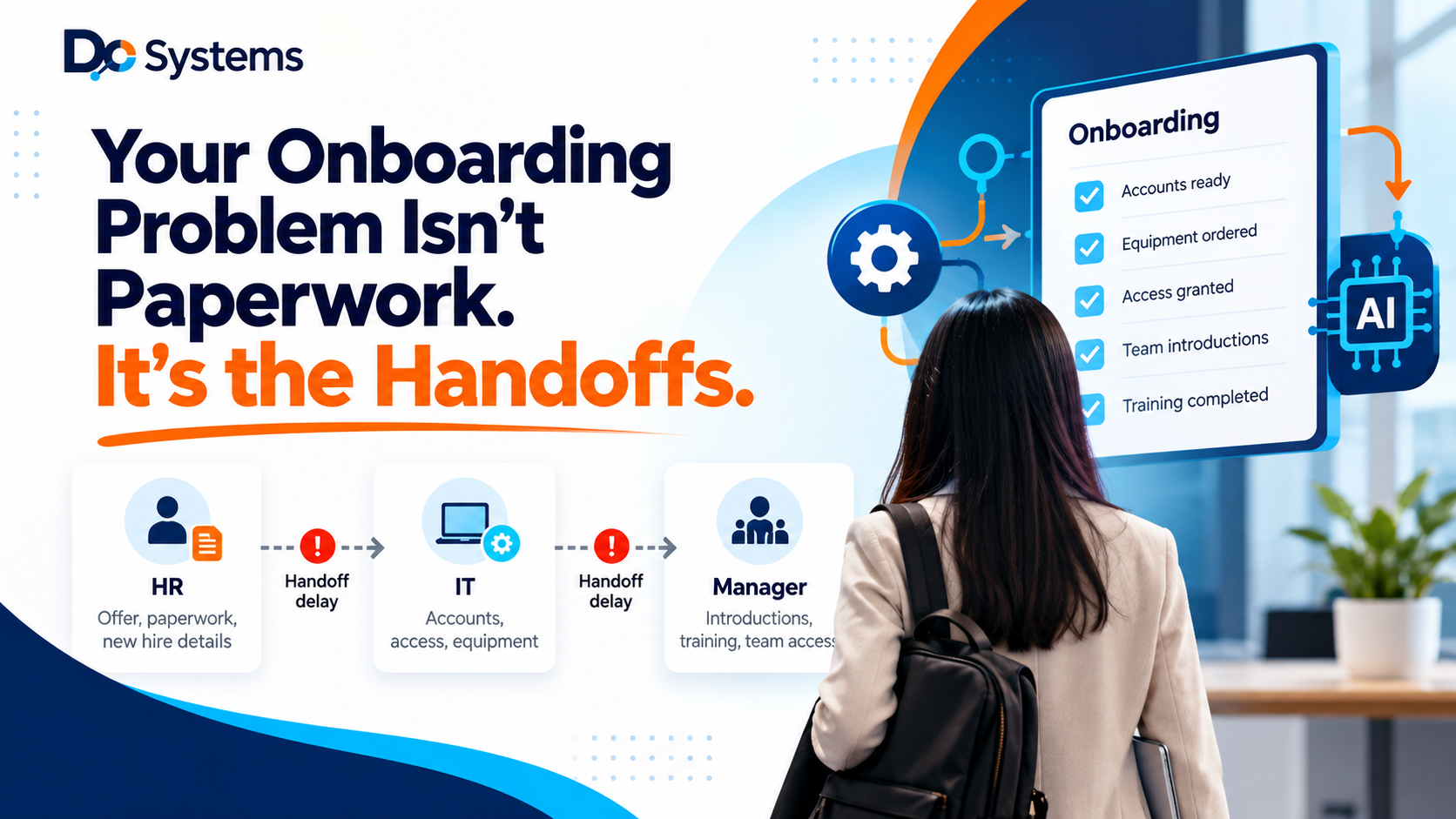
A Chatbot Won’t Fix a Broken Handoff
If leadership’s answer to slow onboarding is “let’s add a chatbot” or “let’s start HR onboarding automation with the new-hire form,” the assumption is that the delay lives in the paperwork.
But if a new hire’s laptop order sits in an IT queue because no one confirmed the start date, a chatbot won’t catch that missed confirmation either.
It will simply ask the same question faster, without closing the gap between HR finishing its part and IT realizing it’s time to start theirs.
When a task moves between HR, IT and a manager, and no single person owns it across that full path, each handoff becomes a place where the task can sit unnoticed.
Automating one step, such as a form submission that triggers an account-creation ticket, doesn’t guarantee anyone is accountable for confirming the ticket gets picked up.
The paperwork moves faster, but the handoff can remain just as stuck.
HR onboarding automation works best when every handoff has a clear owner and someone is responsible for confirming that the next step happens.
Without that accountability, automation may speed up individual tasks without improving the overall onboarding experience.
Pick One Process for HR Onboarding Automation
If a team tries to fix “onboarding” as one initiative, it can end up tackling several separate workflows at once.
Account provisioning, equipment ordering and compliance training each have different owners, systems and points where delays can occur.
Treating all of them as one AI project risks leaving each of them unfixed.
The AI Readiness Checklist addresses this exact problem: pick one high-value use case, not a portfolio.
A process ready for a pilot should involve one repetitive, high-volume task with clear inputs and outputs. It should also have a named manager responsible for its success.
If a company wants to improve onboarding, the target should be something specific, such as “provisioning IT accounts for new hires.”
Trying to automate the entire onboarding journey at once makes it harder to identify problems and measure improvements.
A successful HR onboarding automation pilot starts with one clearly defined workflow, an accountable process owner, and measurable outcomes.
Starting small makes it easier to identify delays, evaluate results, and determine whether the approach should expand to other onboarding tasks.
Check Data Access Before HR Onboarding Automation
Even a narrowly scoped onboarding process can fail a simpler test: can the team access the necessary data within a week without starting a separate data project?
Consider a situation where a new hire’s start date is stored in an offer letter PDF, their role is recorded in an applicant tracking system, and their manager’s name is maintained in a spreadsheet.
There is no clean data path for an automation tool to follow.
Automation layered onto this process would inherit the same uncertainty that employees already deal with manually.
Before adding automation, ask whether the system storing the employee’s start date, role and manager connects to the systems used by IT and facilities.
These connections are necessary for provisioning access, ordering equipment, and completing onboarding tasks.
If those systems cannot communicate, building that connection should be the first project.
Before implementing HR onboarding automation, organizations should verify that employee information can move securely and accurately between the systems involved.
Without accessible and reliable data, even a well-designed automation workflow may create additional exceptions and manual follow-ups.
Ownership Is the Fix, Not the Tool
The AI Readiness Checklist asks whether there is one accountable business owner, a technical counterpart, dedicated time each week, and an executive sponsor who can remove blockers.
If onboarding belongs to “HR” in name but no single person is accountable for tracking a new hire’s progress, adding another tool will not create that accountability.
It simply gives multiple teams another system to check without changing who is responsible for completing the work.
The Society for Human Resource Management (SHRM) also emphasizes the importance of clearly defining onboarding responsibilities across the people involved.
Its guidance on onboarding roles and responsibilities explains how HR, supervisors, coworkers and leadership contribute to the onboarding experience.
Assigning one accountable owner to oversee the complete onboarding journey creates a clearer path for resolving delays.
That person should be able to see where each new hire stands across HR, IT and management.
They should also have the authority to follow up when a task remains incomplete.
Once those responsibilities are established, the same owner can identify which specific steps would benefit most from automation.
Effective HR onboarding automation can improve visibility across departments, but accountability must remain with a designated process owner.
Technology should help that person track progress, identify delays and ensure tasks reach completion. It should not become a substitute for ownership.
What AI-Ready Onboarding Actually Looks Like
An onboarding process that’s ready for automation looks different from one where technology is being used to compensate for missing processes.
A ready process has a named owner who can oversee the entire journey rather than only one department’s responsibilities.
It starts with one clearly defined use case, such as account provisioning, instead of attempting to automate every onboarding task simultaneously.
The necessary data, including start dates, employee roles, manager details and equipment requirements, must be accessible to the relevant systems.
Success should also be defined before the pilot begins, with a specific metric, a review date and clear criteria for evaluating the results.
For HR onboarding automation to deliver meaningful improvements, organizations should evaluate four essential areas.
1. Clear process ownership
Assign one accountable person who can monitor onboarding progress across HR, IT and management.
This person should have the authority to identify delays, coordinate with departments and ensure tasks are completed.
2. A clearly defined workflow
Choose one repetitive, high-value process with clear inputs, outputs and responsibilities.
Starting with a specific workflow makes it easier to identify operational problems and measure the impact of automation.
3. Accessible and reliable data
Verify that the employee information required for onboarding is accessible to the systems responsible for completing tasks.
Data should move securely and accurately between departments without unnecessary manual intervention.
4. Measurable success criteria
Define a baseline, target metric and review date before launching an automation pilot.
For example, a company might measure how long it takes to provision employee accounts before and after automation.
The goal of HR onboarding automation should be to reduce unnecessary delays, eliminate repetitive administrative work and create a more consistent experience for new employees.
None of these readiness checks requires AI to assess.
They require an honest evaluation of how onboarding tasks move between departments and whether someone is accountable for completing the entire process.
Start With the Assessment, Not the Automation
When onboarding delays become a recurring frustration, investing in a chatbot or automation tool may seem like the quickest solution.
However, adding technology to a process with unclear ownership can make existing problems more visible without actually resolving them.
A better first step is to evaluate whether the process has one accountable owner, a clearly defined use case and an accessible data path.
Before investing in HR onboarding automation, businesses should identify the specific gaps preventing onboarding tasks from moving forward.
Fixing those gaps first gives automation a clearer purpose and makes its impact easier to measure.
If your onboarding process keeps stalling between HR, IT and managers, the AI Readiness Checklist can help identify whether the problem is ownership, data access or scope.
Assess your process before investing in another tool to fix it.
AI Readiness Checklist (10 points)
FAQ
Does HR onboarding automation fix slow employee onboarding?
Only if the underlying handoffs have clear ownership and a reliable data path.
When automation is added to a process where no one owns the complete journey, delays between departments can remain unresolved.
Automation can speed up individual tasks, but it cannot independently resolve unclear responsibilities or disconnected workflows.
What should an HR team check before automating onboarding?
Start by selecting one specific process, such as IT account provisioning.
Confirm that there is an accountable owner across HR, IT and management, and verify that the required employee information is accessible.
Teams should also establish measurable outcomes to determine whether automation improves the existing process.
How do we know if our onboarding process is ready for AI?
Evaluate the process against three essential criteria: a clearly defined use case, accessible data and one accountable owner.
If any of these elements is missing, that gap should be addressed before introducing automation.
HR onboarding automation becomes a more practical investment when an organization has established clear ownership, connected systems, and measurable goals.
Comments are closed