
A Chatbot Won’t Fix a Broken Intake Process
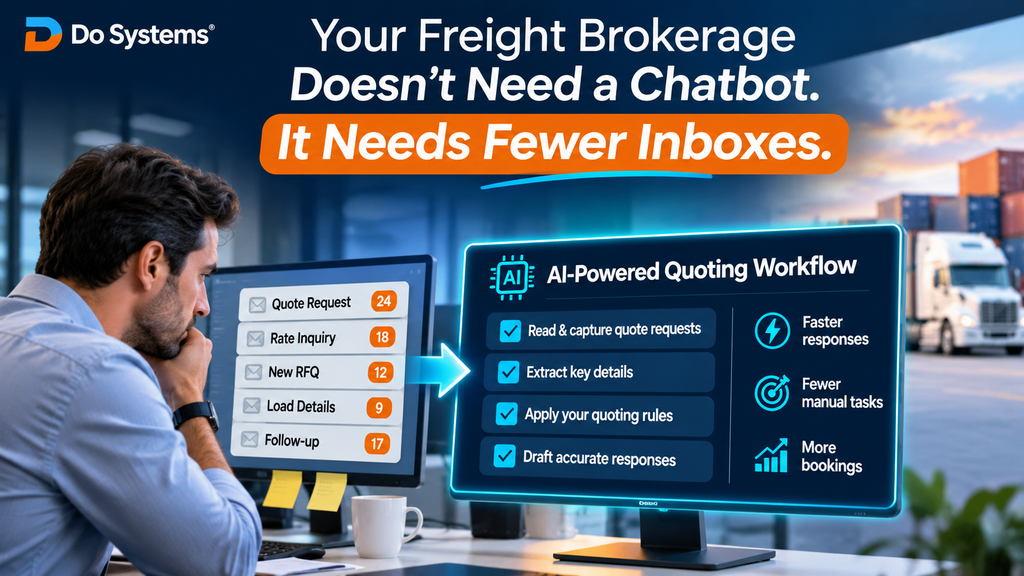
A chatbot on your website will not make your quotes faster. It can add one more inbox to the ones a team already checks, such as a shared quoting email, the dispatcher’s cell phone, and a spreadsheet built to track requests that fell through the cracks. Generative AI consulting for freight brokerage quoting can get sold around the wrong question: which model should we buy? The right question is where a quote request lands the moment it arrives, and how many places a dispatcher has to check before responding.
Check Your Own Intake Before You Check a Vendor’s Demo
You do not need an outside claim to test this. Open your own systems right now. Count the channels a shipper can use to ask for a quote: email, phone, text, a web form, a load board message. Then count how many of those channels write into the same place. If a shipper calls instead of emailing, does that request show up next to the ones that came in by email, or does it live only in a voicemail? This is the test the AI Readiness Checklist calls systems and integration: know which systems the output has to write back to, and confirm those systems expose a way in.
A generative model answering a shipper’s question is a thin layer on top of whatever it can read. Point that layer at five disconnected inboxes and it can produce five disconnected, sometimes contradictory, answers. Point it at one consolidated feed of requests and quote history, and the same model becomes accurate because the problem it is solving got smaller first.
Name One Process, Not a Portfolio
Reject any plan that starts with “deploy a chatbot across the brokerage.” That is a portfolio, not a use case. The checklist is specific on this point: pick one high-value process, owned by one named manager, with clear inputs and outputs. For a brokerage, that process is quote intake and response, not customer service in general and not operations in general.
Name the manager who owns quote response time today. Name the metric already tracked, or admit it isn’t tracked. Average response time, quotes answered per rep per day, quotes lost because no one answered before a shipper went elsewhere: pick the one you can measure now, even roughly, and use it as your baseline. A use case without a named owner and a current baseline is a wish, not a project.
Data Access Is the Real Blocker, Not the Model
Before any conversation about generative AI, answer this: can your team pull all open quote requests, from each channel, into one place within a week, without starting a separate data project first? If the answer involves exporting several spreadsheets, forwarding a shared inbox, and asking a dispatcher to remember what came in by phone yesterday, the brokerage is not ready for a model. It is ready for a consolidation project.
This is not a reason to wait. It is a reason to sequence the work correctly. Fix where requests land. Fix who owns each one the moment it arrives. Only then ask a model to draft a response, flag a stale request, or route a load to the right rep. A model layered onto a scattered intake process does not fix the scatter. It automates the confusion and answers faster, in the wrong direction.
What “Ready” Actually Looks Like
A brokerage ready to pilot something here can state, in one sentence, what the automation does and what number it moves: cut average quote response time for spot freight by catching requests the moment they land instead of when someone checks the shared inbox. That sentence names a process, a metric, and a mechanism. Compare it to “we want an AI chat tool for quoting”: no metric, no process, no way to know if it worked.
Security and compliance deserve the same scrutiny. If a quote tool reads rate history, contract terms, or carrier capacity data, someone needs to approve what data a model can see and where it is hosted before a pilot starts, not after. A team that skips this step is not moving fast. It is deferring a hard conversation until after money has been spent.
Build, Buy, or Fix First
Build-versus-buy is not the only choice. There is a third: fix the intake before deciding either. A vendor demo that looks sharp on a clean data set will look different against five inboxes and a spreadsheet no one updates. Ask a vendor what their tool assumes about where requests already live. If the answer is “it connects to anything,” ask them to show the connection to a shared phone line and a sticky note, because that is where a real quote request sometimes starts.
The fix that moves response time is unglamorous: one intake point, one owner, one system of record for each quote request regardless of channel. That is infrastructure work, not a model selection exercise. It is also exactly the kind of work a generative layer depends on to be useful at all.
Before sitting through another vendor demo, run your own quoting process through a ten-point check: one high-value use case, named ownership, data you can actually reach, and systems that connect instead of collecting screenshots. The AI Readiness Checklist walks through all ten points, scored so you know exactly where quote intake stands today and what to fix before any model touches it.
AI Readiness Checklist (10 points)
FAQ
Does generative AI fix slow quote response times for freight brokerages?
Only after the intake process is fixed. A model layered on scattered email, phone, and spreadsheet requests inherits the scatter. Consolidate where quote requests land first, then the same model has one clean source to work from.
What should a freight brokerage check before hiring an AI consultant for quoting?
Check your own intake first: how many channels a shipper can use to request a quote, whether those channels write to one place, and whether one named manager owns quote response time. Data access and systems integration are the real gating factors, not the choice of model.
Is a chatbot the right starting point for freight brokerage quoting?
A chatbot is a thin interface on top of whatever data it can reach. Deploying one before intake is consolidated does not reduce the number of inboxes; it adds one more channel to check.
Comments are closed