
Quick answer: Compliance sign-off for healthcare AI should not end at launch. Before approving a pilot, require a named on-call owner for model behavior, a defined drift threshold, a documented alerting path, and a fallback workflow staff can use without the AI. Launch-day data review alone leaves a gap no one is watching.
A model that was approved, worked for a while, and then quietly started getting worse, with no one assigned to notice, is an exposure a launch-day sign-off never covered.
Compliance review for a healthcare AI pilot can concentrate on one moment: launch day. What data can the model see. Where is it hosted. Who can access it. That review is real work and it matters. It is also a snapshot. It tells you the model was safe to turn on. It says nothing about whether the model is still behaving the way it was approved to behave three weeks later.
Table of Contents
What Launch-Day Sign-Off Actually Covers
A launch-day review answers a narrow set of questions well: data classification for the process, hosting and model-access rules, and whether the inputs and outputs match what compliance agreed to. This is the work behind checklist point five, security and compliance, and it is necessary. Skip it and you have no business approving anything.
But notice what the review does not ask. It does not ask what happens if the model’s accuracy drops after go-live. It does not ask who finds out, how fast, or what clinical staff do in the meantime. A launch-day sign-off evaluates a system at rest. A production AI tool is not at rest. It processes new cases every day, and nothing in a one-time review checks whether it is still performing the way it was the day you approved it.
Silent Drift Is the Exposure Launch-Day Sign-Off Doesn’t Cover
When a model isn’t approved, the failure is controlled: someone objects, the project pauses, nothing ships until your compliance program signs off.
A model that degrades after approval is a different problem. Your sign-off is already attached to it. Staff were told it was safe to rely on. If its output starts drifting and no one on the sign-off was assigned to watch for that, the gap sits there unaddressed until a person or a bad outcome surfaces it. That exposure comes from the approval itself: it becomes the thing that let the model run unchecked.
Plan for drift the way you plan for any failure mode you can’t schedule: not because you know when it will happen, but because the cost of being unprepared is higher than the cost of a monitoring plan. This is not a claim about how often models drift. It is a reason to ask the question before you sign, not after.
What to Require Before You Sign
Treat these as conditions of approval, not nice-to-haves to revisit later.
Name one owner. Not “IT” and not “the vendor.” A specific person who is accountable for the model’s behavior after go-live, with time set aside to monitor it. A pilot proposal that can’t name that person is not ready for your signature.
Set a drift or error threshold before launch, not after something goes wrong. Define what “the model is no longer performing as approved” looks like in measurable terms, and agree on it at the same table where you approve the data access.
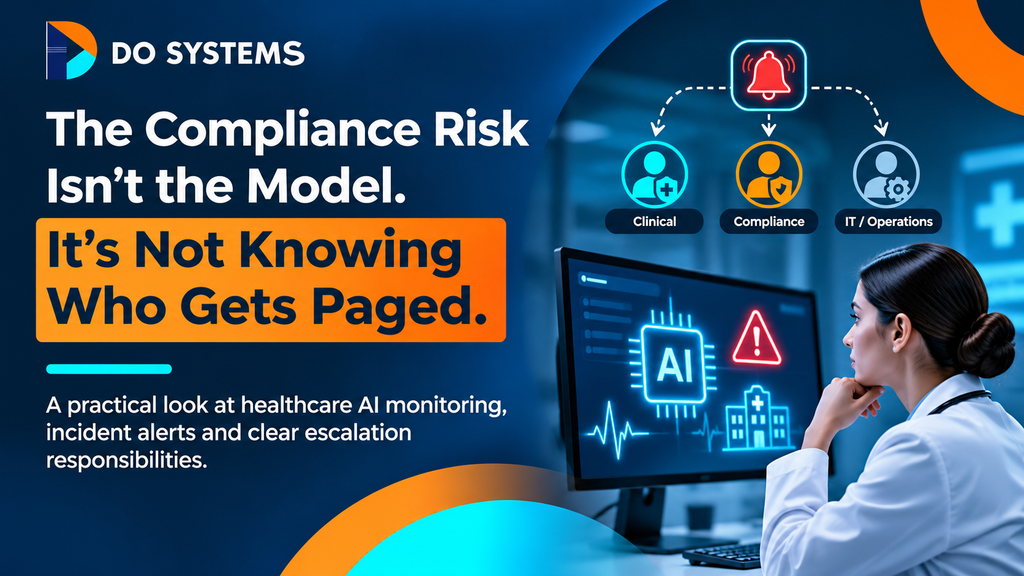
Define the alerting path. Who is paged when the threshold is crossed, through what channel, and within what window. A monitoring plan that says “we’ll know” without saying who gets told and how fast is not a monitoring plan.
Reject any pilot without a documented fallback. Staff need a workflow that does not depend on trusting the AI output, one they can switch to immediately if the alert fires or if something looks wrong before the alert fires.
The Fallback Workflow Is Easy to Leave Out of Sign-Off
A launch-day review can be thorough about what data goes in and silent on what staff do when the output can no longer be trusted. That gap matters most in clinical settings, where a pause in AI-assisted work cannot mean a pause in care.
A documented fallback is not a vague instruction to “use clinical judgment.” It is a written, specific process: the manual steps staff follow, the person they escalate to, and how long the fallback can run before someone above the on-call owner is notified. Write it down before approval, not during an incident. A team writing its fallback process in the middle of a live problem is writing it under the worst possible conditions.
Make Ownership Part of the Approval, Not an Afterthought
Checklist point six calls for a named accountable owner and an executive sponsor who can remove blockers. A compliance lead can read that point as covering who owns the launch. Extend it to who owns the model after launch, too. Ownership that ends at go-live is not ownership, it is a signature.
Require the on-call owner’s name, the drift threshold, the alerting path, and the fallback workflow in writing before you sign. A pilot missing any one of those is not ready for sign-off, even if the data access and hosting review look clean. A clean launch-day review with no monitoring plan behind it is an approval you will have to explain later if something goes wrong and no one was watching for it.
The AI Readiness Checklist walks through all ten points a pilot needs before you approve it, including where ownership has to sit and what security and compliance sign-off should actually cover. Download it and use it as the standard your next AI pilot has to meet before it gets your signature.
AI Readiness Checklist (10 points)
FAQ
What is AI model drift in a healthcare setting?
Drift is when a model’s output quality changes after launch compared to the performance it was approved on, for example when the data it sees in production shifts from what it was trained or validated against. It is a condition to plan for, not a fixed event with a known timeline.
Who should own AI model monitoring after go-live?
One named person, not a department. The owner needs dedicated time to monitor the model’s behavior, authority to trigger the fallback process, and a clear path to escalate to an executive sponsor if the issue isn’t resolved quickly.
What should a fallback workflow include if an AI tool’s output can’t be trusted?
A written, specific set of manual steps staff can follow without the AI, a named escalation contact, and a defined limit on how long the fallback can run before it gets flagged above the on-call owner. It should exist before approval, not get written during an incident.
Comments are closed