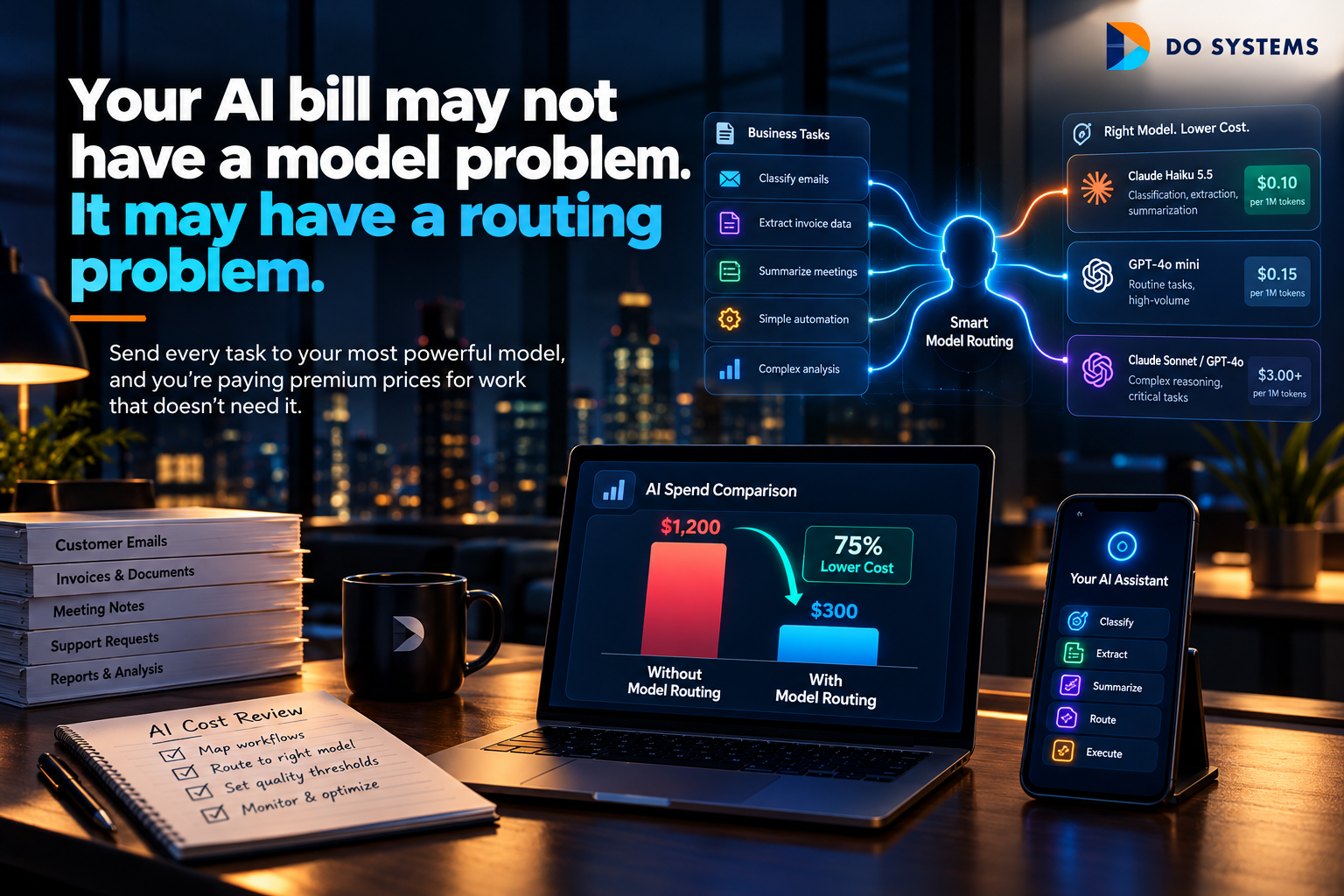
If your AI budget keeps rising while many workflows are still simple classification, summarization, extraction, or routing, the problem may not be AI volume; it may be model choice. For a CTO or CIO, the question is no longer simply which model is best, but which model fits each workload. Anthropic’s October 7, 2026 launch of Claude Haiku 5.5 is a useful proof point: the company positioned it for high-volume, cost-sensitive work and said it costs around 75% less to run on average than its previous Haiku generation.
The 75% headline matters less than the architecture behind it
Anthropic’s headline is attractive because AI buyers understand what a large percentage cost reduction could mean. But a model price cut by itself does not guarantee a lower company-wide AI bill. If your application sends every request to one premium model, a cheaper alternative only helps when your architecture can actually choose it.
Claude Haiku 5.5 is positioned for workloads such as summarization, classification, database queries, compaction, live customer support, browser use, and subagent work. Anthropic lists $0.10 per million input tokens and $0.50 per million output tokens for prompts up to 100K tokens. It also notes that Sonnet 5.5 cache-read pricing was cut in half, reducing the cost of most agentic work by around 20%.
Why mid-size companies feel model-routing mistakes quickly
A large enterprise may absorb inefficient model selection across many teams before finance notices. A mid-size company usually has fewer workflows, fewer platform owners, and less tolerance for infrastructure that quietly becomes expensive. One inefficient default can therefore become a meaningful part of the technology budget without looking like a separate line item.
The harder problem is visibility. AI spend can be distributed across APIs, SaaS subscriptions, embedded assistants, internal applications, and agent workflows. If nobody maps which task calls which model and why, the organization cannot tell whether higher spend is buying better outcomes or simply becoming the default.
Use a quality-to-cost routing diagnostic before changing providers
A practical AI model-routing diagnostic starts with four dimensions: task complexity, quality threshold, volume, and failure cost. A high-volume classification workflow with a low failure cost is a strong candidate for an efficient model. A contract decision or production code change with a high failure cost may justify a stronger model and additional human review.
The important part is to measure the workflow, not just benchmark the model. Define what a correct answer looks like, measure the current error or escalation rate, then test a lower-cost model on a representative sample. If the quality threshold holds, route that workload downward.
The hidden cost is usually the “one model for everything” habit
Using one model everywhere feels operationally clean. It gives developers one API, one prompt style, and one set of expectations. But that simplicity can become expensive as AI adoption expands across departments.
A better pattern is a model portfolio. The application decides which model tier to use based on the job. A lightweight model can classify an incoming request, a stronger model can reason through an ambiguous case, and a human can take over when the consequence of an error is high.
This is also where governance matters. Routing rules should be observable, versioned, and reviewable.
What this looks like in a real mid-size workflow
Consider an illustrative internal operations assistant that processes several thousand requests each month. Most requests may need categorization and a short summary; only a smaller share may require deeper reasoning or a decision recommendation.
A better architecture can classify the request first, route routine work to an efficient model, and escalate ambiguous or high-impact cases. The business then measures cost per completed workflow alongside accuracy and escalation rate.
The objective is not “use the cheapest model.” It is “buy the required level of intelligence only where the workflow needs it.”
Where this goes next
If you are reviewing AI spend and suspect that model choice is becoming an architectural issue, DoSystemsInc can help map the workflows, define routing thresholds, and design an integration plan. Comment ROUTING or reach out about an AI integration project or MOU.
Comments are closed