
Illustrative example, not a real client.
Picture a mid-size hospital’s operations team that ran a ChatGPT pilot for discharge summary drafting last year. This is a hypothetical, not something I worked on. Nurses liked it. It saved them some typing. Six months in, the CFO asked a plain question in a budget meeting: what did this save us, in hours or dollars? Nobody had a number. There was no baseline, no integration with the EHR (staff copied text back and forth by hand), and no sign-off on what patient data had passed through a public tool. The pilot quietly died. I’ve watched a version of this story play out at more than one organization, and it’s usually what pushes a COO toward a scoped pilot instead of another open-ended experiment.
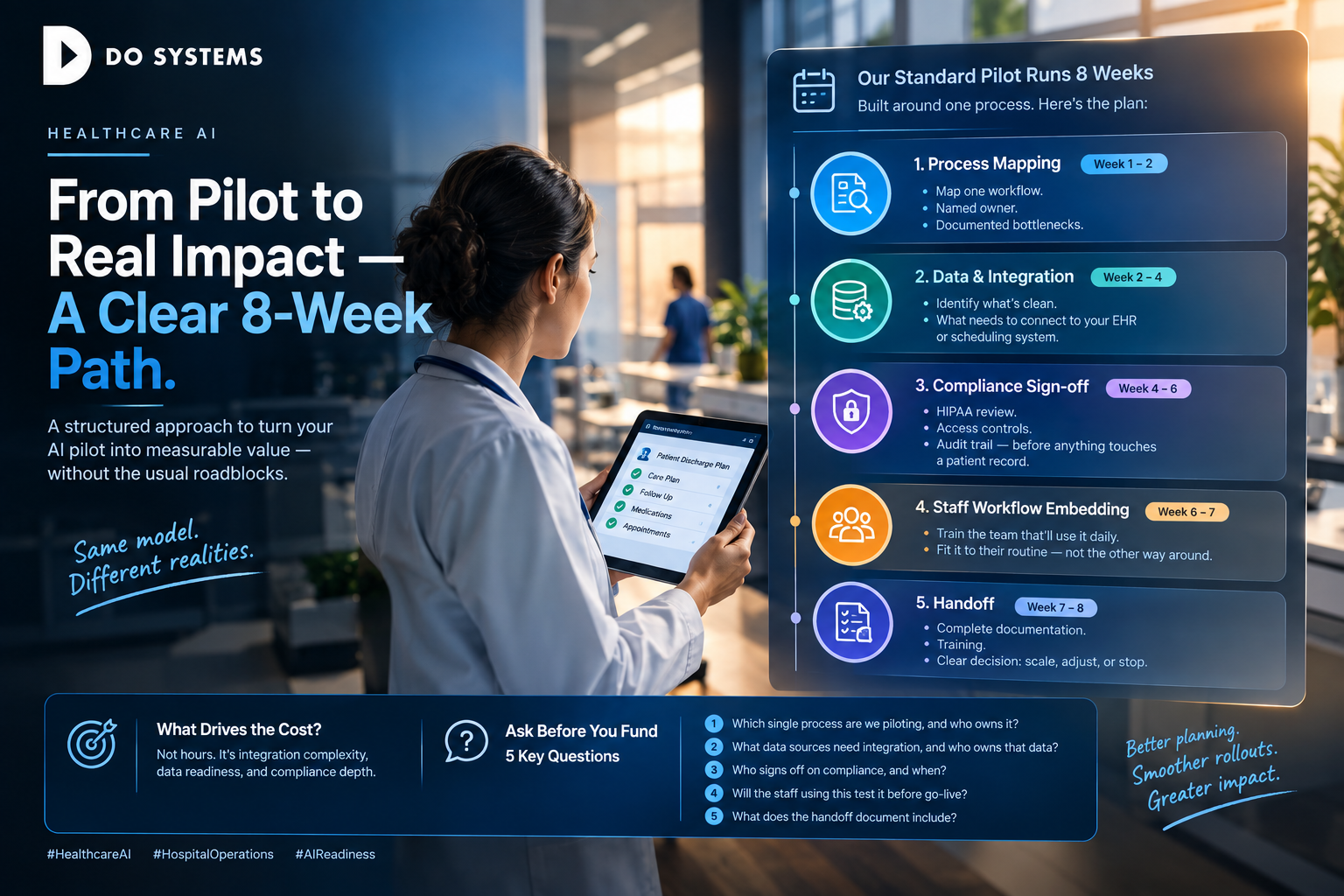
Weeks 1-2: scope, data and compliance sign-off
A real pilot starts narrow. One process, one owner, one metric you can measure today. For a hospital, that might be prior-authorization turnaround time, discharge documentation time, or scheduling no-show rate. Week one is spent naming that process, confirming who owns it, and pulling a baseline: current hours spent, current error rate, current cycle time.
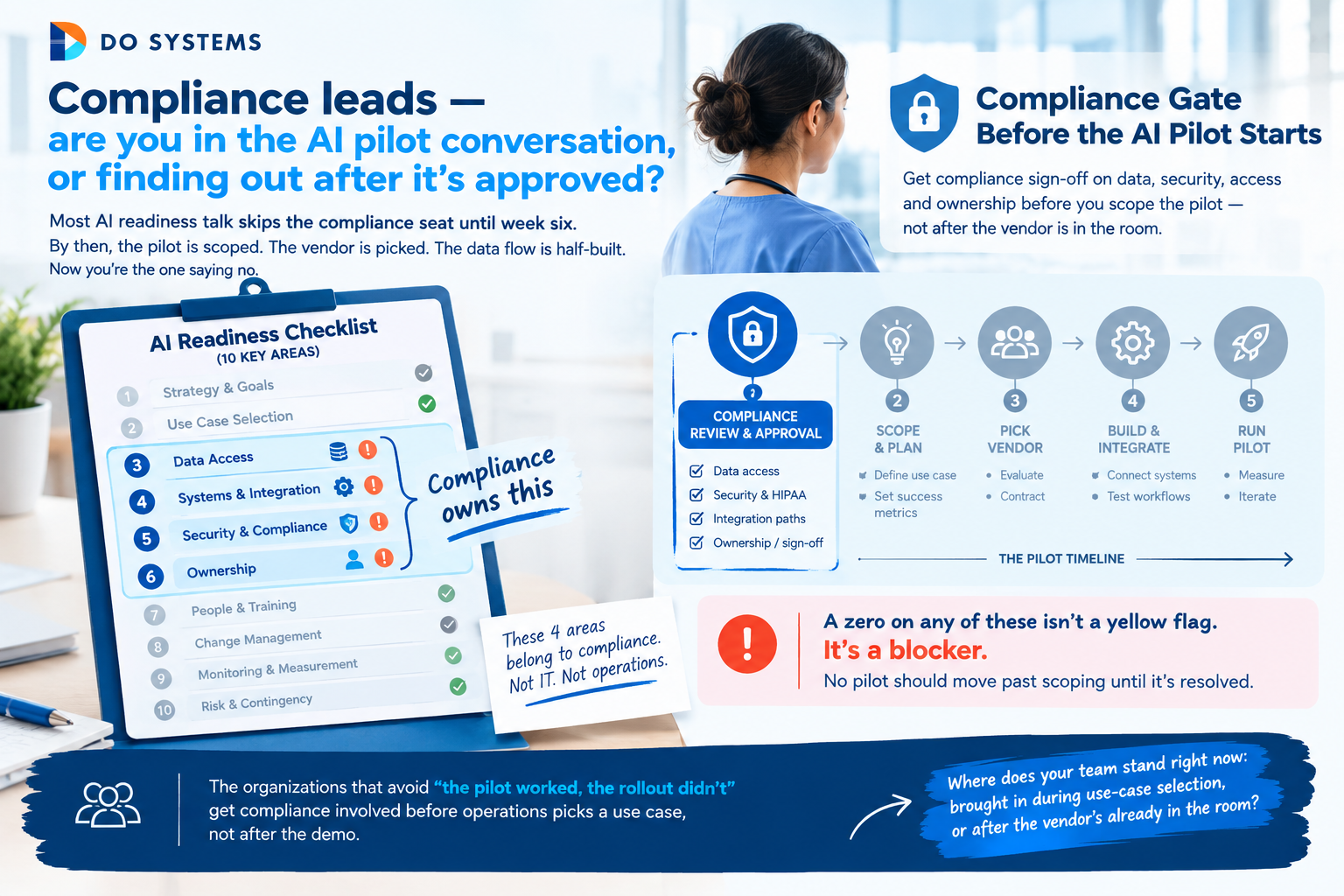
Week two is data and compliance. Where does the data live: the EHR, a scheduling system, spreadsheets? Who can grant access without a separate data project? What’s legally allowed to leave your environment, and does HIPAA or a business associate agreement constrain hosting or model access? I write this down before any building starts, not after. A pilot that skips this step is the one that stalls at go-live because compliance finds out too late.
Weeks 3-6: build, integrate, test with real workflow
This is where the work happens against the systems you actually named in week one, not a demo environment. If the output needs to land in the EHR or a ticketing system, that integration gets built and tested here, not promised for “phase two.” Frontline staff, the people who will actually use this, help define what changes in their day-to-day workflow. If nurses or schedulers weren’t in the room for this, adoption tends to fail later no matter how well the model performs.
By the end of week six, you’re testing against the pass/fail threshold you set in week one: a specific number, not a vibe. Did documentation time drop by a measurable amount? Did the error rate on prior-auth submissions fall? You already agreed what “pass” looks like, so there’s no argument about it now.
Weeks 7-8: pilot review and handoff
The last two weeks are review and decision, not more building. You compare the result to the baseline and the threshold from week one. Three outcomes are legitimate: scale it, fix a specific gap and retest, or stop and document why. What’s not legitimate is ending the pilot because “the demo looked good” with no metric behind it.
Handoff matters here too. Rollout is a separate funded phase with named owners, not an assumption baked into the pilot budget. In my experience, the most common reason a pilot works and then goes nowhere is this exact gap: the pilot was funded, the rollout wasn’t, and nobody planned for it.
Building the AI ROI Business Case Your CFO Will Sign Off On
A CFO doesn’t sign off on enthusiasm. They sign off on a number they can check later. That number needs three things: a named process, a baseline measured before the pilot starts, and a threshold agreed in advance for what counts as a pass. Without those three, there’s no honest AI ROI business case, only a story about how the demo felt.
What moves the actual cost of getting there, since no two pilots are priced the same:
– Integration complexity. One system versus three. A modern API versus a legacy system with no supported integration path. – Data readiness. Clean, accessible data versus data scattered across PDFs, inboxes and personal spreadsheets that needs cleanup first. – Compliance scope. How much HIPAA and data-classification work is needed before data can touch any AI tool. – Change management. Whether frontline staff need structured training and a feedback loop, or the workflow barely changes. – Build versus buy. Custom model work carries different cost drivers than configuring an existing platform against your data.
I can’t give you a number without seeing your specifics, and I’d distrust anyone who does before mapping your process.
Five questions to ask any vendor before you fund a pilot
1. What’s the one metric this pilot will be judged on, and who signs off on pass or fail? No specific number and no specific person means no finish line. 2. Which systems will this write back to, and is that integration in scope now or a “phase two”? A pilot that lives in a separate chat window staff must copy and paste from isn’t a real pilot. 3. Who owns compliance sign-off, and when does that happen? Before the pilot starts, not after data has already moved. 4. Who from operations is designing the workflow, not just IT? If frontline staff weren’t consulted, expect adoption problems later. 5. Is rollout funded separately, or does the estimate quietly assume the pilot becomes production automatically? Ask this before you sign anything.
What we map in the free strategy session
A pilot like this typically runs 6-8 weeks: roughly two weeks to scope the process, pull your baseline and clear compliance; four to build, integrate and test against real workflow; and two to review results and decide scale, fix, or stop. In the session, we map one high-value process in your operation: the metric, the data sources, the systems it needs to touch, and the compliance questions that need answers before anything gets built. What you walk away with is a scoped pilot plan and the beginning of an AI ROI business case, not a generic proposal.
If your last GenAI experiment left the CFO without a number to check, book the free 45-minute AI strategy session and leave with a scoped pilot plan instead.
Free 45-minute AI strategy session
FAQ
How long does a healthcare AI pilot usually take?
A scoped pilot typically runs 6-8 weeks: about two weeks for process scoping, data access and compliance sign-off, four weeks for build, integration and workflow testing, and two weeks for review and a scale/fix/stop decision.
What determines the cost of an AI pilot for a hospital or clinic?
Cost is driven by integration complexity, data readiness, how much compliance and data-classification work is needed, and how much change management staff require. It is not a flat rate; a scoped estimate comes from mapping your specific process.
How do we build an AI ROI business case for a hospital pilot?
Start with a named process, a single baseline metric measured before the pilot, and a pass/fail threshold agreed before you start. Without that baseline and threshold, there is no defensible before-and-after number to show the CFO.
Comments are closed