
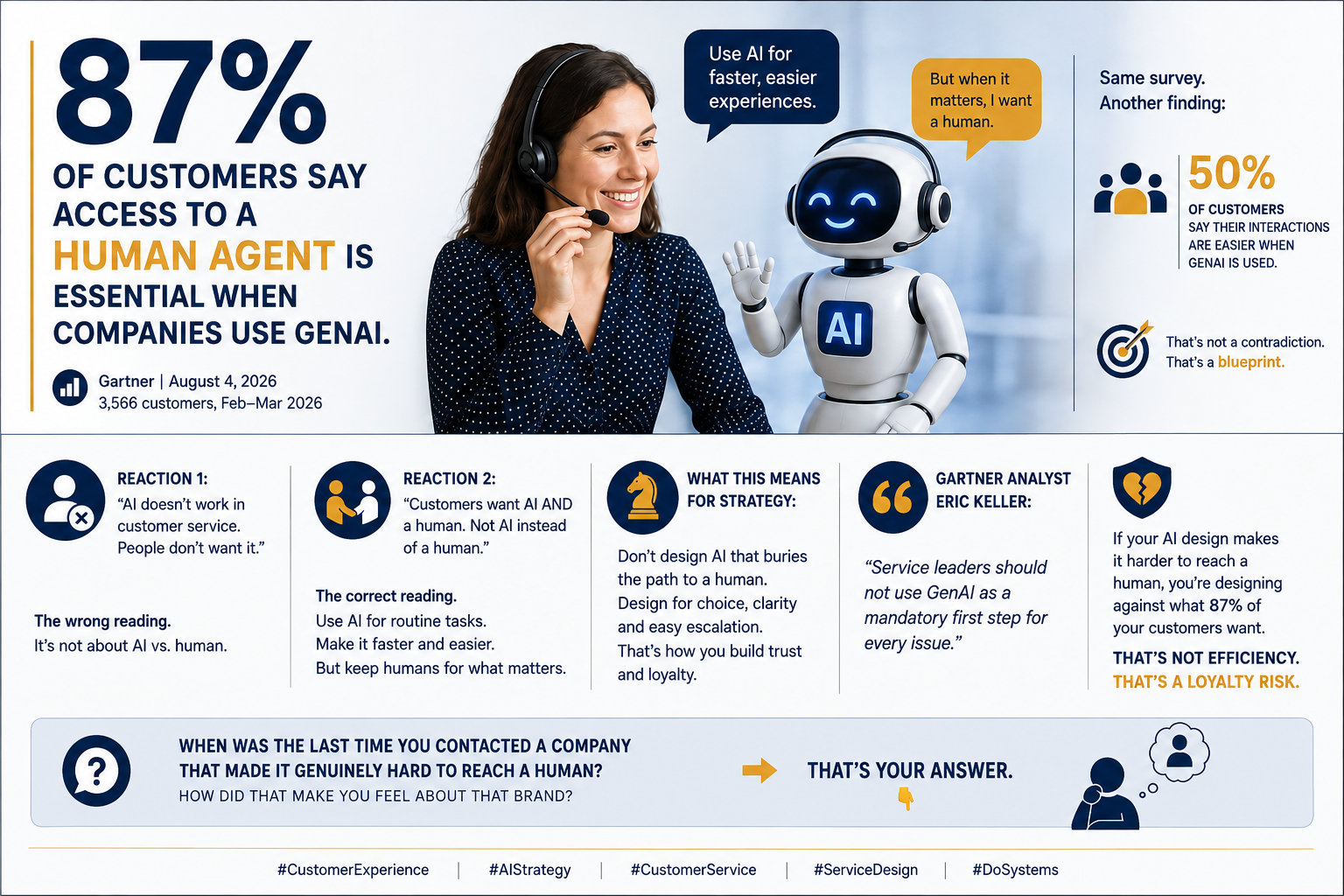
When a new Gartner study finds that 87% of customers say access to a human agent is essential when companies use GenAI, there are two ways to read it.
The first reading: AI in customer service doesn’t work. Customers don’t want it. Stick with your existing team.
The second reading – and the more accurate one – is that customers want both. And the businesses that understand this distinction are building very different service strategies from the ones chasing full automation.
What the Research Actually Shows
Gartner’s August 2026 findings come from the same survey of 3,566 B2B and B2C customers conducted in February and March 2026. Two numbers matter here:
87% of customers say access to a human agent is essential when companies use GenAI.
50% of customers say their interactions with companies are easier when GenAI is used.
These aren’t contradictory findings. They’re a blueprint. Customers are telling businesses: use AI to make things easier – but don’t take away the human when I need one.
The Mistake: Treating Human Agents as a Cost to Remove
The dominant business case for AI in customer service has been headcount reduction. Automate first contact, reduce inbound volume, reduce agent hours. The math is easy to model.
But this framing runs directly against what customers say they want. If 87% of customers consider human access essential in an AI-enabled service environment, then designing your service around AI-first mandatory contact isn’t a cost-reduction play – it’s a loyalty risk.
Gartner’s Eric Keller was specific about this: “Service leaders should not use GenAI as a mandatory first step for every issue.” That’s not a soft recommendation. It’s a warning about a service design pattern that large numbers of businesses are currently building.
What the Right Balance Looks Like
The 50% who say interactions are easier with AI aren’t wrong. There are real categories of customer interaction where AI genuinely improves the experience: checking an order status, updating account details, finding a policy, getting a quick answer to a standard question. These are high-volume, low-complexity queries where AI can deliver a faster, better result than a human queue.
The 87% who want human access aren’t wrong either. There are categories of interaction – complaints, complex queries, high-stakes purchases, emotionally charged situations – where the value of a human agent isn’t just resolution. It’s recognition. Customers want to feel heard, not processed.
The service strategy that works isn’t AI-first or human-first. It’s issue-type routing. AI handles what AI does well. Humans handle what humans do better. And critically – the path to a human is always clearly available, not buried.
For SMBs: This Is Your Competitive Advantage
Larger enterprises are often caught in the ROI pressure to automate as much as possible. As an SMB, your service model doesn’t need to scale the same way – which means you can make choices around human availability that larger businesses struggle to sustain.
The businesses that will build the most loyalty in the next few years aren’t the ones with the most automated service journeys. They’re the ones that use AI to handle high-volume routine contact efficiently, and invest the freed capacity into better human service for the moments that actually matter.
That’s not a technology decision. It’s a service philosophy – one that the data clearly supports.
#CustomerExperience hashtag#AIStrategy hashtag#CustomerService hashtag#AIProjects hashtag#SmallBusiness hashtag#ServiceDesign hashtag#DoSystems
Comments are closed