
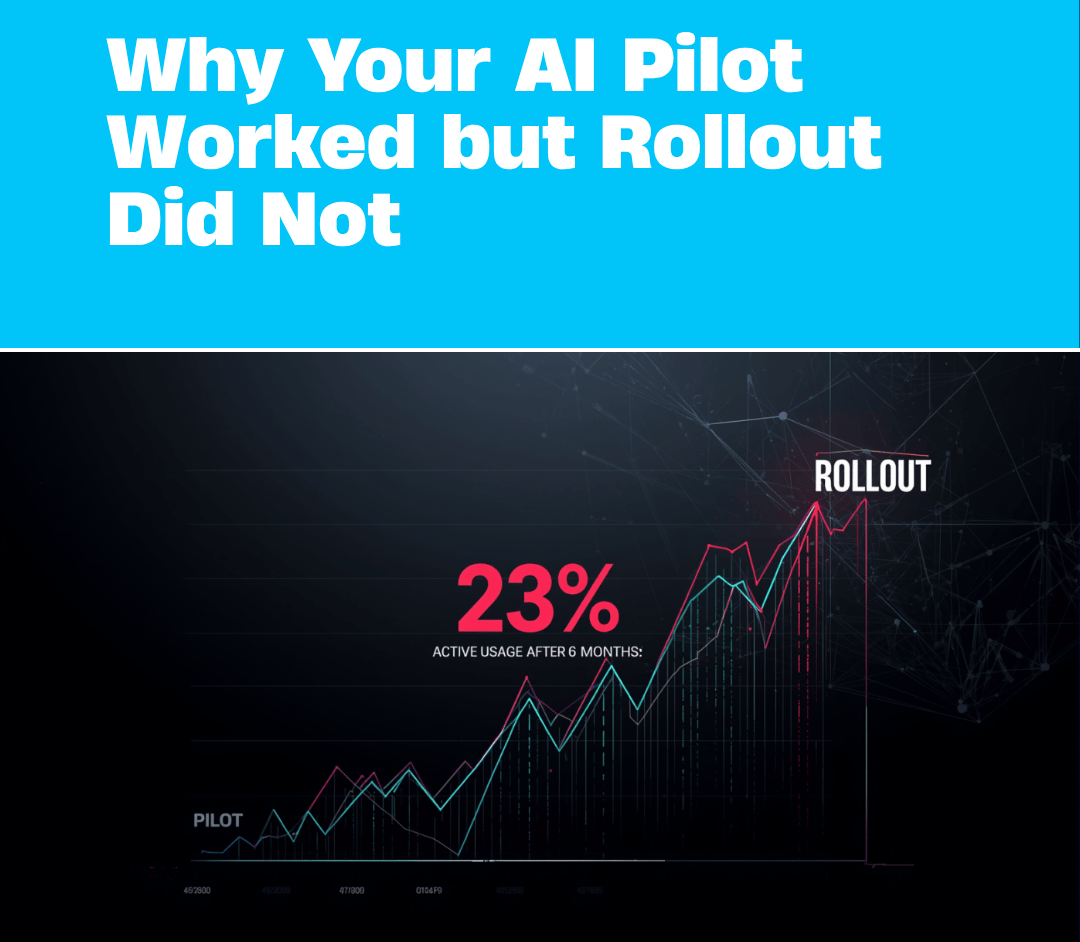
The pilot had gone well by every measure they tracked. Twelve users. Eight weeks. Accuracy above 90 percent. The team was enthusiastic. The steering committee approved the rollout.
Six months later the platform had 200 registered users and an active user rate of 23 percent. The output quality had dropped. Two of the original pilot team had quietly stopped using it. The business case that had been signed off was no longer being referenced.
The technology had not changed. But almost everything else had.
AI pilot failure at the rollout stage is one of the most consistent patterns in enterprise AI adoption, and it is consistently underestimated because pilots are specifically designed to succeed. Understanding why is the first step to building something that actually scales.
Why Pilots Are Structurally Set Up to Succeed
A well-run pilot controls for almost every variable that causes rollouts to fail. The users are selected – typically the most engaged, most technically comfortable people in the team. The data is curated – clean, well-labelled, representative of the use cases the system was designed for. The support is intensive – the development team is closely involved, issues are resolved quickly, feedback loops are short.
None of those conditions persist at scale. At rollout, you have all users, not selected ones. You have all data, not curated data. You have a support model, not a development team on call. And you have an organisation that has other priorities alongside this one.
This is not a failure of the technology. It is a failure to design for the conditions that actually exist at scale.
The Four Specific Things That Break
Data quality at volume: A model trained and tested on curated pilot data encounters the full range of real-world input variability at rollout. Edge cases the pilot never hit. Formats nobody anticipated. Inputs that were outside the training distribution. Accuracy drops, trust erodes, and users stop relying on the output.
Integration brittleness: Integrations that worked cleanly in the pilot environment hit unexpected behavior when connected to production systems at full load. The data flows that worked for twelve users do not always behave the same way for two hundred.
Change management gaps: In the pilot, the twelve users were briefed, trained, and supported directly. At rollout, that level of onboarding does not scale without deliberate investment. Users who receive a login and a quick-start guide and nothing else adopt at a fraction of the rate of users who were properly brought through the change.
Absence of feedback loops: During the pilot, every piece of incorrect output was captured, reviewed, and used to improve the model. At rollout, without a structured mechanism for capturing and acting on feedback, the model stops improving at the point when it needs to improve the most.
What Building for Production Actually Looks Like
The discipline that separates AI deployments that scale from those that stall is designing for production conditions from the start of the project – not after the pilot has passed.
This means testing against the full range of data variability, not just representative samples. It means integration testing under realistic load conditions. It means a change management plan that covers every user cohort, not just the pilot group. And it means a feedback and continuous improvement architecture that does not require the development team to be involved in every iteration.
It also means setting honest expectations. A pilot accuracy of 92 percent will likely come down when the system meets real-world data at scale. Building a business case that assumes pilot accuracy in production is a setup for disappointment. Building one that accounts for a realistic production range and a defined improvement trajectory is honest and durable.
The Question to Ask Before Your Pilot Starts
Before you approve a pilot, ask the team building it one question: how is this designed differently for production than it would be designed if we were only ever running twelve users?
If the answer is that it is not – that the pilot and the production system are essentially the same – then you are setting up a success metric that will not translate. A pilot is only valuable as a proof of concept if the concept being proved is the one you are going to build.
Where We Come In
At Do Systems, we build AI systems with production in mind from the first conversation. The pilot is a validation of the approach, not a separate exercise from the real deployment. If you have an AI pilot that worked and a rollout that has stalled, there is almost always a recoverable path – but it requires understanding specifically what broke. That diagnosis is where we start.
#AIDeployment #AIStrategy #AIConsulting #DoSystems #AIRollout #AIProjects #DigitalTransformation #TechLeadership

Comments are closed