
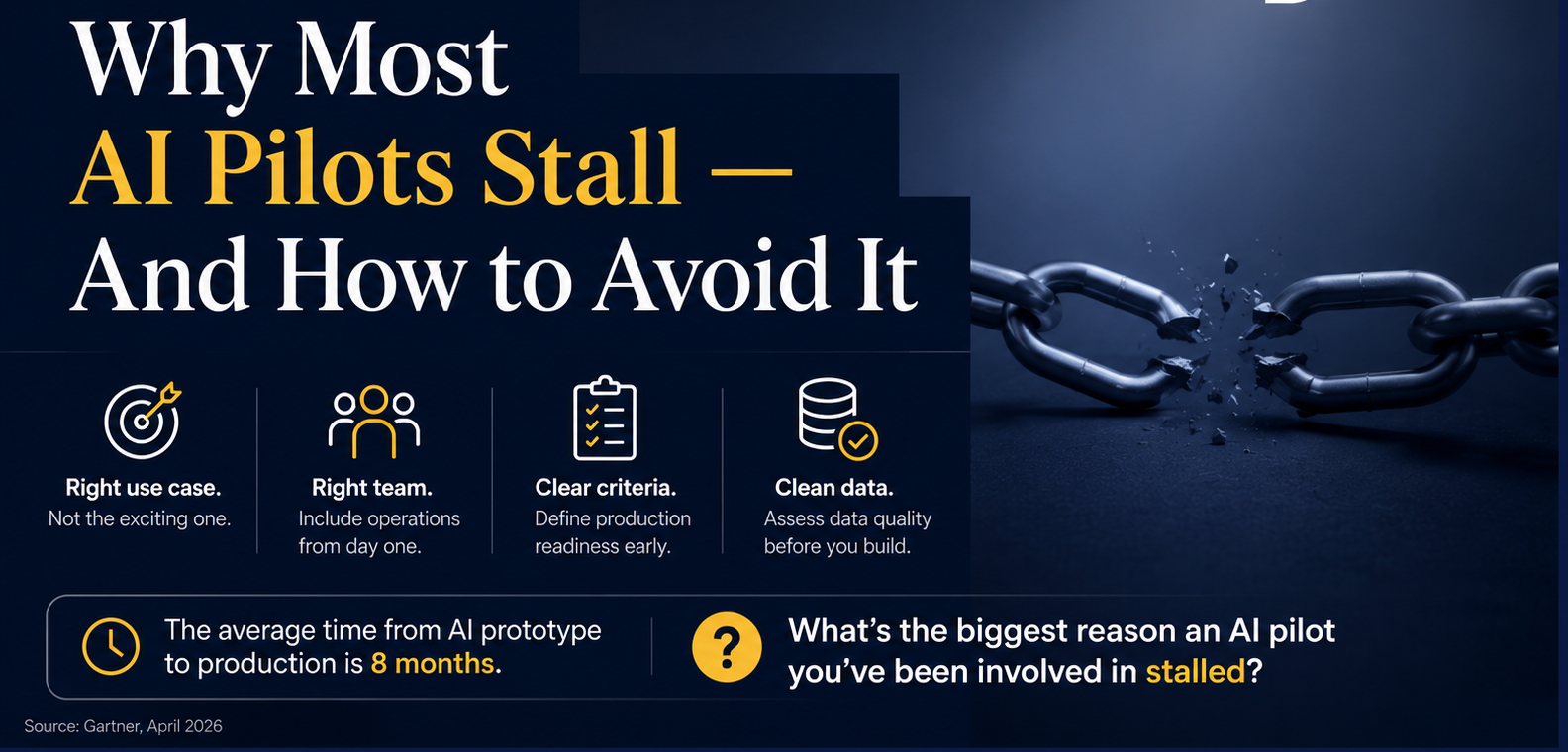
Gartner research published in April 2026 – drawn from a survey of 782 infrastructure and operations leaders in November and December 2025 – found that only 28% of AI use cases fully succeed and meet ROI expectations. A separate Gartner analysis found that only 48% of AI projects make it into production at all, with an average of eight months from prototype to production for those that do.
These are not figures about bad AI technology. They are figures about how AI projects are structured. The organisations hitting 28% are not building worse AI than the organisations hitting 70%. They are making a set of structural decisions early in the project that determine what happens after the demo.
This guide covers what those structural decisions are – and how to make them correctly from the start.
Why AI Pilots Stall
The same Gartner April 2026 research found that 57% of I&O leaders who reported at least one AI initiative failure said their teams expected too much, too fast. That is a useful framing: the problem is not ambition, it is misaligned expectation about what a pilot proves and what production requires.
Wrong Use Case for Piloting
The use cases selected for AI pilots are often chosen for the wrong reasons – they are the most exciting application, they have the most visible leadership support, or they address the largest problem. Excitement, sponsorship, and scale are not the same as pilot suitability.
A good pilot use case has three characteristics: the outcome is measurable in a short time window, the data required is accessible and clean, and the process being improved is stable enough that the AI has a consistent signal to learn from. Complex, cross-functional, data-sparse use cases are not good pilot candidates – regardless of their strategic importance. A narrow, well-defined problem with measurable outcomes is.
Building in Isolation from Operations
AI pilots that succeed in controlled conditions but fail in production almost always share the same structural problem: the pilot was built by a technical team working separately from the operational team that will use the system in production.
The operational team knows things the technical team does not. They know the edge cases the AI will encounter. They know which data fields are unreliable. They know how the process actually works versus how it is documented. Pilots built without this knowledge encounter operational reality for the first time in production – and the gap is rarely small.
The fix is structural: include operational representatives in the pilot team from day one, not as stakeholders who review outputs but as contributors to design.
Measuring the Wrong Things
Most AI pilot metrics measure demo-environment performance: accuracy on a test dataset, speed on a controlled workload, quality of outputs in a curated scenario. These metrics are necessary but not sufficient.
A pilot that reaches production readiness needs to demonstrate three additional things: performance on real production data, not just the test set; performance under the load and edge conditions of the actual operating environment; and adoption – whether the intended users trust and act on the AI’s outputs under real working conditions. A pilot that scores 96% on a test dataset but is routed around by 80% of users in production has not demonstrated production readiness.
The Five Decisions That Determine Whether a Pilot Scales
Decision one: scope the pilot narrowly enough to prove one thing clearly. A pilot that proves a narrow use case works at production data quality is more valuable than a broader pilot that produces ambiguous results across multiple use cases.
Decision two: define production readiness criteria before the pilot starts. Not ‘we will review results after 90 days’ but specific, measurable criteria – accuracy threshold on production data, latency under peak load, adoption rate among target users, error handling behaviour – that must be met for the project to proceed.
Decision three: treat data preparation as the first workstream, not a follow-on task. The most common cause of pilot-to-production failure is data quality problems discovered after development is underway. A data quality assessment at the start of the pilot is faster and cheaper than discovering the gap during integration.
Decision four: design human oversight from the start. How will users review AI outputs? What are the escalation conditions? Who owns decisions when the AI produces unexpected results? These are production design questions that must be answered in the pilot phase.
Decision five: include IT and security review as part of the pilot, not a gate at the end. AI projects that complete development and then encounter IT integration or security review requirements that were not factored into the design typically stall for months. Early involvement prevents this.
What Production-Ready Looks Like from Day One
The pilot phase should produce four outputs, not one. The first is a working model with performance on production data documented. The second is an integration design – how the AI connects to existing systems in production, with dependencies confirmed. The third is an operational runbook: how will the AI be monitored, what triggers a human review, what is the rollback procedure. The fourth is a training plan for the users who will operate the system in production.
A pilot that produces only a working model has completed approximately 40% of the work required to reach production. The remaining 60% is the work most organisations discover they have not done when they try to scale.
Frequently Asked Questions
How long should an AI pilot last?
A well-scoped AI pilot for a single business use case should run 60–90 days. Shorter than 60 days typically does not allow enough time to test on varied production data. Longer than 90 days often indicates scope creep or data preparation problems that should be addressed explicitly.
What percentage of AI pilots succeed?
Gartner research from April 2026 found that only 28% of AI projects in infrastructure and operations fully succeed and meet ROI expectations. Only 48% of AI projects overall reach production. The organisations with the highest success rates share a common characteristic: they defined production readiness criteria before the pilot started.
What is the most common reason AI pilots fail?
Poor data quality is the most frequently cited cause – Gartner estimates 60% of AI projects are abandoned due to inadequate data readiness. Misaligned expectations about what a pilot should prove are a close second.


Comments are closed