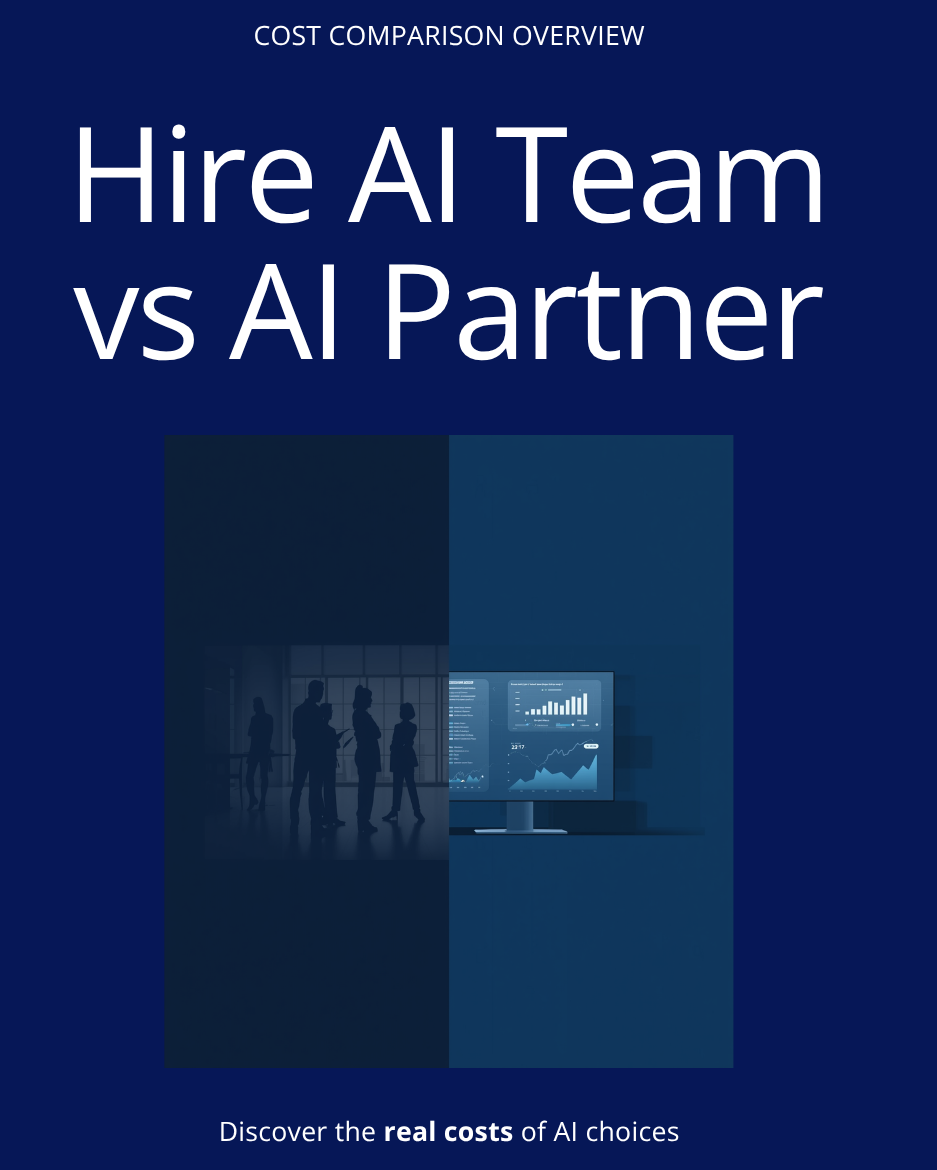
The question comes up in almost every AI strategy conversation I have with business owners. We want to move on AI. Should we hire for it or bring in a partner?
It sounds like a straightforward build-versus-buy question. It is not. It is a question about where you are in your AI journey, what you actually need right now, and what kind of capability you are trying to own long-term.
The honest answer is that most businesses should start with a partner. Not because internal teams are a bad idea – in the right circumstances they are the right answer – but because the circumstances under which an internal team makes more sense than a partner are more specific than most business owners realise.
The Real Cost of an Internal AI Team
The number that surprises most people: a minimum viable internal AI team – three to four people capable of building and deploying a production AI system – costs between $575,000 and $900,000 annually in fully loaded employment costs. That is before recruitment fees, onboarding time, and the months of ramp-up before the team produces anything in production.
Senior machine learning roles typically take 8–14 weeks to fill – and that is per hire. For a team of four, sequential hiring means you are looking at 9–15 months before you have a functioning unit – and that is assuming you can attract the talent at all, which in the current AI labour market is a significant assumption.
Compare that to the cost of an external AI consulting partner on a first project: typically $100,000–$200,000, with production output in weeks rather than months. The financial case for starting externally is clear for most businesses.
What an External AI Partner Actually Delivers
A credible AI consulting partner brings three things an internal hire cannot: immediate capability, cross-industry experience, and the ability to absorb project risk.
Immediate capability means the team that starts on your project has already built similar systems before. They have seen the failure modes. They know what the data problems typically look like. They have a methodology that has been tested and adjusted across multiple engagements. An internal hire – however talented – brings none of that context on day one.
Cross-industry experience means they have seen how AI performs in contexts your business has not operated in. That pattern library is often where the most valuable consulting insights come from – not what worked in your industry specifically, but what worked in an adjacent one that your team has never thought to look at.
Risk absorption means that if the first project does not deliver as expected, you have not committed $750,000 in annual salary to the outcome. You have learned something significant for $100,000–$200,000, and you can adjust the approach before scaling.
When Building an Internal Team Makes Sense
Internal AI capability becomes the right investment when AI is genuinely core to your competitive differentiation – not just operationally useful, but central to how your business creates value that competitors cannot easily replicate.
If the AI systems you are building involve deeply proprietary data or processes that you cannot share with an external party, internal ownership becomes necessary. If the volume and pace of AI development work is sufficient to justify a full team – multiple projects running simultaneously, continuous model improvement, a long roadmap – then the economics of internal employment eventually flip in its favour.
But these are specific conditions, not the default for most SMBs. Most businesses are not at the point where internal AI ownership makes financial or operational sense yet.
The Hybrid Model Most Mature Programmes Use
The approach that consistently produces the best outcomes for growing businesses is not a binary choice between partner and internal team. It is a sequenced hybrid: start with a consulting partner to get the first projects into production and learn what skills you actually need, then build internal capability gradually while the partner continues delivery, and transition to an internal-led model with external support for specialised needs over 12–18 months.
This path delivers fast production output – the thing most business owners actually need right now – while building permanent capability over time. It also means the internal team you eventually hire is joining a programme with proven processes and running systems, rather than starting from a blank page.
Where We Come In
DoSystems works with businesses as an AI consulting partner – building, deploying, and handing over AI systems that are in production, not in a slide deck. For clients who want to build internal capability over time, we structure engagements to transfer knowledge as we go. The goal is a business that can own its AI capability long-term. DoSystemsInc.com
Frequently Asked Questions
How much does it cost to build an internal AI team?
A minimum viable internal AI team of 3–4 people costs $575,000–$900,000 annually in fully loaded employment costs, plus 8–14 weeks of recruitment time per senior hire.
What does an AI consulting partner cost?
A first AI project with an external consulting partner typically costs $100,000–$200,000 and delivers production output in weeks – significantly faster and cheaper than building internal capability from scratch.
When should a business hire an internal AI team?
When AI is core to competitive differentiation rather than just operational efficiency, when proprietary data cannot be shared externally, and when the volume of AI work justifies the ongoing cost of a full team.
What is the hybrid AI model?
The hybrid model uses a consulting partner for initial project delivery while gradually building an internal team over 12–18 months. Most mature AI programmes use this approach because it delivers fast results while building permanent capability.
#AIConsulting #AIStrategy #AITeam #DoSystems #InHouseAI #AIOutsourcing #DigitalTransformation #BusinessAI

Comments are closed