Few topics generate more anxiety in organisations than AI and jobs. And few topics are more poorly served by the way they are typically discussed – either as a story of replacement and loss, or as a reassuring story of net job creation that underestimates the disruption involved in getting from here to there.
The research from WEF, McKinsey, and IBM tells a more nuanced story. AI will create more roles than it displaces – globally, by a significant margin. But the workers losing roles are not automatically the ones gaining them. And the skills required across almost all roles are changing faster than most workforce development programmes are designed to handle.
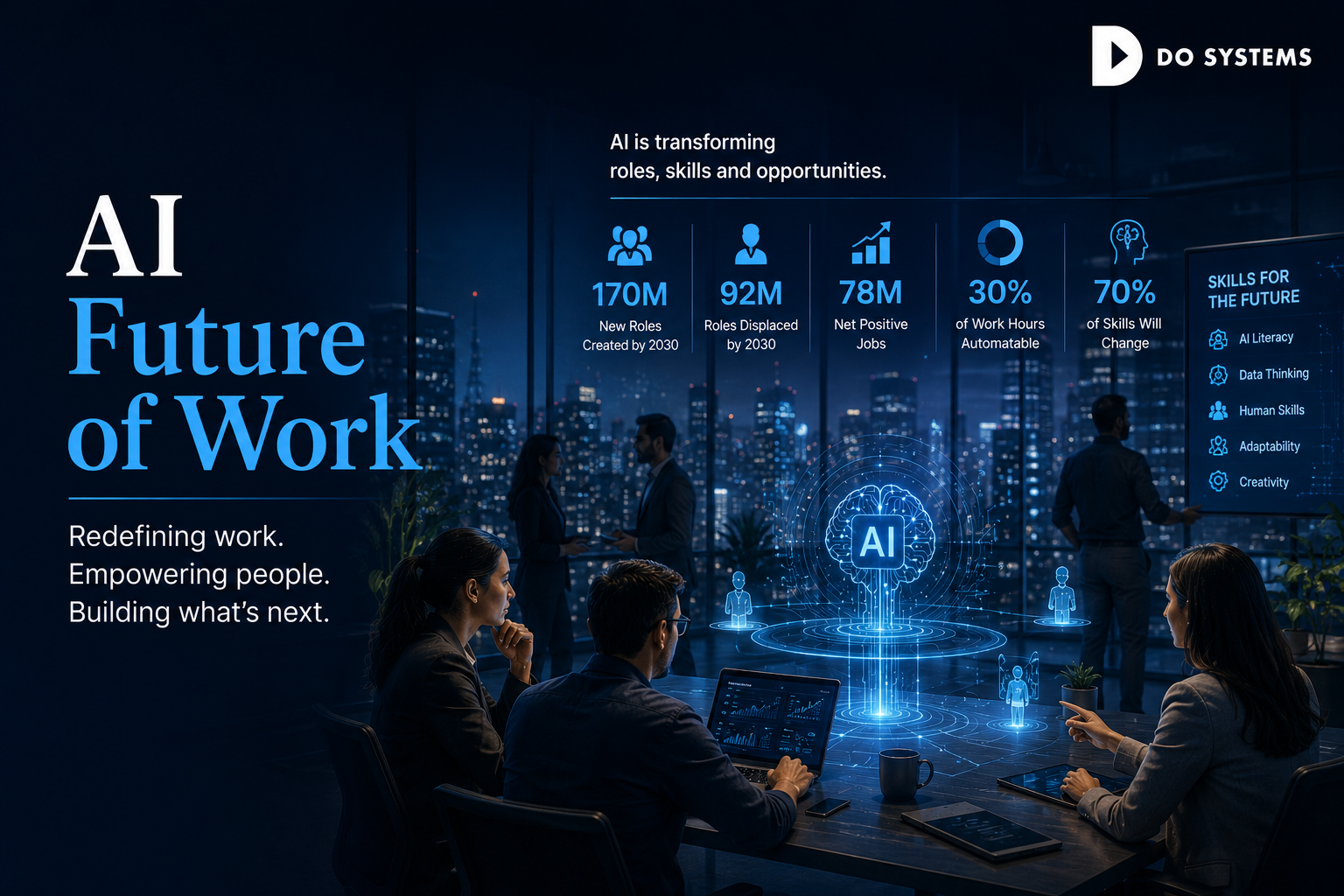
The WEF Future of Jobs Report 2025 – drawing on employer surveys covering more than 14 million workers across 55 economies – projects that AI and automation will create approximately 170 million new roles globally while displacing roughly 92 million by 2030. The net positive of 78 million jobs is real. But so is the transition challenge it contains.
For business leaders, the relevant question is not ‘will AI take jobs?’ It is: ‘which tasks in my organisation are AI-automatable, which roles need to change, and what does that mean for hiring, training, and workforce planning in the next 12 to 24 months?’
What the Research Actually Shows About Job Displacement
AI displaces tasks, not jobs – at least in most cases. The distinction matters enormously for workforce planning.
McKinsey’s analysis estimates that approximately 30% of all work hours could be automated by 2030. But those automated hours are not evenly distributed across roles. They are concentrated in specific task types: data collection and processing, predictable physical activities, and routine cognitive tasks with defined rules. Roles that are heavily concentrated in these task types face significant transformation. Roles that combine these tasks with judgement, relationship management, creative problem-solving, or physical dexterity are less exposed.
The WEF’s analysis found that the fastest-growing roles through 2030 are concentrated in technology (AI and machine learning specialists, data analysts, cybersecurity professionals), green economy (renewable energy engineers, environmental specialists), and care economy (healthcare workers, social services, education). The fastest-declining roles are concentrated in clerical and administrative functions, data entry, and manual production tasks.
For most SMBs, the practical implication is not mass redundancy – it is task reallocation. The accounts payable clerk who currently processes invoices manually will process fewer invoices manually as AI handles more of that workflow. The question is what they do with the time freed up, and whether that reallocation is designed deliberately or left to chance.
The Skills Gap Is the More Urgent Problem
The more pressing challenge from the research is not job elimination – it is skills transformation at a pace that current training programmes are not designed to match.
McKinsey estimates that 70% of job skills will need to change by 2030. The WEF finds that more than 50% of the global workforce needs some form of reskilling or upskilling within the next four years. These numbers reflect the pace of AI capability development – the tools available today are meaningfully different from those available two years ago, and the tools available two years from now will be meaningfully different again.
The skills in highest demand are not primarily technical. The WEF’s Future of Jobs research consistently identifies analytical thinking, creative thinking, and AI literacy as the top skills employers plan to prioritise through 2030. AI literacy – the ability to work productively alongside AI tools, understand their outputs, and identify where they need human judgement – is the skill that cuts across every function and every role level.
The organisations that are closing the skills gap most effectively are doing three things: making AI literacy training role-specific rather than generic (a finance professional needs to know how to use AI in finance workflows, not how AI works in general), building practical application into training (participants leave each session with something they can use before the next one), and treating skills development as an ongoing programme rather than a one-time event.
What Business Leaders Should Do Now
Four actions that the research consistently identifies as high-value for business leaders managing AI’s workforce impact.
Conduct a task-level audit, not a job-level assessment. The question ‘will AI affect this role?’ is less useful than ‘which tasks within this role are AI-automatable, and what proportion of total time do those tasks represent?’ A role where 20% of tasks are automatable is a redesign opportunity. A role where 70% of tasks are automatable requires a fundamentally different workforce plan.
Invest in AI literacy before you need it. Organisations that begin AI literacy training before deploying AI tools see faster adoption, fewer errors, and better employee sentiment than those that deploy first and train reactively. Training that happens after a tool is live is catching up. Training that happens before it is live is preparation.
Design for reallocation, not just efficiency. When AI automates tasks currently done by people, the default outcome is efficiency gains measured in time saved. The high-value outcome is reallocation – those freed hours directed to higher-value work. The difference between these two outcomes is deliberate design: defining what higher-value work looks like for each affected role and building the structures that make the reallocation happen.
Communicate transparently and early. The WEF research finds that uncertainty about AI’s impact on roles is a significant driver of workforce anxiety and resistance. Organisations that communicate clearly about what AI will and will not change, what training will be provided, and how role transitions will be managed see better adoption outcomes than those that deploy AI with minimal communication.
Frequently Asked Questions
Which jobs are most at risk from AI?
The roles most exposed to AI automation are those where the majority of tasks involve predictable, rule-based cognitive work: data entry, routine document processing, standard report generation, and repetitive customer transactions. Roles that combine these tasks with significant relationship management, novel problem-solving, or physical dexterity are less exposed. The WEF’s analysis identifies clerical and administrative roles, data entry workers, and manual production operators as facing the most significant transformation through 2030.
Will AI create enough new jobs to replace the ones it eliminates?
The WEF Future of Jobs Report 2025 projects a net positive of approximately 78 million jobs globally by 2030 (170 million created, 92 million displaced). However, the workers losing roles are not automatically the ones gaining new roles – the transition requires deliberate reskilling and reallocation. The net positive number is meaningful for macro-economic planning but should not be used to understate the transition challenge at the level of individual organisations and workers.
How should SMBs approach AI workforce planning?
Start with a task-level audit of your current workforce – identifying which tasks within each role are AI-automatable and what proportion of total working time they represent. Then design the reallocation: what higher-value work will be made possible by the time freed. Then build the AI literacy training needed to execute the transition. The organisations that manage AI’s workforce impact best treat it as a workforce design question, not just a technology deployment question.
How do you build AI literacy in a team?
The most effective AI literacy programmes share three characteristics: they are role-specific (each session connects to the actual work the participant does), they include practical application (participants leave with something they can use before the next session), and they run as a programme rather than an event (weekly or fortnightly sessions over 6-8 weeks outperform a one-day event). AI literacy is a practice, not a certificate.
Comments are closed