
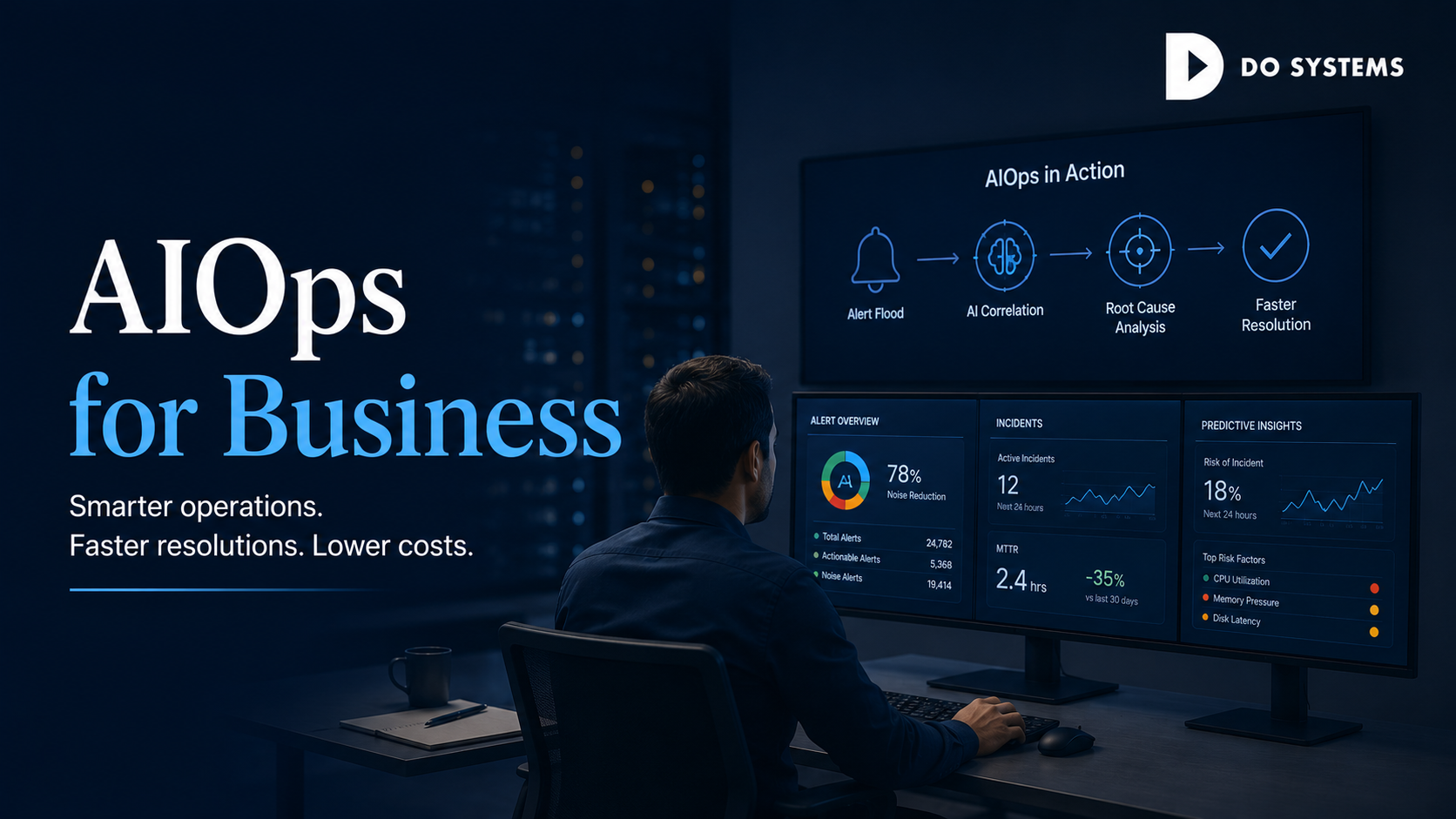
The average enterprise IT operations team receives thousands of alerts per day. Studies consistently find that 50-70% of those alerts are duplicates, noise, or related to the same underlying incident. The team spends significant time triaging alerts rather than resolving the problems that generate them.
AIOps Artificial Intelligence for IT Operations addresses this at the data layer, not the headcount layer. Rather than adding staff to process more alerts, AIOps applies machine learning to correlate events, suppress duplicates, identify root cause patterns, and surface signal from noise.
Gartner’s April 2026 analysis found that 80% of CEOs say AI will force operational capability overhauls in their organisations. In IT operations specifically, Gartner projects 70% of enterprises will deploy agentic AI for IT infrastructure operations by 2029, up from less than 5% today.
This guide explains what AIOps actually does operationally, where it delivers clear value, what you need in place before it works, and how to evaluate vendors without being misled by feature lists.
The Operational Problems AIOps Solves
AIOps is most valuable in three specific operational contexts. If your team does not have these problems, AIOps is not yet the right investment.
Alert fatigue at scale. When monitoring generates more alerts than the team can meaningfully review, important signals get missed in the noise. AIOps uses event correlation and pattern recognition to group related alerts, suppress known noise patterns, and surface alerts that require human attention. Organisations that implement alert correlation consistently report 50-80% reductions in actionable alert volume.
Slow mean time to resolution (MTTR). When incidents take hours to diagnose because root cause requires correlating events across multiple systems, AIOps reduces diagnostic time significantly. By analysing historical incident data and current event patterns, AIOps surfaces probable root causes alongside the incident.
Reactive rather than predictive operations. Traditional monitoring tells you when something has already failed. AIOps can identify patterns that historically precede failures — CPU utilisation trajectories, memory leak patterns, network latency trends — and alert before service impact occurs. This shift from reactive to predictive is the highest-value AIOps outcome, but it requires the most data history to achieve.
Four Core AIOps Use Cases
Event correlation and noise reduction. The most widely adopted AIOps capability. ML models learn which alert patterns are meaningful, which are duplicates, and which are correlated — grouping related alerts into single incidents and suppressing low-signal noise. This is the fastest-payback AIOps use case for most IT teams.
Anomaly detection and capacity management. AIOps continuously monitors performance metrics against learned baselines and flags deviations. This is particularly valuable for capacity planning — identifying infrastructure components approaching limits before they create performance degradation.
Automated root cause analysis. When an incident occurs, AIOps analyses the event timeline, service dependencies, and historical resolution patterns to suggest probable root causes. It does not replace experienced engineers — it gives them a starting hypothesis that accelerates diagnosis.
Change impact analysis. AIOps analyses the relationship between infrastructure changes (deployments, patches, configuration changes) and subsequent incidents — surfacing which changes are most correlated with instability. Particularly valuable for organisations with frequent release cycles.
What You Need Before AIOps Works
AIOps platforms require infrastructure data maturity that many SMBs underestimate. Three prerequisites determine whether an AIOps implementation delivers value or becomes a data quality project.
Centralised, consistent monitoring data. AIOps needs event data from across your infrastructure in a single accessible stream. If your monitoring is fragmented — different tools for network, servers, applications, cloud — with no centralised event store, AIOps has nothing consistent to analyse. Infrastructure monitoring consolidation typically precedes successful AIOps deployment.
Sufficient historical incident data. AIOps platforms typically require 6-12 months of historical incident and event data to build reliable correlation and root cause models. Deploying AIOps on a system with limited history produces generic results until sufficient data accumulates.
A Gartner survey of I&O leaders (May through July 2025) found that 54% are adopting AI to cut costs, but 50% cite budget constraints and 48% cite integration difficulties as their primary challenges. Both obstacles are most acute when monitoring and data foundations are not yet in place before AIOps deployment begins.
Process documentation for known incident patterns. AIOps learns fastest when human knowledge about known incident patterns, resolution procedures, and false-positive rules is codified at the start. Organisations that document their top 20 incident types before deployment see faster time-to-value than those that rely entirely on the ML model to learn from scratch.
How to Evaluate AIOps Vendors
What monitoring sources do you natively integrate with, and what are the integration requirements for our stack? Native integration with your current tools significantly reduces deployment time and complexity.
How does your event correlation model work — is it rule-based, ML-based, or hybrid? Rule-based correlation is faster to deploy but less adaptive. ML-based requires more data but improves over time. Understanding the model type tells you what to expect in the first 90 days versus 12 months.
What does your alert volume reduction look like for customers with an event volume similar to ours? Request documented metrics from reference customers with comparable infrastructure complexity — not headline numbers from the vendor’s top-performing deployments.
How is root cause suggestion validated, and how do engineers provide feedback to improve it? The feedback loop between engineer-confirmed root cause and the model’s suggestion is the primary mechanism by which AIOps improves.
What are the data retention and sovereignty requirements for our event data? AIOps platforms process infrastructure event data at high volume. Data residency, retention period, and security classification are procurement considerations that should be confirmed before contract.
Frequently Asked Questions
Is AIOps only for large enterprises?
AIOps originated in large enterprise environments, but cloud-native platforms now offer SMB-tier pricing appropriate for teams managing hundreds rather than thousands of infrastructure components. The key threshold is not size — it is alert volume. If your team is spending meaningful time on alert triage rather than incident resolution, AIOps delivers value regardless of company size.
How is AIOps different from traditional IT monitoring?
Traditional monitoring generates alerts when thresholds are breached — it detects that something is wrong. AIOps adds a layer of intelligence: correlating which alerts are related, identifying probable root causes, predicting problems before they cause alerts, and learning which patterns are meaningful signals versus noise.
How long does AIOps take to show results?
Event correlation and noise reduction typically shows results within 30-60 days of deployment. Root cause analysis and anomaly detection improve more gradually, typically reaching reliable performance after 3-6 months of operational data. Predictive failure detection requires the most history and typically matures over 6-12 months.
What is the cost of AIOps for an SMB?
Cloud-based AIOps platforms for SMB environments typically range from $1,000-$5,000 per month depending on monitored nodes, event volume, and integration complexity. Some observability and ITSM platforms include AIOps capabilities in broader platform subscriptions.

Comments are closed