
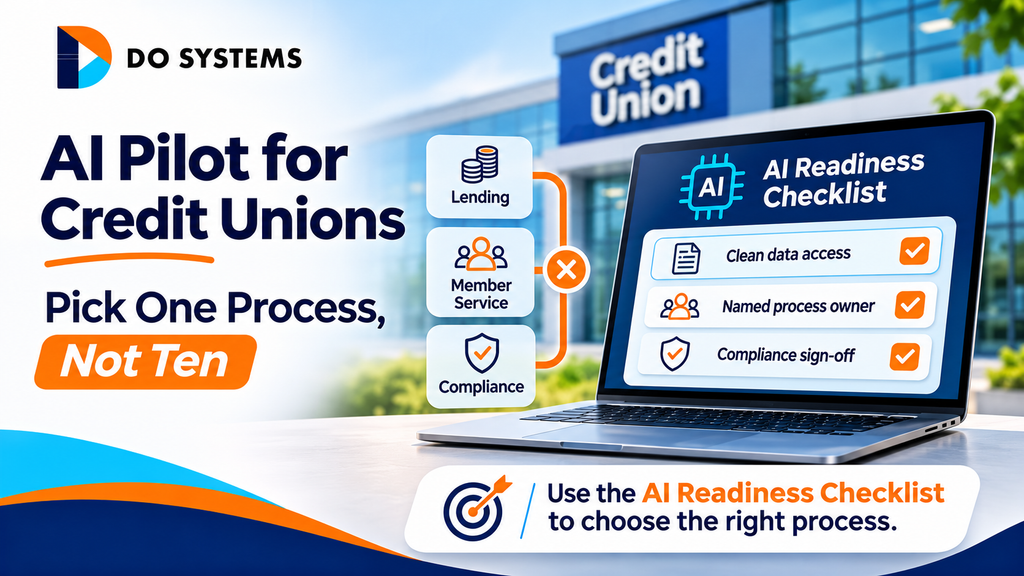
Quick answer: An AI pilot for credit unions should start with one back-office process: one with clean data access, a named owner and compliance sign-off already possible. Use the AI Readiness Checklist to score it. A pilot that tries to cover lending, member service and compliance at once is unlikely to ship.
Three departments, one AI pilot, little chance it ships.
That is what can happen when a credit union’s leadership decides to “do AI” across lending, member service and compliance in the same initiative. Each department has its own process owner, its own data quirks and its own compliance exposure. A pilot scoped to satisfy all three does not move faster because three departments want it. It moves into committee. A committee reviews pilots. It does not run them.
Pick one process. Use a checklist, not a vision statement, to pick it. A focused AI pilot for credit unions is easier to assess because the work, ownership and success measure can be stated clearly.
Table of Contents
Why Fragmented Data Kills an AI Pilot for Credit Unions
A credit union’s core banking system may not be set up to hand data to three workflows at once. Lending data may sit in one format, member service interactions in a CRM or call log, and compliance documentation wherever the last exam cycle left it. A pilot that spans all three inherits all three data problems before a single model runs anything.
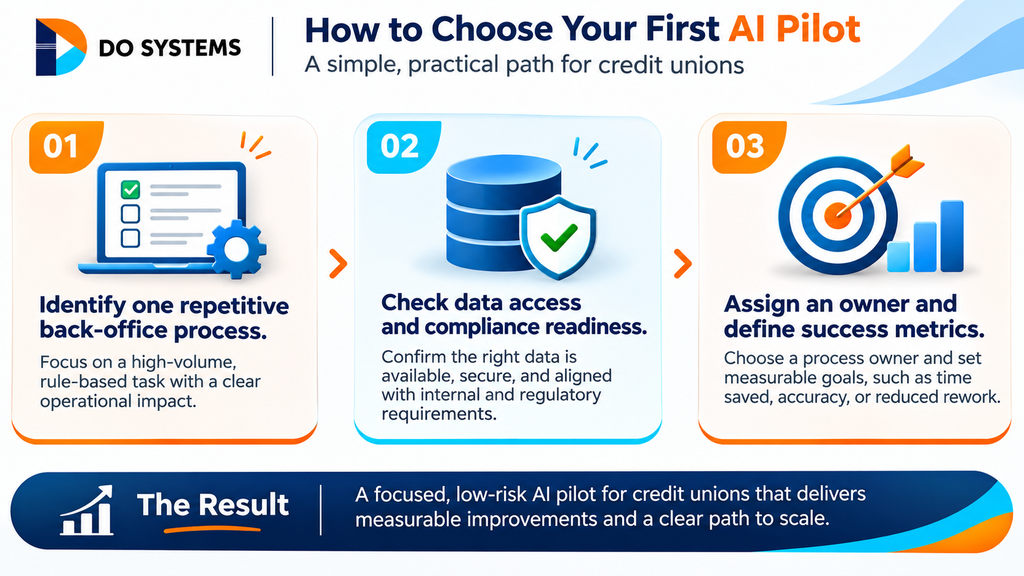
For an AI pilot for credit unions, name one process instead. A repetitive, high-volume process with clear inputs and outputs, owned by a named manager, is checklist item two for a reason: a use case that needs three departments to agree before it starts is a red flag, not a scope. A list of fifteen ideas is not a pilot plan. One process is.
For an AI pilot for credit unions, a smaller scope also makes it easier to check which data is available, which systems are involved and who can approve access. That information should be known before anyone commits to a build.
Run the Checklist as a Filter, Not a Formality
When evaluating an AI pilot for credit unions, the AI Readiness Checklist scores ten points, zero to two each, for a total out of twenty. Seventeen to twenty means ready to pilot, twelve to sixteen is nearly ready, six to eleven means prepare first, and zero to five is not yet. A zero on data access, security and compliance, or ownership blocks a pilot on its own. For a back-office pick, start with data access, item three.
Score every candidate process against data access before anything else: can the team pull the data this process needs within a week, without a data project first? A team that already knows where the data lives, who owns it, and that it is reasonably complete and current has a real candidate. A team relying on data in PDFs, inboxes and personal spreadsheets does not, no matter how valuable the process looks on paper.
An AI pilot for credit unions should pass that practical data test before moving to model selection. If staff cannot reliably retrieve the inputs, changing the model will not remove that bottleneck.
Loan document intake and exception handling may score well on this filter, because the inputs are structured documents and the outputs are a small, defined set of actions. That is a reason to look there first, not a guarantee any single credit union’s version of that process is ready.
Security and Compliance Sign-Off Comes Before Scope, Not After
Item five is a blocker on its own, and it stays a blocker until it is cleared. Data classification has to be done for the specific process before member data leaves the core system. Hosting and model-access rules need to be agreed in writing, not assumed. A team that already pastes account numbers into a public chat tool is not a sign the risk is low; it is the reason this step cannot wait.
An AI pilot for credit unions must have a clear answer to where sensitive data goes, who can access it and which approvals are required. Those answers affect the choice of workflow as much as they affect the technology.
When selecting an AI pilot for credit unions, reject any scope where security and compliance sign-off is scheduled after the build starts. Ask for it before the process is selected, not after the vendor is selected. A compliance lead owns item five directly and shares ownership of items three and four with IT, because data access and systems integration both touch what compliance has to approve before anything moves.
An AI pilot for credit unions should follow established risk management and regulatory compliance practices. The National Credit Union Administration (NCUA) provides guidance on AI implementation, risk management, and third-party vendor oversight. Credit unions should review these considerations before deploying AI-powered workflows involving sensitive member information.
Build, Buy or Partner Looks Different for a Regulated Back Office
Item ten asks for an honest view of internal skills, maintenance load after launch, and time-to-value for build, buy and partner options. In a regulated back office, “we can build it” carries a cost a generic software project does not: whoever builds it also owns the compliance burden of every update, every model change and every new data connection for as long as the process runs.
For an AI pilot for credit unions, the build-versus-buy discussion should include how the workflow will be reviewed after deployment, not only how quickly a demonstration can be produced. A viable pilot needs a long-term owner.
Before approving an AI pilot for credit unions, count who will run, monitor and fix the pilot in month six before deciding to build it in-house. A small internal team that can stand up a workflow in a sprint may not have the bandwidth to re-certify it after the next exam cycle. That is not a reason to default to buying either. It is a reason to score the option honestly instead of defaulting to whichever answer feels safer today.
What Picking One Process Actually Looks Like
State the business case in one sentence with a number attached: one named process, one metric, and a baseline measured today. “We want to use AI in lending” is not a business case. “Exception handling in loan document intake takes a measurable number of hours per week and carries a measurable error rate” is.
An AI pilot for credit unions becomes more measurable when the team records that baseline before any workflow changes. Then the review can compare the pilot against the original process rather than against a promising demo.
For an AI pilot for credit unions, name one accountable business owner and one technical counterpart. Define pass/fail before the pilot starts: a target metric, a minimum threshold, a review date, and what happens if it misses. Fund the pilot and the rollout together. A pilot funded without rollout funding is how a pilot works in testing and then goes nowhere.
Start by comparing two or three potential back-office workflows. For each process, document the weekly transaction volume, average handling time, frequency of errors, and availability of supporting data. This makes an AI pilot for credit unions easier to evaluate based on measurable operational needs rather than departmental preferences. A process with accessible data, clear ownership, and a manageable number of exceptions may be a stronger starting point than a larger initiative involving multiple teams.
During implementation, establish a clear human review process for AI-generated outputs that require additional verification. Track processing time, correction rates, and the percentage of cases that still require manual intervention. These measurements help decision-makers determine whether an AI pilot for credit unions genuinely reduces operational friction or simply shifts work between departments.
Before expanding automation, review the results against the original success criteria. Confirm that the process remains compliant, the responsible team can monitor performance, and the workflow delivers consistent improvements.
None of this happens inside an AI pilot for credit unions that tries to cover three departments at once. It happens inside a pilot scoped to one process, filtered through all ten points, with the blockers cleared before the build starts.
A Small Pilot Scorecard Before You Begin
To keep the choice practical, compare each candidate workflow against the same five questions. How many cases pass through it each week? How much time does each case take today? What share requires a correction or escalation? Can staff retrieve the data safely without manually stitching together several sources? And who has authority to approve a change to the process?
For an AI pilot for credit unions, document these answers before speaking with a vendor. The baseline does not need to be perfect; it does need to be traceable to real operational records. If a number is unknown, assign someone to collect it rather than treating a guess as evidence.
Next, define a narrow test group, a review schedule, and a human fallback when an output is incomplete or incorrect. Ask compliance and IT to approve the exact data fields, access permissions, and audit trail before testing begins. The pilot should make exceptions visible, not hide them behind an automated decision.
At the end of the trial, compare results against the baseline and decide whether to improve, expand, or stop. This keeps an AI pilot for credit unions accountable to measurable process outcomes, not a polished demonstration.
Score Your AI Pilot for Credit Unions Before You Commit
Run your own back-office candidates through the same ten points before you scope anything. The AI Readiness Checklist gives you the questions, the scoring bands and the red flags to score lending, member service and compliance processes side by side, so the process you pick is the one the data, the compliance sign-off and a named owner actually support.
Use that comparison to decide which candidate can be piloted responsibly now and which one needs data cleanup, clearer ownership or earlier compliance review. A well-scoped AI pilot for credit unions is a decision about operational readiness first and technology second.
AI Readiness Checklist (10 points)
FAQ
What is the first AI pilot a credit union back office should run?
The one that scores highest on the AI Readiness Checklist, not the one leadership is most excited about. Look for a repetitive, high-volume process with a named owner, data the team can pull within a week, and a path to compliance sign-off before the build starts. Loan document intake and exception handling may fit this profile. The right AI pilot for credit unions is the one that can meet those requirements in the credit union’s actual environment.
Why does compliance sign-off have to happen before the pilot is scoped, not after?
Security and compliance is a blocker on its own in the AI Readiness Checklist. Data classification, hosting rules and model-access limits have to be agreed in writing before any member data leaves the core banking system. Scoping a pilot first and seeking sign-off later means rebuilding the scope once compliance pushes back. Early sign-off helps keep an AI pilot for credit unions aligned with what IT and compliance can support.
Should a credit union build its own AI workflow automation or buy a solution?
Score build, buy and partner honestly for each process instead of defaulting to either. Count internal skills, the maintenance load after launch, and who will run, monitor and fix the pilot in month six. A regulated back office carries ongoing compliance work with every update, which changes the math compared to a non-regulated workflow. For an AI pilot for credit unions, the best option is the one the team can maintain and govern after launch.
Comments are closed