
Quick Answer: What is AI incident response for business operations?
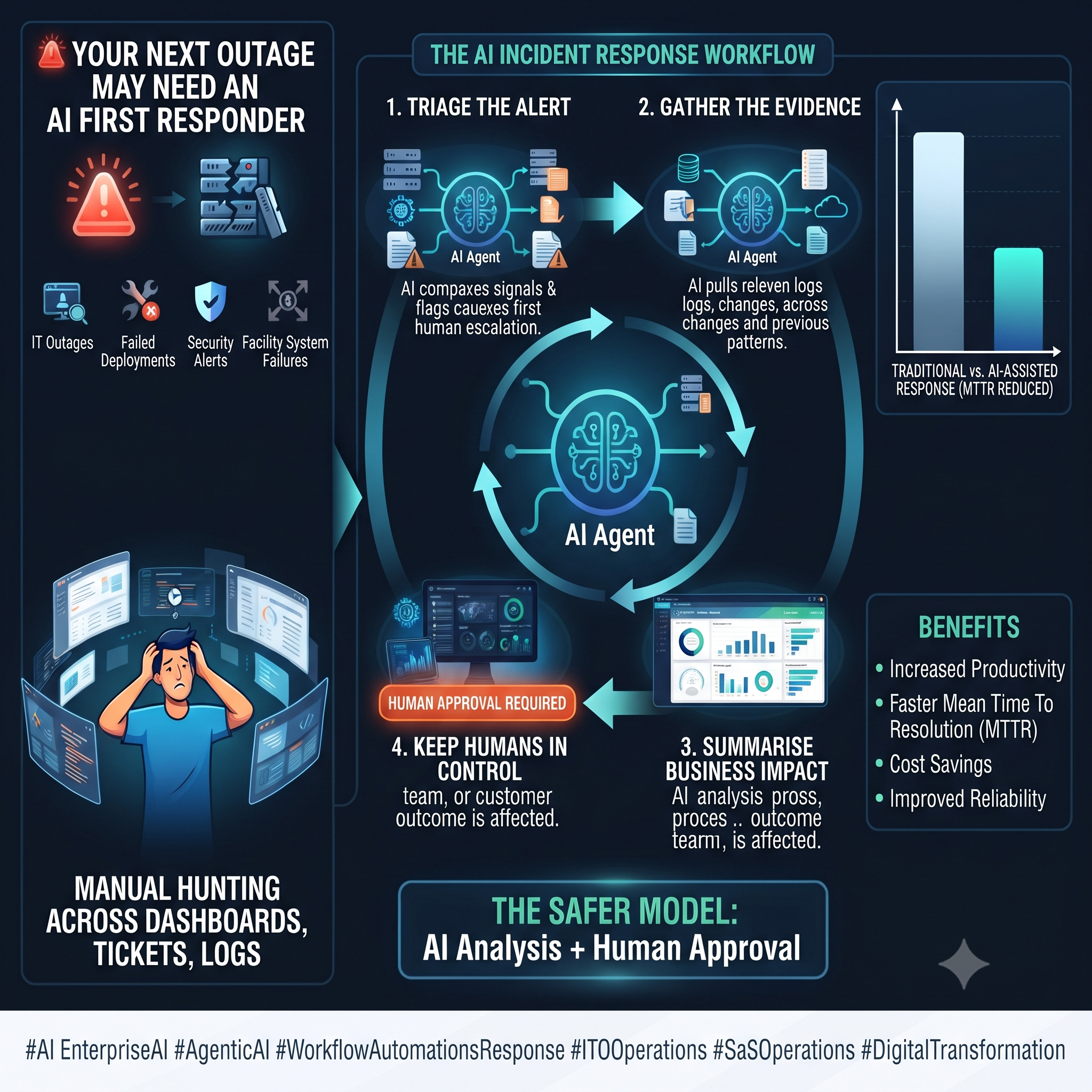
AI incident response uses AI agents to monitor alerts, investigate logs, summarise impact, and recommend next actions during operational or IT incidents. A verified August 18 enterprise example showed AI agents acting as first responders for CI/CD failures, with humans still approving high-risk actions.
Downtime is rarely caused by one missing dashboard. It usually grows while teams search for context, compare clues, and decide who should act first.
That is why AI incident response is becoming a practical operations topic. The value is not magic automation. It is faster evidence gathering when minutes matter.
Why incident response is ready for AI agents
Incident response often starts with uncertainty. An alert fires, but the real cause may sit across logs, tickets, dashboards, deployment history, or previous incidents.
Humans can analyse that information. The problem is speed and focus. During an outage, skilled people spend valuable time collecting facts before they can make decisions.
According to Anthropic’s August 18 publication, AI agents are being used as first responders for CI/CD failures. The described workflow includes monitoring alerts, investigating logs, drafting situation reports, and helping teams reduce mean time to resolution.
For business leaders, the important point is broader than CI/CD. The same pattern can support outages, failed deployments, security alerts, and facility system failures.
What an AI first responder actually does
An AI first responder does not need to own the entire incident. In a well-governed workflow, it handles the early work that slows teams down.
It triages alerts
AI agents can review incoming signals and compare them with recent system activity. They can help separate noise from issues that need escalation.
This matters because many teams still rely on manual checks across several tools. That creates delay before anyone agrees on the first action.
It gathers evidence
The strongest use case is evidence gathering. An agent can investigate logs, review deployment history, and look for related patterns.
That does not remove the engineer or operations leader. It gives them a cleaner starting point.
It drafts situation reports
During an incident, leaders need clear updates. Teams also need an audit trail after the event.
AI can draft situation reports that summarise what happened, what is known, what is uncertain, and what actions are recommended. Humans can then review and approve the message.
The business case for AI incident response
The business value comes from reducing friction inside critical workflows. Faster triage can reduce downtime. Better summaries can improve escalation. Cleaner records can support compliance and post-incident review.
For mid-sized SaaS, manufacturing, logistics, healthcare, and similar businesses, this can affect more than IT. A failed system can slow production, delay shipments, interrupt internal teams, or create customer risk.
AI incident response also protects scarce technical capacity. Engineers should not spend the first phase of every incident searching for basic context. They should focus on judgement, approval, and recovery.
The control model matters
The direct lesson from this development is not full autonomy. The safer model is AI-supported incident response with human approval for high-risk actions.
That means leaders should define agent permissions before deployment. An agent may be allowed to read logs, summarise alerts, or recommend escalation. Production changes should still require accountable human approval.
Anthropic’s August 19 publication on human-agent team operating patterns reinforces the need to think about how people and agents work together. RSAC’s August 19 focus on trustworthy infrastructure for agentic AI points to the same leadership issue: trust needs design.
How leaders should start
Start with one painful incident workflow. Do not begin with a broad transformation programme.
Choose a recurring issue where the evidence is scattered. Examples include outages, failed deployments, security alerts, or facility system failures.
Then define the operating rules:
- What systems can the agent read?
- Who owns the workflow?
- What gets logged?
- Which actions require approval?
- When should the agent escalate?
Finally, measure outcomes. Track response time, downtime, labour hours, repeat incidents, and escalation accuracy.
These metrics make the business case visible. They also stop the project from becoming a vague AI experiment.
The leadership takeaway
AI incident response is not about replacing experts. It is about giving every critical incident an instant analyst.
The companies that gain from this approach will not be the ones that hand control to agents too quickly. They will be the ones that use agents to gather evidence, improve decisions, and keep humans accountable for risky actions.
For a mid-sized business, that is a practical AI investment. It is narrow, measurable, and tied to operational resilience.
Frequently Asked Questions
How quickly can a company pilot AI incident response?
A practical pilot can start with one defined workflow, such as outages, failed deployments, security alerts, or facility system failures. The key is to limit scope, define permissions, and measure response time, downtime, labour hours, repeat incidents, and escalation accuracy.
Does AI incident response mean agents fix production systems automatically?
No. The safer model is AI evidence gathering with human approval for high-risk actions. Agents can triage alerts, analyse logs, draft situation reports, and recommend next steps while accountable people approve production changes.
What risks should leaders control first?
Leaders should define agent permissions, ownership, logging, and approval rules before using AI in live incident workflows. These controls help reduce operational risk and create a usable audit trail.
Which teams benefit most from this workflow?
IT operations, engineering, security, facilities, and operations teams can benefit when incidents require fast context across multiple systems. The best starting point is a workflow with frequent escalations, scattered evidence, and measurable downtime impact.
Comments are closed