
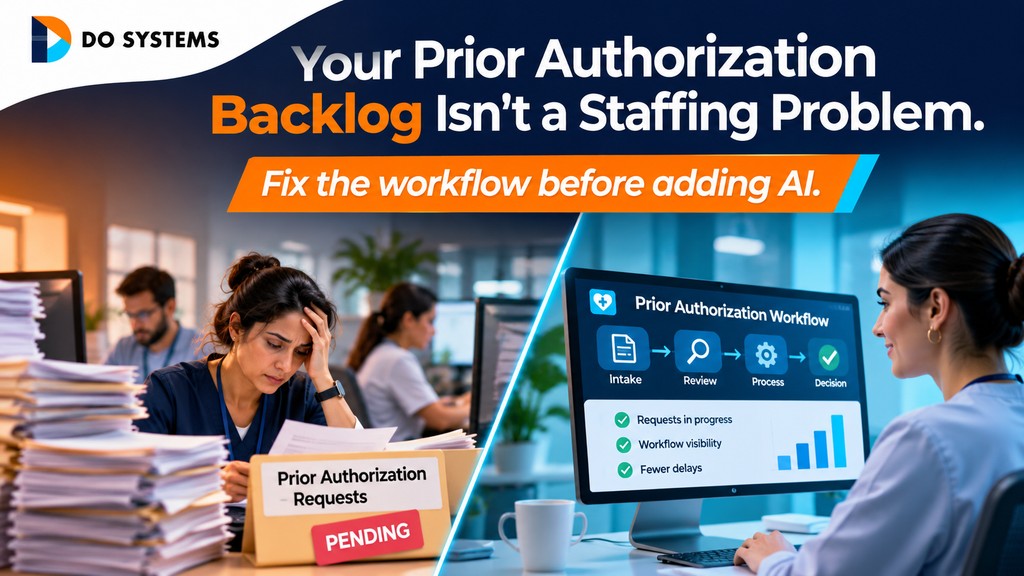
The headcount reflex
A prior authorization backlog looks like a people problem. Requests pile up, denials stack behind them, and the easiest lever to reach for is adding hours or adding headcount. Ask yourself whether that is the lever you are pulling, or whether you have tested the process underneath it. Headcount buys throughput for exactly as long as volume holds still. It does nothing to the underlying process, and the underlying process decides whether AI assistance will help or just add a tool the team doesn’t trust.
Before you ask whether AI can help with prior authorization, ask whether the process itself is ready to be helped. That is a different question than “can AI do this task,” and it is the one that actually predicts whether a pilot survives contact with your operations team.
Readiness starts with data access, not data existence
The data your team needs for prior authorization exists somewhere. That was never the question. The question is whether your team can pull it within a week, without a data project first. Can a staff member retrieve the clinical documentation, the payer requirements, and the case status in one sitting, from known locations, owned by named people?
Answer that honestly before you answer anything about AI. A process where the documentation lives in scanned PDFs, the payer portal status lives in someone’s browser tabs, and the clinical notes live in the EHR under three different templates is not a process that is ready for assistance. It is a process that needs its data mapped first.
Name where each input lives. Name who owns access to it. Find one input where you cannot do both in a single sentence, and you have found your first blocker. It has nothing to do with staffing levels.
Systems & integration: where the backlog actually lives
Prior authorization is not one task. It is a handoff between systems: the EHR holds the clinical record, the payer portal holds the submission and status, and somewhere in between a person may do the translation by hand. Check whether that translation step is where your backlog forms. Do not let a pilot skip this step because a model can draft a justification letter: writing a convincing document is not the same as moving it into a system that accepts it.
Ask the systems question directly: which systems does the AI output need to write back to? If the answer is “the EHR and the payer portal,” find out whether those systems expose a supported integration path or whether staff would be copying and pasting between a chat window and two logins. A tool that lives in a separate window, disconnected from the EHR and the payer portal, adds a step. It does not remove one.
Do not evaluate a vendor or a pilot on what it can generate. Evaluate it on where that output lands and how many hands touch it before it reaches the payer.
Ownership: the question still unasked
A prior authorization backlog crosses clinical, administrative, and revenue cycle lines, which means accountability can fall through the gaps between them. That is the condition the ownership checklist point is built to catch.
Name one accountable business owner for this process. Not a committee. Not “revenue cycle” as a department. One person, with time set aside weekly, who can also point to a technical counterpart who understands the EHR and payer portal integration paths well enough to make decisions. If that owner does not exist yet, creating one is the actual first step toward AI readiness, ahead of any vendor conversation.
An operations lead who owns this process should also be the one answering the data access and systems questions above. A team that splits those answers across IT, clinical, and billing without one person reconciling them will find that a pilot stalls in the gap between departments, not because the technology failed.
What “ready” looks like, concretely
Ready does not mean confident. Ready means you can answer specific questions about this one process, not about AI in general.
State the business case in one sentence with a number attached: one named process, one metric such as cycle time or denial rate, and a baseline you can measure today. “We want AI for prior authorization” is not a business case. “We can state today’s average turnaround for one specialty’s requests, and we want to cut it” is closer. Finish that sentence with a real number, or treat the gap as your starting point, not a case for AI.
Pick one high-value use case, not a portfolio. Prior authorization for one specialty or one payer category, owned by a named manager, is a start. Prior authorization everywhere, for everyone, all at once, is not a pilot. It is a reorganization wearing a pilot’s name.
Define success before you start. Set a target metric, a minimum threshold, and a review date. Reject any pilot that does not have a pass/fail line drawn before the first request runs through it. A pilot that ends when “the demo looks good” is not a pilot. It is a demo.
Check security & compliance sign-off on what data may leave your environment for this process, and confirm that sign-off exists before data moves anywhere, not after. Look honestly at budget & timeline too: is there funding and calendar time for the pilot and for the rollout that follows it, or only for the pilot? The checklist flags an unfunded rollout stage as one reason a working pilot goes nowhere. Check your own budget and calendar against that line before you start.
Staffing fixes volume. Readiness fixes process.
Overtime buys you throughput on the same handoffs. It does not change how many systems a request has to pass through, who owns the decision when something stalls, or whether your data is in a shape anything can act on. Those are process questions, and they are answerable this week, without hiring anyone and without buying anything.
Run your prior authorization process through the ten readiness points honestly, with your operations lead and your IT lead in the same room. Score it. A low score is not a failure; it is a map of exactly what to fix before a pilot, not after one stalls.
If you want the full set of ten points, scored and explained, with the blockers that stop a pilot cold, get the AI Readiness Checklist and score your prior authorization process against it before your next planning meeting.
AI Readiness Checklist (10 points)
FAQ
Is AI consulting for prior authorization just about automating denials?
Not only. Denial handling sits downstream of the readiness question: whether the process feeding it has clear data access, named system integrations, and one accountable owner. Automating a disorganized handoff only moves the disorganization faster.
What should a revenue cycle lead check before considering an AI pilot for prior authorization?
Start with data access (can your team pull what it needs within a week), systems & integration (does the output have a defined path into the EHR and payer portal), and ownership (is there one named accountable person). Security and compliance sign-off, which also blocks a pilot on its own, comes next.
Does adding staff ever help a prior authorization backlog?
It can relieve volume temporarily. It does not address whether the underlying process has the data access, system integration, or ownership structure needed to support any future automation or AI assistance.
Comments are closed