
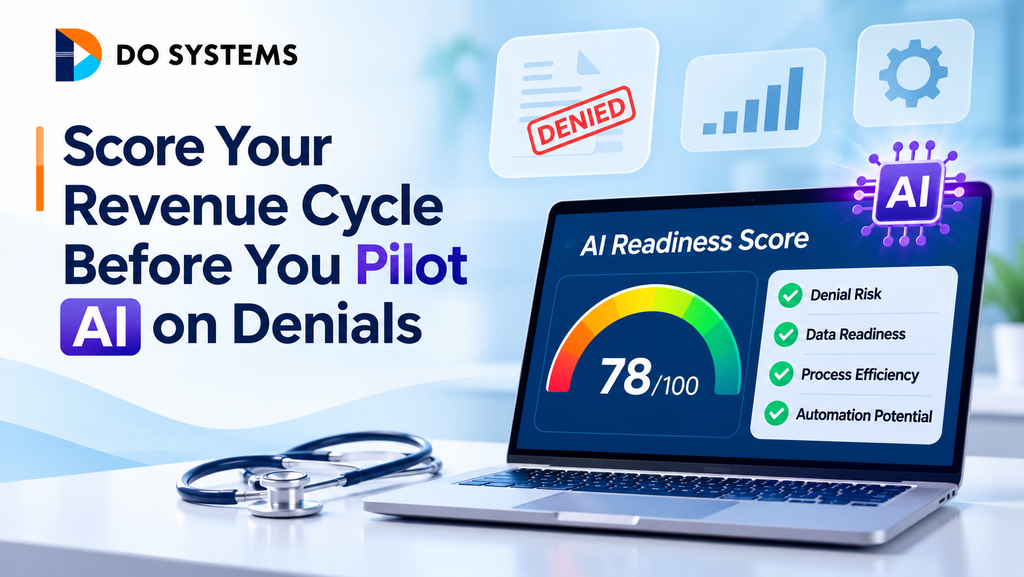
A denial management pilot can fail without the AI model being weak: no one named an owner, the data lives in several systems that do not talk to each other, or the team never set a pass/fail line before the kickoff meeting. Score the process before you buy anything.
The AI Readiness Checklist was built for exactly this gap: ten questions, scored 0 to 2, that tell you whether a process is ready for a pilot or needs work first. Run it against denial management specifically, not the revenue cycle in general. A process this concrete deserves a concrete answer.
Define the Business Case and Pick One Use Case
State the value of fixing denials in one sentence with a number attached: initial denial rate, appeal win rate, average days to resolve, or dollars written off as uncollectible. If the only sentence you can produce is “we want to reduce denials with AI,” you do not have a business case yet. You have a direction.
Pick one use case inside denial management, not the category itself. Eligibility denials are not the same problem as coding denials or timely-filing denials. Each has different root causes, different source systems and different staff doing the follow-up. Name the specific denial type, the volume it represents, and the manager who owns the queue today. A pilot aimed at “denials” in general needs more departments to agree before anything starts. A pilot aimed at one denial type, owned by one manager, does not.
Test Data Access Before You Test the Model
Ask whether the team can pull the data this process needs within a week, without a data project first. For denial management that means the denial codes and reason text, the original claim data, and the payer correspondence, which may be spread across the EHR, the clearinghouse and the billing system.
Ready looks like this: you know which system holds the denial reason code, who has login access to pull it, and the data is current enough to act on without a reconciliation step. Not ready looks like this: denial reasons sitting in PDF remittance advices, staff retyping codes into spreadsheets, or no one able to say which system is the source of truth for a given claim.
Score this one honestly. A zero here is a blocker on its own, independent of how good the rest of the process looks.
Confirm the System Can Write Back, Not Just Read
Know which systems the AI output has to write back to before you pilot anything. For denial management that is likely the billing system, for updating claim status and queueing the appeal, and sometimes the EHR, for the clinical documentation needed to support the appeal.
Ready looks like this: the target system exposes an API or a supported integration path, and someone on the team has already confirmed it. Not ready looks like this: the AI lives in a separate chat window, and staff copy the recommended appeal language back into the billing system by hand. That is not automation. That is a browser tab added to an already full desktop.
Put Security, Compliance and Ownership in Writing
Get security and compliance sign-off on what claim and patient data may leave your environment before you pilot, not after. Classify the data this process touches, agree on hosting and model-access rules, and write down the limits your organization has agreed to for this kind of data. If staff are already pasting claim details into a public AI tool to draft appeal letters, that is not a readiness gap. That is an active risk, and it should stop before the pilot starts, not after it is scored.
Name one accountable business owner and one technical counterpart. The owner should be the revenue cycle manager responsible for the denial queue you picked, with time set aside each week, not an executive who signs off once and disappears. A denial management project that belongs to IT or an innovation team, with no one from the revenue cycle floor involved, scores a zero on ownership no matter how strong the technology is.
Ask the People Working the Queue, and Set a Pass/Fail Line
Ask the billing and follow-up staff who work the denial queue today whether they want this, before you roll it out. A team that defines the new workflow with frontline staff can see a different adoption curve than a team that announces the tool after it is already built. When staff fear a project is aimed at their jobs, they may not adopt it well, regardless of what the dashboard shows in week one.
Define the pilot’s pass/fail line before it starts: target metric, minimum threshold, review date, and what happens if it misses. For a denial pilot that might be appeal win rate on the chosen denial type, or days to resolution, measured against a baseline from before the pilot. Reject any pilot that does not have this in writing. A pilot that ends when the demo looks good is not a pilot. It is a product demo with no accountability attached.
Fund the Rollout, Not Just the Pilot
Confirm there is money and calendar time for the pilot and the rollout stage, not just the pilot. Scope the pilot to weeks, with a funding path already named for what happens after it passes. Pilot funding without rollout funding can kill a pilot that already proved itself: the team shows the result, then loses the budget and the people needed to scale it. Fund both before you start.
Decide honestly what to build, buy or bring in help for. Count who will run, monitor and fix the denial automation in the months after launch, not just who will build it. A revenue cycle team with strong billing-system expertise but no AI engineering capacity should weigh that honestly against a team that has both. Defaulting to “we can build it” without that count is a readiness gap, not a strategy.
Add Up the Score
Score each of the ten points 0, 1 or 2, and add them up out of 20. A denial management process scoring 17 to 20 is ready to pilot. A score of 12 to 16 means close, with specific gaps to close first. A score of 6 to 11 means prepare the process before you touch a vendor conversation. Below 6, the process is not ready, and no vendor demo will fix that.
Remember the override: any zero on data access, security and compliance, or ownership stops the pilot regardless of the total score. A 19-out-of-20 process with a zero on security sign-off is not a 19. It is a blocker with good intentions attached.
Run this scoring exercise on your denial management process before the next AI vendor conversation, with the operations lead and IT lead scoring it together. The AI Readiness Checklist walks through all ten points with the same ready-versus-red-flag detail used here, so you can score your own process on paper before anyone pitches you a platform.
AI Readiness Checklist (10 points)
FAQ
What is an AI readiness assessment for revenue cycle management?
It is a scored review of one revenue cycle process, such as denial management, against ten factors: business case, data access, system integration, security and compliance sign-off, ownership, adoption and funded rollout. Each factor scores 0 to 2, for a total out of 20, with any zero on data access, security or ownership blocking the pilot regardless of the total.
Which revenue cycle process should we pilot AI on first?
Pick one high-volume process with a named owner, not the whole revenue cycle. Inside denial management, that means one denial type, such as eligibility or coding denials, not the category as a whole, with a manager who owns that queue today.
Why does a successful revenue cycle AI pilot sometimes stall after it proves itself?
The pilot stage gets funded and the rollout stage does not. The checklist flags this: budget and calendar time need to cover the pilot and the scale-up, named before the pilot starts.
Comments are closed