The AI Tool Egress Review: Why Mid-Size Companies Need One Before the Next Agent Goes Live
What actually happened
On November 5, 2026, a user filed issue #107757, titled “Bug Report: Privacy violation in User-Agent header,” in the anthropics/claude-code repository. They reported that Claude Code “divulged my email to arbitrary 3rd parties in the User-Agent request header while conducting web searches without my permission.” They argued the behavior “should not be a setting with opt-out or opt-in behavior” and should be removed entirely. They also said they are moving their company to a different toolchain.
The issue carries the labels bug, area:security, area:tools, and platform:macos. When we read it, it was open, with no visible maintainer response and no linked fix. The reporter attributes a rise in scam email to the header, but the issue itself doesn’t establish that link. No specific receiving sites or reproduction steps are given.
The blind spot: egress, not ingestion
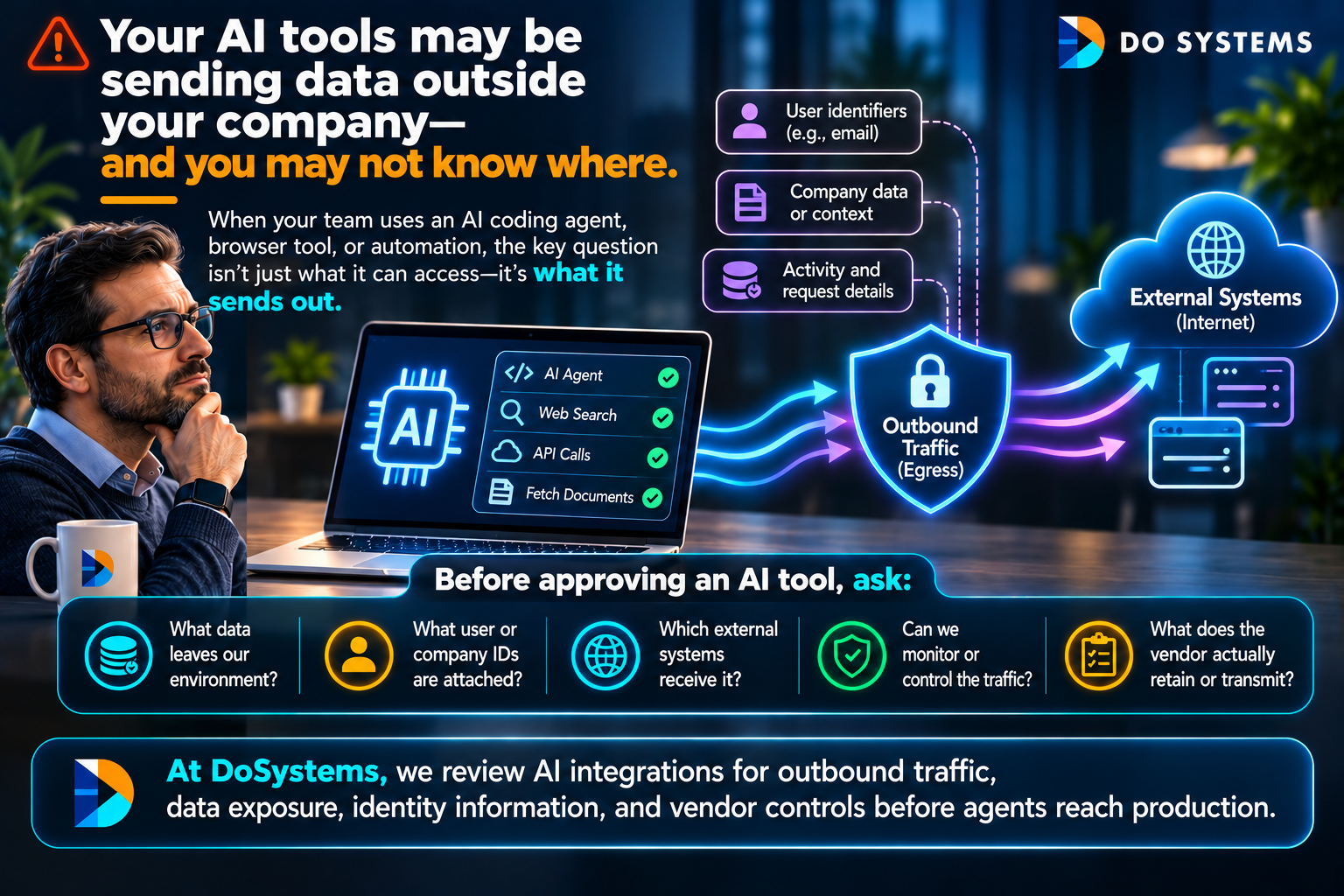
Most AI risk reviews focus on what goes into a model: prompts, uploaded files, training opt-outs. Agentic tools add a second direction. When an agent searches the web, fetches a page, or calls an API, it makes outbound requests on your behalf. Those requests carry headers, tokens, and sometimes context. If identifiers such as an employee’s email ride along, they end up in other companies’ server logs, and you have no contract with those companies. Traditional DLP watches email and file shares, so it rarely inspects an agent’s HTTP traffic.
Why this hits mid-size companies harder
Large enterprises usually force developer tools through a proxy and a security review. Mid-size companies tend to adopt AI tools bottom-up: an engineer installs an agent, it proves useful, and it spreads. By the time IT notices, it may be running on dozens of machines with no inventory, no egress policy, and no named owner. Mid-size firms also have smaller security teams, so the review that would have caught this often never happens.
A practical diagnostic
Start by asking whether you can list every AI tool in use that can make outbound requests: browsing, fetching, or calling third-party APIs. If not, discovery comes before policy. Next, ask whether anyone has inspected what those tools actually send, by watching real traffic through a logging proxy rather than reading vendor documentation. Third, check whether your vendor contracts state which identifiers the client attaches to outbound requests and whether customers can control that. Fourth, ask whether agents run under named employee identities or dedicated service identities. Finally, ask who owns the decision when a tool’s egress behavior changes in an update. If nobody does, the next unreviewed change won’t reach anyone.
Flagged Illustrative Example (not a real client case)
Picture a 220-person logistics software company whose engineering team adopted three AI coding and research agents over six months. None went through procurement, because each cost less than a team lunch per seat. A new security lead runs one week of developer traffic through a logging proxy. One tool attaches the signed-in user’s email to outbound requests. Another sends repository names to a third-party search API. Neither was malicious, and neither was known. The fix took two weeks: an approved-tools list, agent traffic routed through a proxy that strips identifying headers, and a one-page egress checklist added to the AI tool request form.
Where this goes next
Agentic tools are only going to make more outbound calls, not fewer, so egress review belongs at the start of AI adoption, not after an incident. At DoSystemsInc, we build egress mapping into every AI integration project, alongside model choice and workflow design. If you’d like the six questions we use, comment “EGRESS” on our LinkedIn post or reach out to the DoSystemsInc team directly.
Comments are closed