
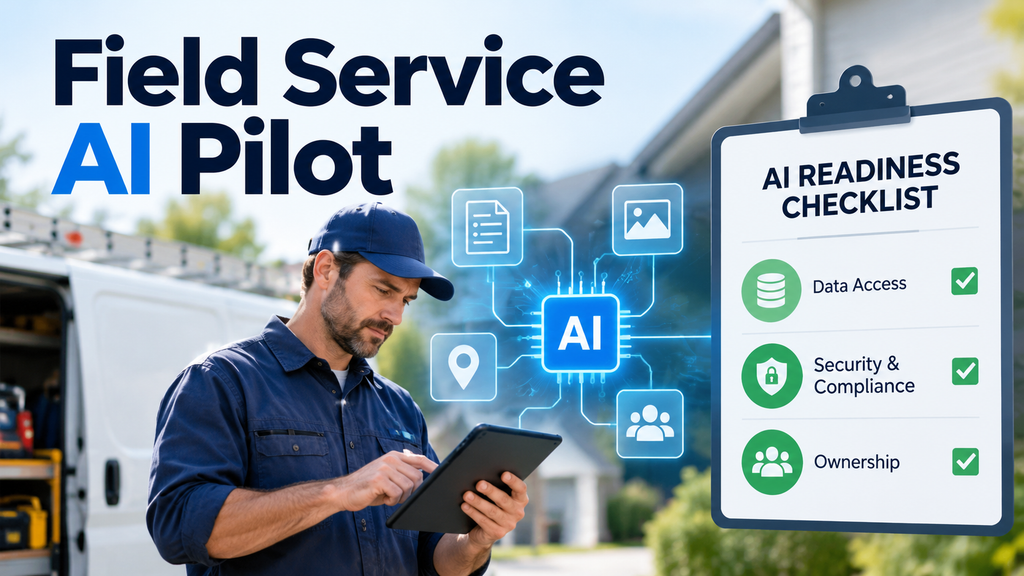
Quick answer: A field service AI pilot can stall before it starts if a team scores zero on data access, security and compliance, or ownership. These three items override the AI Readiness Checklist’s other seven. If job notes and customer data move through personal phones and texts with no signed-off rule, the pilot is not ready.
Table of Contents
The Hidden Blocker in Field Service AI Pilots
Leadership wants an AI assistant for dispatch, job notes, or customer follow-up. That request can arrive before anyone has checked where the underlying data actually lives, who can access it, or who is accountable for the workflow it would touch. That gap, not the AI model itself, is what decides whether a pilot can move forward.
Before launching a field service AI pilot, organizations need to understand how operational data is collected, stored, shared, and governed. Without this foundation, even a promising automation initiative can encounter problems before implementation begins.
If technicians already carry phones, take photos on the job, and text updates back to the office, it can be tempting to assume the data pipeline is good enough to automate. The AI Readiness Checklist treats that as a question to verify, not an assumption to build on.
If job notes, photos, and customer details move across personal phones, group texts, and whichever app a technician happens to prefer, there may be no single, consistent place for an AI system to pull current data from. And if what counts as sensitive customer information in that mix has not been formally defined, an AI pilot risks collecting and processing data that was never cleared to leave the company.
The checklist scores 10 points on a 0–2 scale, for a maximum of 20. A team might look at the total and ask whether it cleared a bar like 12 or 17. That’s the wrong first question.
One rule matters more than the total: a zero on data access, security and compliance, or ownership blocks a pilot by itself, regardless of what the other nine points add up to.
Why Technician Data Capture Habits Matter More Than the AI Model
A field service operation considering its first AI pilot is not really evaluating a model. It is evaluating whether the inputs to that model are trustworthy, current, and legally shareable.
The success of a field service AI pilot depends on having reliable operational data and clearly defined responsibilities. An AI system cannot consistently improve workflows when its underlying information is incomplete, fragmented, or inaccessible.
Illustrative example, not a real client.
Picture a field service team where a technician’s job notes live in a personal notes app, and photos sit in a camera roll that syncs to a personal cloud account.
In that setup, an AI assistant trained or fed on that data would inherit all of the inconsistency and none of the governance.
A team that is excited about the use case but has not mapped where its data actually lives is in the exact pattern the checklist is built to catch, whether the industry is field service or something else.
If a team scores high on checklist items like “one high-value use case” or “success criteria for the pilot” but scores a zero on data access, the pilot is not nearly ready.
It is not ready at all, because the AI cannot reliably reach the data it would need to do the job.
The Three Checklist Items That Can Block a Field Service AI Pilot
Three items on the checklist carry this override power on their own.
1. Data Access
Can the team pull the data this process needs within a week, without a data project first?
If job notes, photos, and customer details are scattered across phones, texts, and personal apps, the honest answer may be no, and it may not be clear to anyone exactly where all of it lives.
For a field service AI pilot, data accessibility means more than simply having digital records. The information must be available through a consistent, approved process that the proposed AI workflow can reliably use.
2. Security and Compliance
Have security and compliance signed off on what data may leave the company environment?
If technicians are sending customer addresses, equipment photos, or service history through personal messaging apps, and that sign-off has not happened, the practice has outrun the written policy.
Security reviews should happen before an AI solution begins accessing operational records, particularly when customer information or sensitive service data is involved. Organizations allowing technicians to use personal devices should also consider NIST’s guidance on Bring Your Own Device (BYOD) security, which outlines approaches to managing security and privacy risks when employees access business data through personal devices.
3. Ownership
Is there one accountable business owner, with a technical counterpart, for this specific workflow?
If the plan for an AI assistant sits with “IT” or “leadership wants this” and no named operations owner has dedicated time each week to run it, that box is also empty.
A successful field service AI pilot needs someone responsible for defining the workflow, monitoring progress, resolving operational problems, and measuring results.
Any one of these three at zero stops the pilot, even if the business case is sharp and the use case is well chosen.
What “Ready” Looks Like for Data Access, Security, and Ownership
Ready does not mean perfect. It means specific and documented.
Data Access Readiness
For data access, ready looks like knowing exactly where technician job notes and photos are supposed to live, who owns that system, and whether the data arriving there is complete enough for the process in question.
If the honest answer today is “it depends on the technician,” that names the gap instead of assuming it away.
Before investing in a field service AI pilot, teams should confirm that the information needed for automation can be accessed consistently without introducing an entirely new data collection project.
Security and Compliance Readiness
For security and compliance, ready looks like a data classification exercise for this one workflow, a written rule on hosting and model access, and a clear line on what customer information can or cannot leave the environment, including through consumer messaging apps.
If a technician currently texts a photo of a customer’s property to a dispatcher, someone needs to decide, in writing, whether that channel is approved going forward.
Documenting these rules helps prevent uncertainty about which systems, devices, and communication channels are appropriate for AI-supported workflows.
Ownership Readiness
For ownership, ready looks like a named operations manager with dedicated time for the pilot, and an executive sponsor who can resolve conflicts between field habits and new process.
If the workflow currently belongs to “whoever picks it up,” that is the gap to close first.
Establishing ownership early gives the project a clear decision-maker and helps prevent implementation from becoming an undefined responsibility shared across departments.
Running the Checklist Before You Scope a Field Service AI Pilot
A field service team that wants to move an AI pilot forward without hitting this wall can run the data access, security and compliance, and ownership questions before anything else on the list.
If any of the three comes back at zero, the next step is not scoping the AI pilot.
The next step is fixing that one item: naming where data lives, writing the rule on what can leave the environment, and naming the business owner.
Only after those three clear a 1 or 2 does it make sense to score the remaining seven items: the business case, the single use case, systems integration, the adoption plan, success criteria, budget and timeline, and the build-versus-buy decision.
Scoring all ten gives a full picture, but the three override items decide whether that picture is worth building yet.
A field service operations manager does not need a finished AI strategy to start this work.
The starting point is smaller: pick the one workflow under consideration, and get honest answers on where its data lives, who has signed off on what can leave the company, and who owns the outcome.
By completing these readiness checks before launching a field service AI pilot, organizations can identify operational gaps early and create a more practical foundation for implementation.
If you want to score your own team against these three override items, plus the other seven, the AI Readiness Checklist walks through all ten and shows exactly where a field service workflow stands before anyone scopes a pilot.
AI Readiness Checklist (10 points)
FAQ
What makes field service data governance different from office-based AI projects?
Field service data can be captured outside a controlled office environment if technicians use personal devices, texts, or apps for job notes and photos.
That possibility is exactly what the data access and security and compliance items on the AI Readiness Checklist are built to catch before a pilot starts.
Can a field service AI pilot proceed if the business case is strong but data access is weak?
No. The checklist’s override rule holds that a zero on data access, security and compliance, or ownership blocks the pilot on its own, independent of how strong the business case or use case scores are.
Who should own the decision about what field data can leave the company environment?
The checklist points to security and compliance as the direct owner of that sign-off, with data access and systems integration handled jointly with IT, and the named business owner responsible for the overall workflow.
Comments are closed