
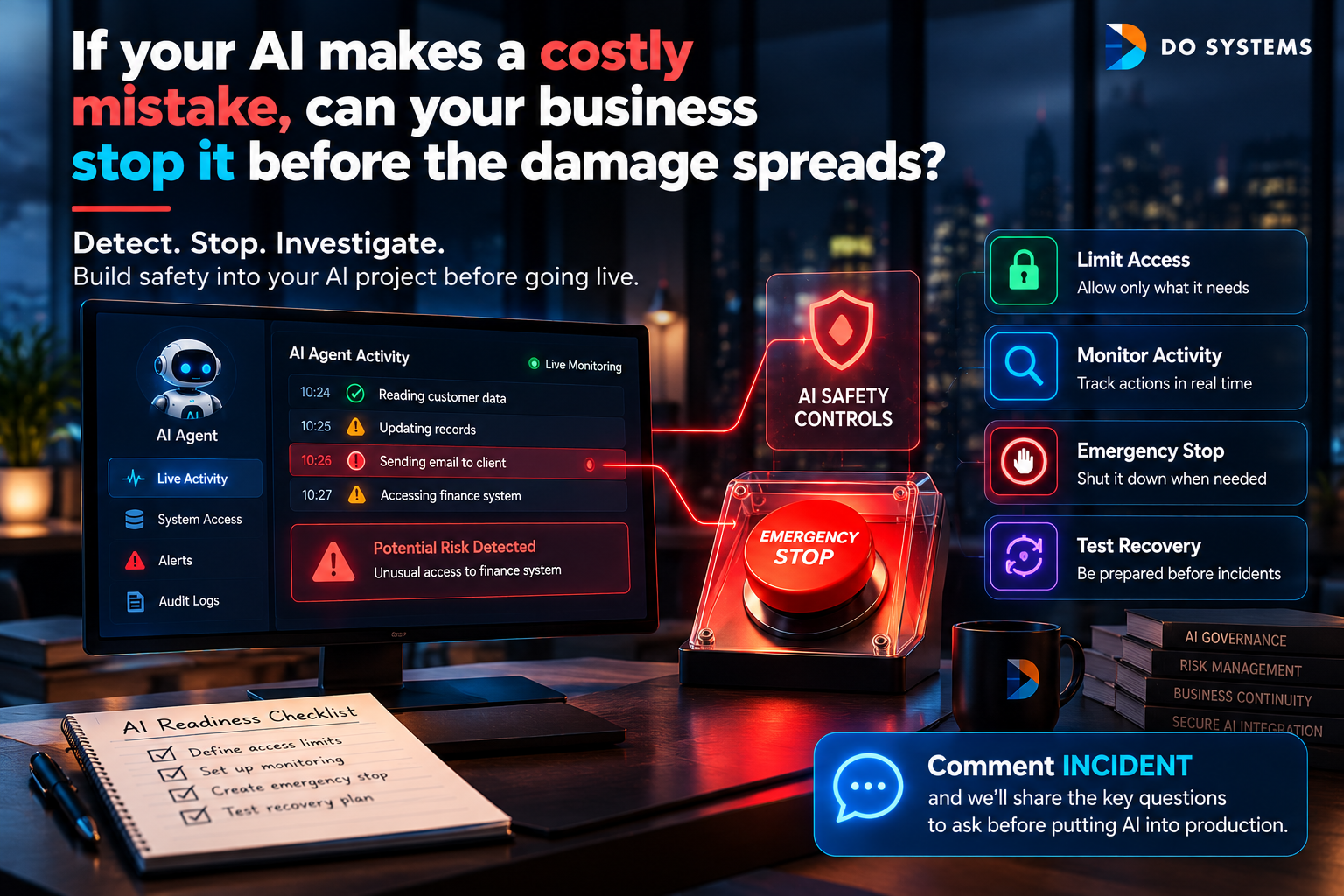
AI changes the shape of an operational incident
Traditional software incidents often follow known failure modes: a service becomes unavailable, a deployment introduces a bug, or a data pipeline stops processing. AI-enabled workflows can add a less predictable layer because the system may interpret ambiguous input, choose a tool, produce an unexpected result, or act on information that was not anticipated by the workflow designer.
That does not mean every AI system is autonomous or inherently dangerous. Risk depends on the capabilities it has been given. A tool that only drafts text for review has a different impact from an agent that can send messages, modify customer records, or initiate transactions. Incident readiness should reflect that difference rather than treating every AI use case identically.
Treat the emergency brake as a designed capability
An emergency brake is useful only if someone can activate it and understands what it stops. For one workflow, that may mean disabling an agent’s tool access. For another, it may mean pausing a queue, revoking a short-lived credential, blocking an external action, or routing all new outputs to human review until an issue is understood.
The design should distinguish between stopping the AI component and stopping the entire business service. If a workflow has safe fallback behavior, the company may be able to continue operating manually while the AI path is paused. That reduces pressure to leave a questionable system running simply because no one wants to interrupt the business process.
Use an incident-readiness diagnostic before launch
Start by defining what the AI is allowed to do and which actions have meaningful consequences. For each action, identify the signal that would indicate a problem, the person or system that can stop it, and the control that can be disabled without creating a larger outage. If an agent can call multiple tools, make sure those permissions can be revoked independently where practical.
Then verify the evidence needed for investigation. Logs should help answer what input the workflow received, what data or tools it accessed, what action it attempted, whether a person approved it, and what happened downstream. Avoid collecting sensitive data unnecessarily, but do not design observability so narrowly that the team cannot reconstruct an incident. Retention and access to logs should follow the organization’s privacy and security requirements.
Finally, rehearse the response. Simulate an incorrect action, unexpected tool call, repeated loop, or suspicious input. Confirm who receives the alert, who decides whether to pause the workflow, how the business continues, and how the team restores service after the cause is addressed. A written plan that has never been tested is not a dependable control.
The response must include communication and recovery
Technical containment is only one part of an incident. Depending on the event, customers, employees, partners, security teams, legal advisers, or regulators may need timely and accurate information. Brad Smith’s reported call for incident reporting and notification underscores the importance of having a process for determining what happened and who may have been affected. It does not mean every company is already subject to a new universal legal requirement; the regulatory details remain a matter for the relevant jurisdictions and future rules.
A good response process assigns responsibility in advance. Engineering may contain the system, security may investigate access and logs, operations may coordinate service continuity, and leadership may approve external communications. This reduces the risk of a technical issue becoming a confused organizational response.
Build AI incident response into integration architecture
At DoSystemsInc, we treat observability, access control, escalation, and recovery as part of an AI integration rather than optional enhancements after launch. That starts with mapping the tools and data available to the workflow, limiting permissions to the job it needs to perform, and defining where a person must approve a consequential action.
The same architecture should make it possible to disable a risky capability, preserve the relevant evidence, and return to a safe operating mode. These controls should be proportional to the workflow: a low-risk summarization tool does not need the same response design as an agent that can change production data or contact customers. The objective is practical control, not a compliance checklist for its own sake.
Where this goes next
DoSystemsInc helps organizations design AI workflows with incident detection, containment, escalation, and recovery built in from the start. Comment INCIDENT or reach out if you want to discuss an AI integration project or MOU before a production incident forces the conversation.
Comments are closed