
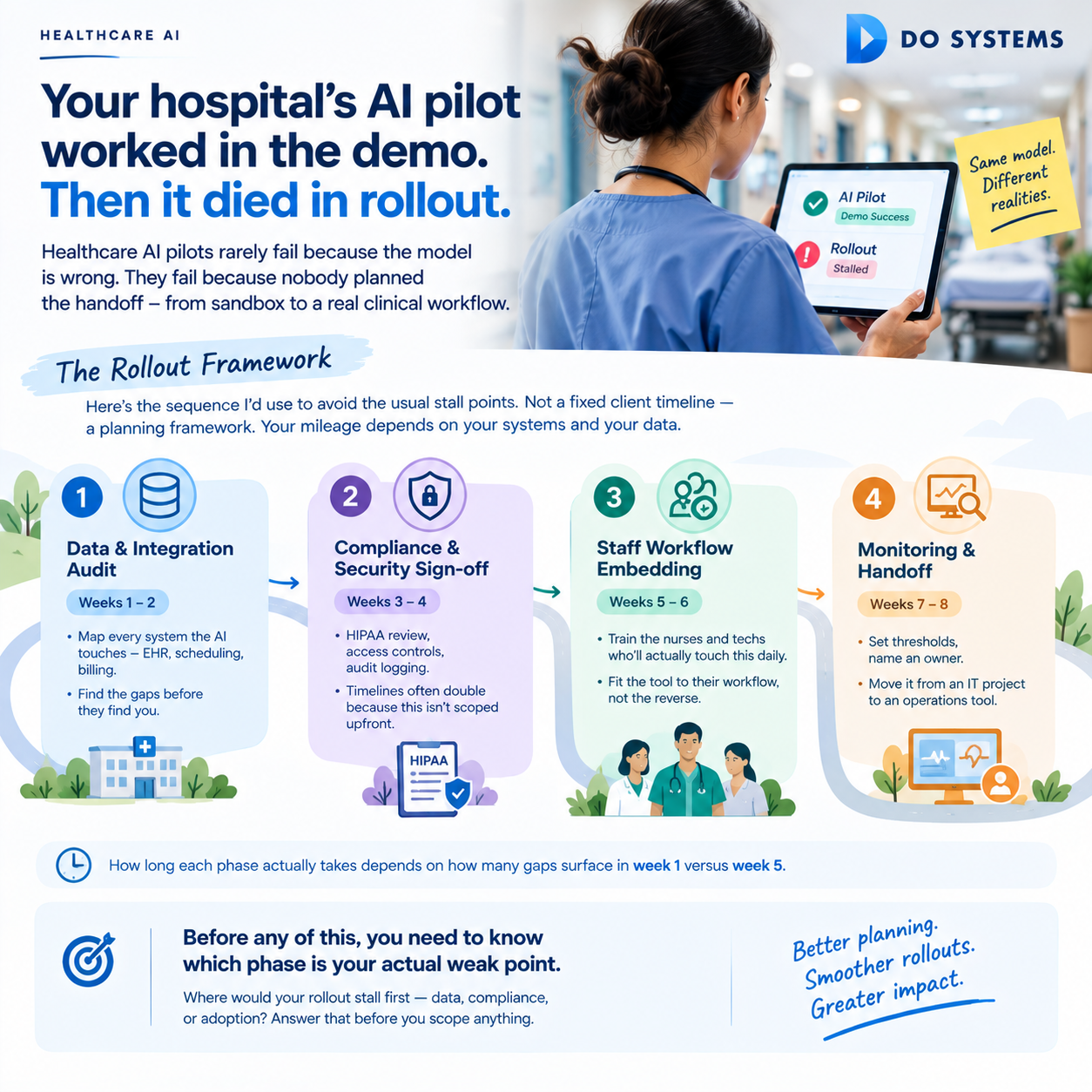
Your Pilot Didn’t Fail. It Got Abandoned.
This is a common pattern in healthcare AI rollouts: the model worked, the demo worked, and then the project quietly stopped being anyone’s job. Months later, nobody can say with confidence whether it’s still running or who would notice if it stopped.
Illustrative example, not a real client: a hospital pilots a tool that flags a specific clinical risk pattern. It performs well in testing. Some time after go-live, nobody can confirm when its output was last reviewed, or whether it’s still pulling from the correct data feed. The pilot didn’t fail on accuracy. It failed because nothing after the demo was planned.
We see this as a sequencing problem, not a model problem. What follows is a general framework for thinking through pilot-to-production planning, structured around AI workflow automation inside a hospital’s real systems. It is not a documented DoSystems methodology and not a fixed schedule applied identically to every engagement: it’s a structure for the conversation. Your systems, your data readiness, and your compliance backlog will shape the actual calendar. The order of operations matters more than the exact week count.
Weeks 1-2: Data and Integration Audit
Before writing a rollout plan, two questions need answers on paper: where does the data this process needs actually live, and which systems must the AI output write back into.
In a hospital setting, that means naming the specific EHR module, the tables or FHIR resources involved, and confirming a supported API path exists, not a plan that has nurses copying output out of a chat window into the chart by hand. If the honest answer is “the data’s split across three systems and a shared drive of PDFs,” that’s not a detail to fix during rollout. It’s the reason pilots stall, and it needs resolving before anything else moves.
The target for this stage is a one-page data and integration map, signed off jointly by IT and the process owner, naming every system the pilot touches today and every system it needs to reach at scale.
Weeks 3-4: Compliance and Security Sign-Off
This is the stage most pilots skip, because a small test running on a handful of cases with no live patient data can get away without full sign-off. Production can’t move forward without this step closed.
Security and compliance need specific answers here: what data classification applies to this workflow, what data leaves the environment versus stays hosted internally, and how that maps to HIPAA and any existing BAA terms. If staff are already pasting patient information into a general-purpose AI tool “to see if it helps,” that’s the exact risk this stage exists to catch, not something to route around.
This needs to be in writing, with a named compliance lead who signs off, before workflow embedding starts. Skipping this step doesn’t cause a quiet failure. It causes a public one, usually during an audit, well after staff have started relying on the tool.
Weeks 5-6: Staff Workflow Embedding
A tool that lives in a separate browser tab staff have to remember to open gets abandoned within weeks, no matter how accurate it is. This stage is about making the output appear inside the workflow clinicians and operations staff already use, at the point they’d need it.
That means sitting with the people who will run this daily, not just their managers, and walking the current process end to end. What changes for them, what stays the same, and where the recommendation shows up on their existing screen all need to be decided together. A short training path and a feedback channel checked weekly work better than a one-time announcement email.
If the people using the tool weren’t part of deciding how it fits into their day, expect it to sit unused regardless of how it performed in testing. That’s not a training problem to fix later. It’s the design question this stage is meant to answer.
Weeks 7-8: Monitoring and Handoff
A pilot nobody is monitoring isn’t in production. It’s running unattended. This stage sets the metric tracked after go-live, the threshold that triggers a review, and who owns that review.
A business owner needs weekly time set aside for this, plus a technical counterpart who watches system health, data drift, and integration errors. What happens if the metric slips below threshold, scale it, fix it, or pause it, gets decided in advance, with the first review date on the calendar now.
A short runbook belongs here too: what the tool does, what it depends on, who to call if it breaks, and what a normal week of output looks like versus an abnormal one. That document is what lets a pilot team step away without the workflow quietly degrading. If keeping the system running depends on one person remembering how everything is wired together, the handoff isn’t finished, no matter how good the pilot metrics looked at week six.
Where the Readiness Checklist Fits
Every stage above assumes some questions already have answers: is there a named process owner, can the team pull the data without a separate data project, has compliance actually been asked rather than assumed fine, and is there budget for the rollout stage, not just the pilot. Stalled rollouts tend to trace back to one of these sitting unanswered before the sequencing work ever started.
That’s what the AI Readiness Checklist covers: ten questions, self-scored, spanning business case, data access, security and compliance, ownership, adoption, and budget for both pilot and rollout. A single “not true” on data access, security, or ownership is a blocker on its own, regardless of the total score. Running it with an operations lead and IT lead together, before committing to a rollout sequence for AI workflow automation, shows which of the four stages above will move fast for a given organization, and where the real work is hiding.
Plan the Sequence Before You Plan the Calendar
The order matters more than the count of weeks: audit before sign-off, sign-off before embedding, embedding before monitoring. Compress any of those steps and the pilot that worked in testing becomes the tool nobody trusts by month six. Treat the eight-week structure above as a sequence to adapt, not a fixed schedule to hit.
Before scoping the next phase of a rollout like this one, walk through the AI Readiness Checklist with your operations and IT leads. It takes about 15 minutes and shows where a sequence like this will move fast for your organization, and where it won’t.
AI Readiness Checklist (10 points)
FAQ
Is eight weeks a guaranteed timeline for every hospital rollout?
No. It’s a general sequence for planning, not a fixed timeline. Adjustments follow from data readiness, integration complexity, and compliance backlog, which vary by organization.
What’s the most common reason a working pilot never reaches production?
The most common failure mode is that pilot budgets don’t extend to rollout: training, monitoring, and ongoing ownership need separate funding and a named owner apart from the pilot team. Without that funding and ownership, a pilot that worked has nowhere to go.
Should compliance review happen before the pilot starts, or before rollout?
Before scaling past a small test group. Data classification and hosting rules affect how the pilot itself should be built, so waiting until rollout to involve compliance is how a pilot gets stopped after staff are already relying on it.
Comments are closed