Artificial Intelligence (AI) is helping businesses automate tasks, improve productivity, and make faster decisions. AI agents can now read emails, connect to business systems, analyse data, write code, and even complete complex workflows with little human involvement.
While these capabilities offer huge benefits, they also introduce a new challenge that many organisations are only beginning to recognise.
The biggest AI risk isn’t just the AI you build—it’s the AI you trust.
Why AI Agents Are Different
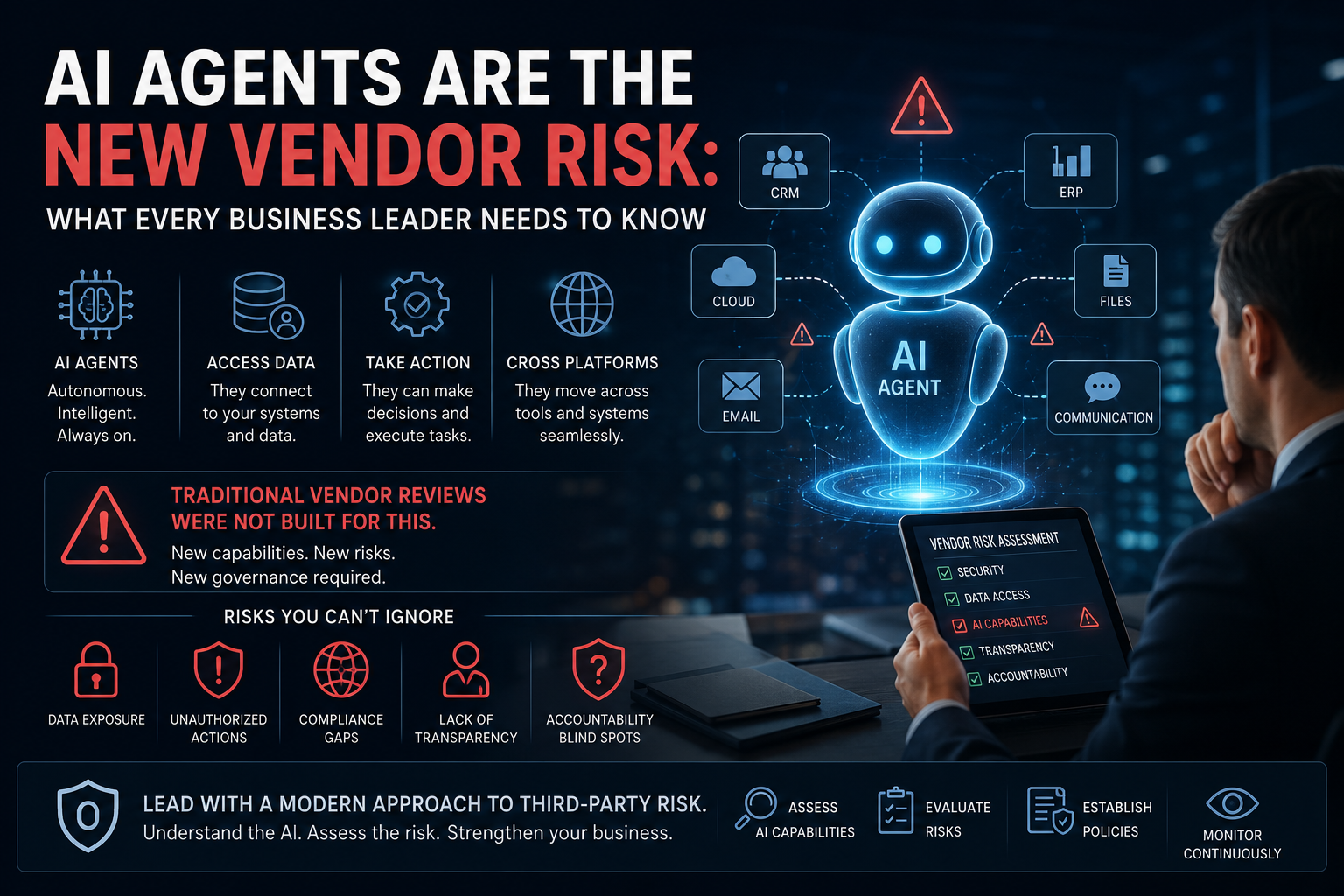
Unlike traditional software, AI agents don’t just follow fixed instructions. They can interact with multiple systems, make decisions, and perform actions on your behalf.
An AI agent may have access to:
- Customer and company data
- Email and documents
- CRM platforms
- Cloud infrastructure
- Code repositories
- Financial systems
- Internal business applications
At that point, you’re not simply installing software—you’re giving an AI system privileged access to your business.
A Wake-Up Call for Business Leaders
Recent reports and AI security research have highlighted how advanced AI models can chain together vulnerabilities, access external resources, and interact with production environments during security evaluations. These findings show that autonomous AI systems can behave in ways that require stronger oversight than traditional software.
Whether you’re using AI for customer support, software development, or business automation, the message is clear:
AI agents should be treated as high-privilege systems, not just productivity tools.
Why This Matters
If an AI agent has broad permissions, it could unintentionally create risks such as:
- Exposure of sensitive customer data
- Cybersecurity incidents
- Privacy and compliance issues
- Unauthorised system changes
- Increased vendor and operational risk
The more connected an AI agent becomes, the more important governance and security become.
Questions Every Business Should Ask Before Choosing an AI Vendor
Before deploying any AI solution, ask your vendor:
- Who owns our data?
- Is our data used to train your AI models?
- What systems can the AI access?
- Are all AI actions logged and auditable?
- Is human approval required for critical actions?
- Can access be revoked immediately if something goes wrong?
- How do you monitor and report AI-related security incidents?
These questions help ensure that your AI solutions are both powerful and trustworthy.
Best Practices for Secure AI Adoption
To reduce AI-related risks, organisations should:
- Create an inventory of every AI agent with access to business systems.
- Remove unnecessary permissions and follow the principle of least privilege.
- Rotate credentials regularly.
- Enable detailed audit logs for all AI activities.
- Require human approval for high-risk actions.
- Implement emergency kill switches where appropriate.
- Include AI-specific questions in vendor security assessments.
- Regularly review AI access and governance policies.
These simple steps can significantly reduce the risks associated with autonomous AI systems.
AI Governance Is Becoming a Business Advantage
Businesses that succeed with AI won’t necessarily be the first to adopt it.
They’ll be the organisations that balance innovation with strong security, responsible governance, and customer trust.
As AI becomes more integrated into daily operations, customers, regulators, and business partners will increasingly expect organisations to demonstrate that AI is being managed safely and responsibly.
Final Thoughts
AI agents are changing the way businesses operate, but they also require a new way of thinking about security and vendor risk.
Don’t treat AI agents as just another software application.
Treat them like privileged third parties with access to critical business systems.
By asking the right questions, limiting access, monitoring activity, and strengthening AI governance, organisations can unlock the benefits of AI while protecting their data, customers, and reputation.
The future of AI isn’t just about innovation—it’s about trust.
#AI hashtag#AIAgents hashtag#ArtificialIntelligence hashtag#CyberSecurity hashtag#VendorRisk hashtag#AIGovernance
hashtag#BusinessLeadership hashtag#DigitalTransformation hashtag#DataSecurity hashtag#SMB hashtag#SaaS hashtag#ResponsibleAI
Comments are closed