
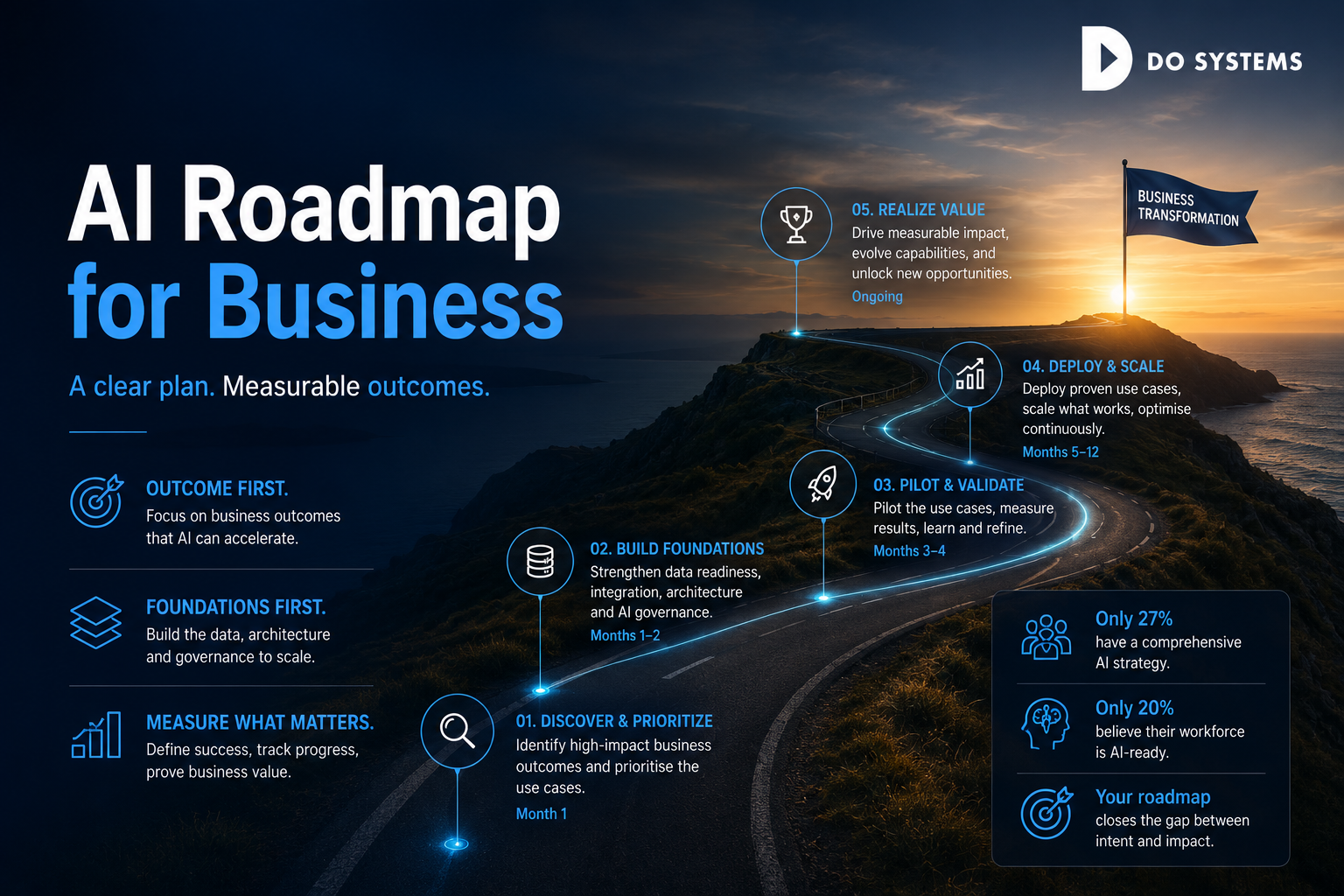
The difference between an AI strategy and an AI roadmap is specificity. A strategy describes direction. A roadmap describes what you will do, when you will do it, what it will require, and how you will know it has worked.
Gartner’s December 2025 survey of 197 CxOs and senior business leaders found that only 27% of executives have a comprehensive AI strategy – and only 20% believe their workforce is truly AI-ready. The majority of business leaders are aware of AI’s importance without having translated that awareness into a plan.
Gartner also found in May 2026 that by 2027, 50% of enterprises without a people-centric AI strategy will lose their top AI talent. The competition for people who can implement, manage, and optimise AI in business environments is intensifying – and a clear roadmap is increasingly a prerequisite for attracting and retaining them.
Gartner predicts that more than 50% of enterprise AI initiatives will fail to reach production through 2027 because foundational architecture is missing. A roadmap that sequences the foundational work – data, governance, integration – before the AI deployment addresses this directly.
This guide gives you a practical 12-month AI roadmap framework that works for SMBs – covering prioritisation, sequencing, governance, resourcing, and measurement.
Step 1: Start With Business Outcomes, Not Technology
The most common AI roadmap failure starts at the beginning: the roadmap is organised around AI capabilities rather than business outcomes. A capability-led roadmap produces a list of AI tools to evaluate. An outcome-led roadmap produces a prioritised set of business problems to solve, with AI as the solution mechanism.
The starting question for your roadmap is not ‘what AI can we deploy?’ It is ‘what are the three to five business outcomes that would most meaningfully change our results in the next 12 months – and which of those could AI credibly accelerate?’
Map each candidate business outcome to the AI use case that addresses it. Then assess each use case against the four criteria from AI workflow automation thinking: data availability, rule-density, transaction volume, and business impact. The highest-scoring use cases on these criteria are your roadmap candidates – not the most exciting ones, the most feasible-and-impactful ones.
Limit your first-year roadmap to two to three use cases. This is not a lack of ambition – it is the recognition that AI implementation requires data work, integration work, governance work, and change management, all of which take time and attention. Organisations that attempt too many concurrent AI deployments execute none of them well.
Step 2: Sequence the Foundational Work First
One of the most reliable predictors of AI roadmap failure is starting with the AI deployment before completing the foundational work that makes it possible. Gartner’s finding that 50%+ of AI initiatives fail to reach production due to missing foundational architecture is a direct description of this pattern.
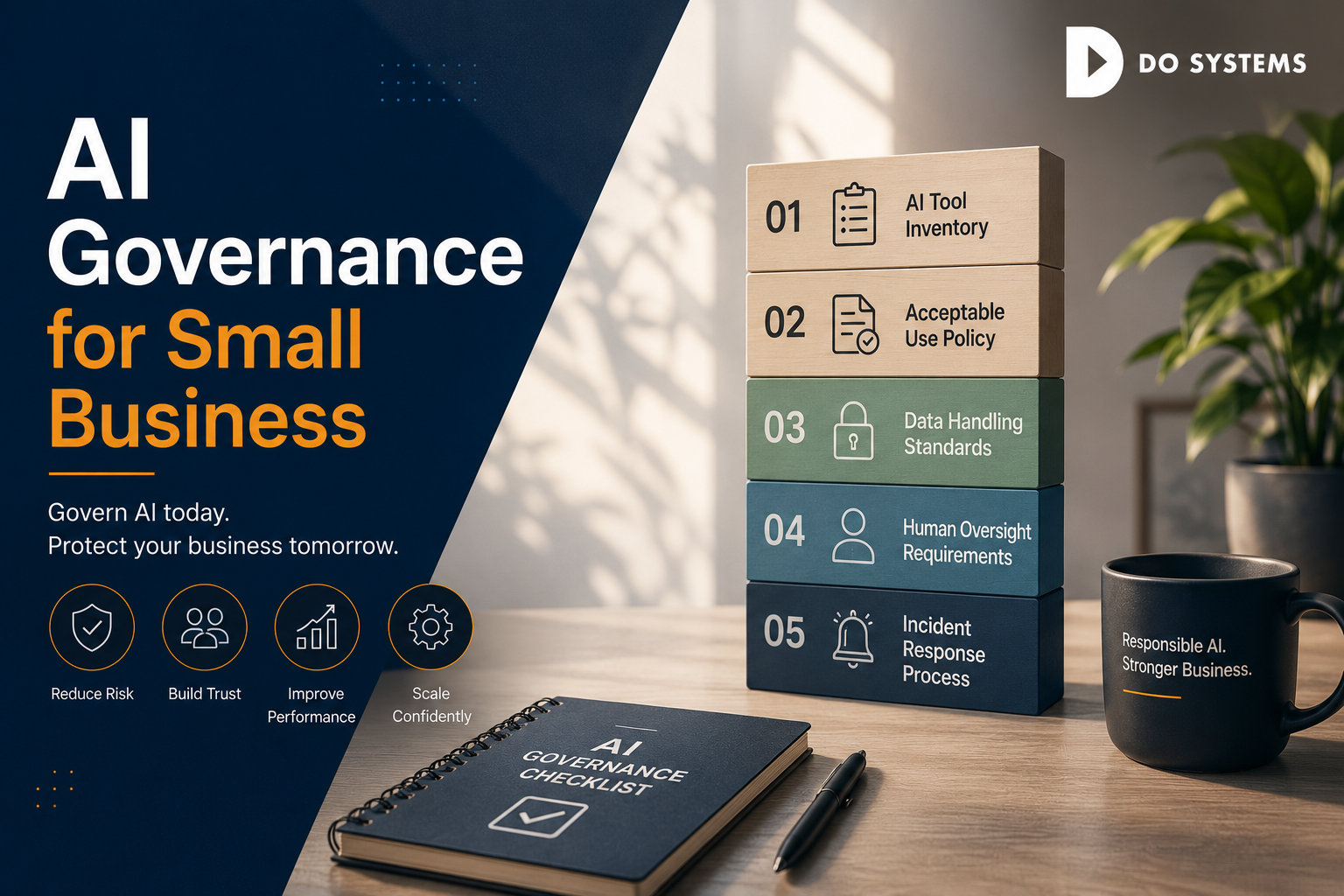
The foundational work that should precede any AI deployment includes: data readiness assessment and remediation for the specific use case, integration architecture design and build, AI governance framework establishment (tool inventory, acceptable use policy, data handling standards, human oversight definition), and stakeholder preparation (the people whose work will change need to understand what is changing and why before it changes).
In a 12-month roadmap, months one and two are almost always foundational work months. This can feel like slow progress when the leadership expectation is to see AI deployed quickly – but organisations that spend months one and two on foundations deploy in months three and four rather than discovering in months five and six that the data or integration is not ready.
The sequencing principle: no AI deployment before data readiness assessment is complete. No multi-system AI deployment before integration architecture is designed. No customer-facing AI deployment before acceptable use policy and data handling standards are in place.
Step 3: Define Success Before You Start
Every AI use case on your roadmap should have defined success criteria before implementation begins. Those criteria should include a pre-deployment baseline, a target metric at 90 days, and a business value metric at 180 days.
Pre-deployment baseline: measure the current state of the process the AI will improve. Time per transaction, cost per transaction, error rate, cycle time – whatever the relevant operational metrics are for that use case. Without this baseline, you cannot demonstrate improvement.
90-day target: what does efficiency improvement look like at 90 days? Define a specific, measurable target – not ‘faster processing’ but ‘30% reduction in average processing time per invoice’. This target determines whether the deployment is on track and whether adjustments are needed.
180-day business value metric: what business outcome does the efficiency improvement translate to? Cost reduction that flows to margin, revenue improvement from faster cycle time, risk reduction from fewer errors. This is the number that matters to leadership and to the ROI case for the next phase of the roadmap.
Assign measurement ownership to the business function that owns the outcome – not the IT team that deployed the AI. This removes the conflict of interest from ROI measurement and ensures the metrics are business-relevant rather than technically defined.
A 12-Month Roadmap Template
This is a realistic sequencing framework for an SMB deploying AI for the first time.
- Months 1-2 (Foundation): AI tool inventory and governance framework. Data readiness assessment for Use Case 1. Integration architecture design. Stakeholder communication and AI literacy preparation. Vendor evaluation and selection for Use Case 1.
- Months 3-4 (First Deployment): Use Case 1 implementation and integration. Testing and pre-launch validation. Go-live with human oversight protocols. Baseline measurement established.
- Months 5-6 (Optimise and Measure): Use Case 1 performance review at 90 days. Optimise based on escalation analysis and performance data. Governance review – update acceptable use policy based on operational learning. Begin data readiness assessment for Use Case 2.
- Months 7-9 (Second Deployment): Use Case 2 implementation. Apply lessons from Use Case 1 to integration and change management. Use Case 1 reaches 180-day business value measurement milestone.
- Months 10-12 (Scale and Plan): Use Case 2 performance optimisation. Use Case 1 ROI documented and reported. Year 2 roadmap planning – now informed by two completed deployments, real data, and operational learning.
Frequently Asked Questions
How many AI use cases should be on a first-year road map?
Two to three is the realistic number for most SMBs. Each deployment requires data work, integration work, governance work, and change management. Attempting more than three concurrent AI deployments in year one typically means none of them are executed well. A focused roadmap with two to three well-executed deployments builds more organisational capability than a broad roadmap with six partially-completed ones.
How do you get leadership buy-in for an AI roadmap?
Build the business case from business outcomes, not technology. Present each use case as a business problem with an AI solution – quantified in terms of current cost, target improvement, and expected business value. Include the foundational work costs (data, integration, governance) in the investment figure. Leadership buy-in is easier when the roadmap is framed as a business investment with defined returns rather than a technology initiative with uncertain outcomes.
What should be in an AI roadmap document?
A practical AI roadmap document should cover: the business outcomes the roadmap is designed to achieve, the use cases selected and why (including the evaluation criteria used), the sequencing and dependencies between use cases, the foundational work required and its timeline, the resource requirements (internal time, external costs, vendor contracts), the success metrics for each use case with pre-deployment baselines, and the governance framework that applies to all deployments. It should fit in 10-15 pages – a longer document is rarely read by the people who need to approve it.
How often should an AI roadmap be updated?
A 12-month AI roadmap should be reviewed quarterly and updated at the six-month mark. AI capabilities, vendor offerings, and business priorities all change significantly over 12 months – a roadmap written in January that has not been reviewed by July is likely outdated. The quarterly review checks progress against milestones and updates the plan based on what has been learned. The six-month update rebuilds the second half of the roadmap with the benefit of six months of operational experience.

Comments are closed