Small and medium businesses are not too small to be targeted. They are, in many cases, specifically targeted because they hold valuable data and typically have weaker security controls than enterprises.
IBM’s 2025 Cost of a Data Breach Report documents the scale of the SMB problem: 88% of SMB breaches included a ransomware component, compared to 39% for enterprise organisations. The SMB ransomware exposure rate is more than twice that of large companies partly because of lower detection capability and partly because SMBs are more likely to pay ransoms to restore operations.
AI is changing the security economics for SMBs in a meaningful way. The same IBM report found that organisations using AI and automation in security operations saved an average of $1.9 million per breach and detected threats 51 days faster. No other single factor in IBM’s research delivers comparable financial impact.
This does not require an enterprise security budget. Several AI-powered security tools are now available at SMB-appropriate price points. What it does require is understanding which tools address which threat patterns, and in what order to deploy them.
The Threat Landscape SMBs Are Actually Facing
IBM’s 2025 Cost of a Data Breach data shows that the average global cost of a data breach is $4.44 million. For US organisations, the figure is $10.22 million a record high. For an SMB, a breach of that magnitude is existential.
The three most common attack vectors against SMBs are phishing (credential theft through deceptive email), ransomware (encrypting business data and demanding payment), and supply chain compromise (gaining access to SMB systems through a trusted vendor or software product).
IBM’s research identified a growing threat category: shadow AI. In 20% of breaches analysed, shadow AI employees using unsanctioned AI tools that process company data was a contributing factor, adding an average of $670,000 to incident costs. For SMBs, shadow AI risk is particularly acute because employee AI tool adoption often outpaces IT visibility.
One in six breaches in IBM’s research involved attackers using AI themselves most commonly to draft personalised phishing emails (37% of AI-assisted attacks) or deepfake impersonations (35%). The social engineering threats arriving in your inbox are becoming harder to identify through traditional means, because AI-generated phishing content quality is significantly higher than manually crafted attacks.
Four AI Security Use Cases for SMBs
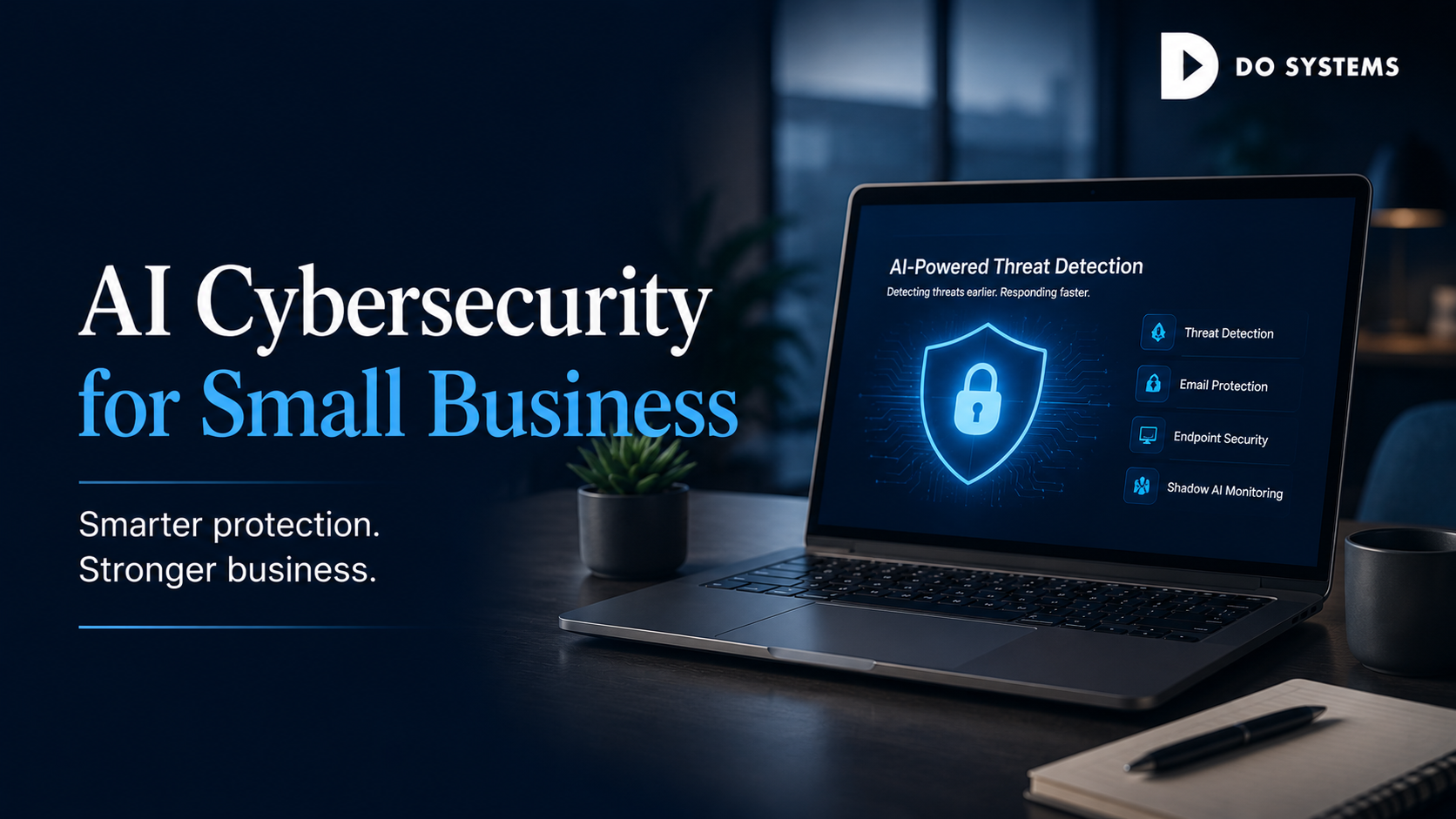
AI-powered email security. Email remains the most common initial attack vector. AI-powered email security platforms move beyond signature-based filtering to behavioural analysis that identifies novel phishing attempts, business email compromise (BEC), and social engineering patterns that traditional filters miss. This is the most accessible and highest-impact first deployment for most SMBs.
Endpoint detection and response (EDR) with AI. Traditional antivirus detects known malware signatures. AI-powered EDR monitors endpoint behaviour continuously, detecting anomalies that indicate compromise even when the malware itself has not been seen before. For SMBs with distributed remote workforces, EDR provides visibility across devices that perimeter security cannot reach.
AI-enhanced SIEM for log correlation. Security information and event management (SIEM) aggregates security logs from across your environment. AI adds the correlation layer identifying which log events across different systems indicate a coordinated attack pattern, rather than requiring staff to manually review log files. Cloud-native SIEM platforms have made this capability accessible to SMBs without a dedicated security operations centre.
Shadow AI monitoring. Given IBM’s finding that shadow AI contributed to 20% of breaches, monitoring for unsanctioned AI tool use is now a meaningful security control. Tools that monitor outbound data flows and application usage can identify which AI tools employees are using, what data they are inputting, and whether those tools are covered by organisational security policies.
How to Build a Prioritised SMB Security Plan Using AI
Security investment for SMBs should be sequenced by threat probability and impact, not by technology novelty.
Start with email security. It addresses the highest-probability attack vector and delivers the fastest reduction in breach risk. AI-powered email security platforms typically deploy in days with no infrastructure changes required.
Add EDR across all business endpoints before adding SIEM. Endpoint visibility without correlation is more immediately valuable than correlation without endpoint visibility. Once EDR is generating reliable endpoint data, SIEM correlation adds a meaningful second layer.
Address shadow AI risk through policy before you address it through tooling. A clear, communicated policy on which AI tools are approved — and a simple mechanism for employees to request approval for tools they want to use reduces unsanctioned adoption that creates security risk.
Measure your improvement against IBM’s benchmark: the 51-day faster detection achieved by AI and automation users. Tracking your mean time to detection (MTTD) and mean time to response (MTTR) before and after AI security deployments gives you documented evidence of risk reduction which matters for both internal reporting and cyber insurance purposes.
Frequently Asked Questions
Is AI cybersecurity too expensive for small businesses?
AI-powered email security and EDR are now available at SMB price points many platforms price per user per month in a range accessible to businesses with 10-200 employees. The relevant comparison is not the monthly platform cost against the IT budget; it is the platform cost against the $4.44 million average breach cost documented by IBM. The economics of AI security investment are clear at almost any company size.
Can AI fully automate cybersecurity for an SMB?
No. AI automates detection, alert correlation, and initial response triage it does not eliminate the need for human security oversight. For most SMBs, that human oversight comes from a managed security service provider (MSSP) or a part-time virtual CISO. AI makes that human oversight significantly more effective by reducing the alert volume and investigation time required.
What is shadow AI and why is it a security risk?
Shadow AI refers to AI tools used by employees without IT or security team knowledge or approval. The security risk arises because employees often input sensitive business data customer records, financial information, proprietary documents into AI tools whose data processing practices and security standards are unknown. IBM’s research found shadow AI contributed to 20% of breaches, adding an average of $670,000 to incident costs.
How does AI help with ransomware specifically?
AI-powered EDR and network monitoring can detect the behavioural patterns that precede ransomware encryption file system activity anomalies, unusual process execution, lateral movement patterns and trigger automated containment responses before encryption begins. Traditional antivirus detects ransomware by signature after execution; AI-powered detection addresses the pre-encryption behaviour window.
Comments are closed