The phishing email that hit her inbox on a Thursday morning looked exactly like it came from her accountant. The name. The signature. The writing style – including the slightly informal tone her accountant always used. It referenced a conversation from two weeks earlier that only the two of them had discussed.
It was not her accountant. It was an AI system that had scraped her accountant’s public communications, analysed the writing patterns, and generated a message indistinguishable from the real thing. She clicked the link. The breach that followed cost her business six weeks and $80,000 to resolve.
This is the new reality of cyberattacks in 2026. And it requires businesses to fundamentally update how they think about security.
What Has Actually Changed
Cyberattacks have always existed. What AI has changed is the economics and scale of sophisticated attacks. Techniques that previously required skilled human hackers – personalised social engineering, vulnerability discovery, identity spoofing – can now be automated at a cost that makes targeting any business, regardless of size, economically viable for attackers.
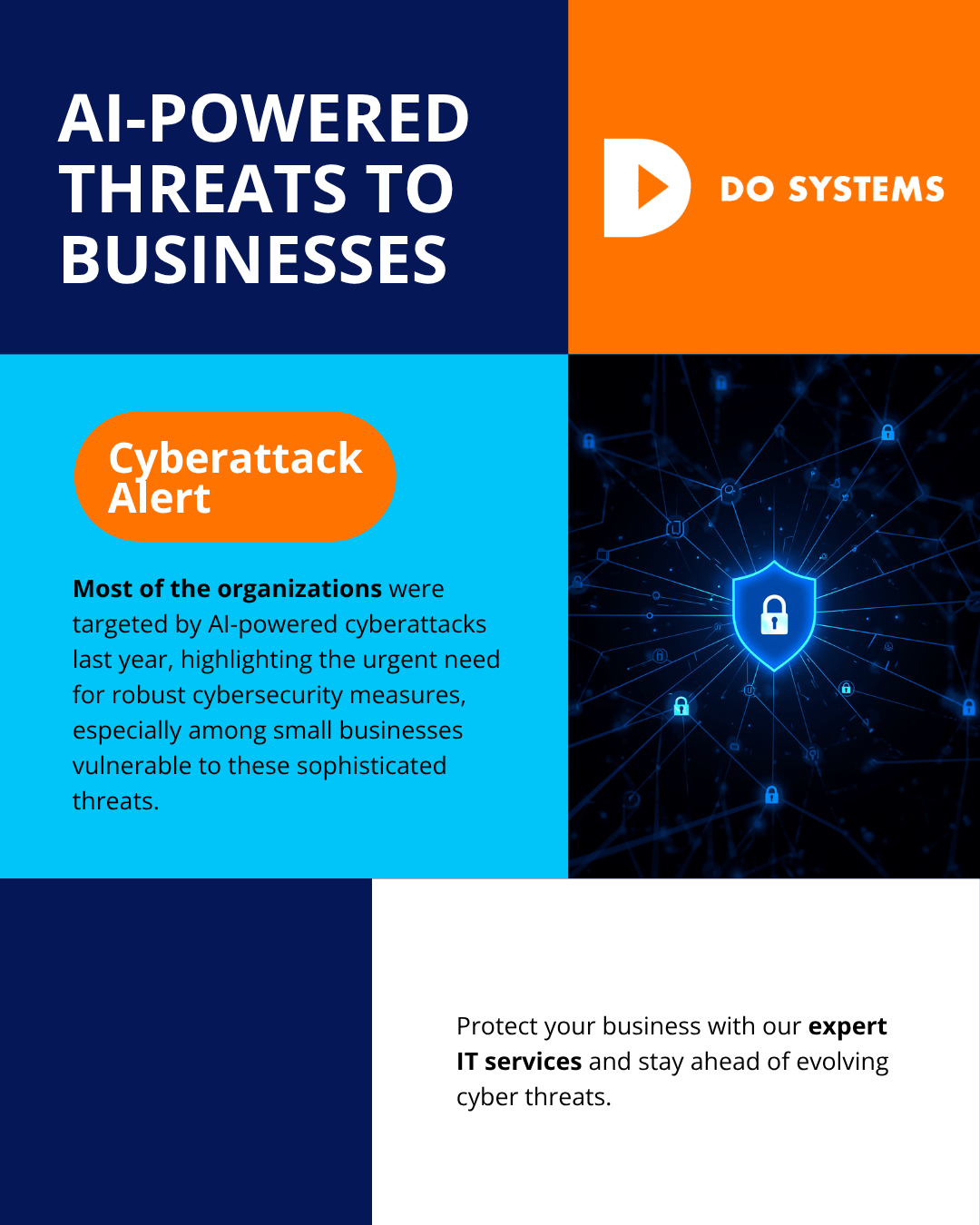
The numbers reflect this shift. 87% of organisations were targeted by an AI-powered cyberattack in the past year. Over 80% of phishing attacks now use AI in some form – from email generation to target reconnaissance. Phishing is projected to account for more than 42% of all global breaches in 2026, with agentic attacks – AI systems that conduct multi-step, personalised deception campaigns autonomously – driving that number higher. IBM’s X-Force Threat Index recorded a 44% increase in attacks exploiting public-facing application vulnerabilities, largely driven by AI-enabled vulnerability discovery.The defining characteristic of AI-powered attacks is speed. Traditional security monitoring is calibrated to human attack timescales. AI attacks operate at machine speed – discovering vulnerabilities, generating attack vectors, and executing breaches in windows that are measured in minutes rather than hours.
The Four AI Attack Types Businesses Face Right Now
1. AI-Generated Phishing and Social Engineering
AI analyses public communications – emails, LinkedIn posts, company website content – and generates highly personalised messages that mimic known contacts. The tell-tale signs of phishing that users have been trained to spot – generic greetings, poor grammar, implausible scenarios – are absent. These messages are contextually accurate and stylistically convincing.
2. Automated Vulnerability Discovery
AI systems continuously scan public-facing systems, APIs, and applications for vulnerabilities, operating at a speed and breadth that manual penetration testing cannot match. A vulnerability that your security team might find in a scheduled quarterly review is found by an AI attacker within hours of appearing.
3. Deepfake Identity Attacks
Nation-state actors and sophisticated criminal groups now use AI to generate synthetic identities – complete with believable professional histories, AI-generated photographs, and fabricated credentials – that infiltrate organisations as apparent legitimate employees or contractors. Once inside, they operate quietly, altering code, exfiltrating data, or establishing persistent access over months.
4. AI-Accelerated Ransomware
AI is used to identify the most valuable and vulnerable targets within a compromised network, optimise the timing and sequencing of ransomware deployment, and automate negotiation processes. Annual global damages from ransomware multi-stage extortion attacks are forecast to reach $74 billion in 2026.
What Defending Against AI Attacks Requires
Traditional security tools – firewalls, signature-based antivirus, periodic patch cycles – were designed for a threat landscape that no longer exists. They detect known threats at human speed. AI attacks are new, evolving, and fast.
Effective defence against AI-powered attacks requires AI-powered detection. Behavioural analysis that establishes what normal looks like for your specific environment and flags deviations in real time – not after a threshold is crossed, but when a pattern first emerges. This is the core of how modern managed security operates, and it is why the gap between businesses with AI-assisted security monitoring and those without has widened significantly in the past two years.
It also requires a different approach to staff awareness. The signals that trained users to spot phishing are no longer reliable. Updated awareness training needs to reflect the actual threat – AI-generated messages that are contextually accurate and stylistically indistinguishable from legitimate communications.
Where We Come In
DoSystems integrates AI-powered security monitoring into managed IT services for SMBs – continuous behavioural analysis, real-time anomaly detection, and threat response that operates at the speed the threat landscape now demands. If your current security posture was designed before AI-powered attacks were the norm, that assessment is overdue.
Frequently Asked Questions
What are AI-powered cyberattacks?
AI-powered cyberattacks use machine learning to automate vulnerability discovery, generate convincing phishing messages, create synthetic identities, and deploy ransomware with greater speed and personalisation than human-led attacks allow.
Are small businesses targeted by AI cyberattacks?
Yes. AI has lowered the cost of sophisticated attacks to the point where targeting any business is economically viable for attackers. 87% of organisations were targeted by AI cyberattacks in the past year, regardless of size.
How can businesses defend against AI-powered attacks?
Effective defence requires AI-powered detection – behavioural monitoring that identifies deviations from normal patterns in real time. Traditional signature-based tools are insufficient against AI-generated, rapidly evolving threats.
What is agentic phishing?
Agentic phishing is an AI-driven attack where an autonomous system conducts multi-step, personalised deception campaigns without human involvement – researching targets, generating contextually accurate messages, and adapting based on responses.
#AICybersecurity #AIThreats #Cybersecurity #DoSystems #AIAttacks #SmallBusinessSecurity #CyberDefense #AIStrategy
Comments are closed