I had a conversation last year with a business owner — let’s call him Mike — who ran a 25-person accounting firm. Smart guy. Built his business from nothing over 15 years.
He called me frustrated. Not angry. Just tired.
“We’ve fixed this server issue three times in the past six months,” he said. “Same problem. Different invoice. I’m starting to think IT is just a money pit.”
I hear this more than you’d think. And every time, it tells me the same thing — the business isn’t dealing with a technology problem. It’s dealing with an approach problem.
The Break-Fix Trap
Most small businesses manage IT the same way they handle a leaky faucet. Ignore it until it’s a problem. Call someone. Pay them. Move on.
That works fine for plumbing. It’s a disaster for technology.
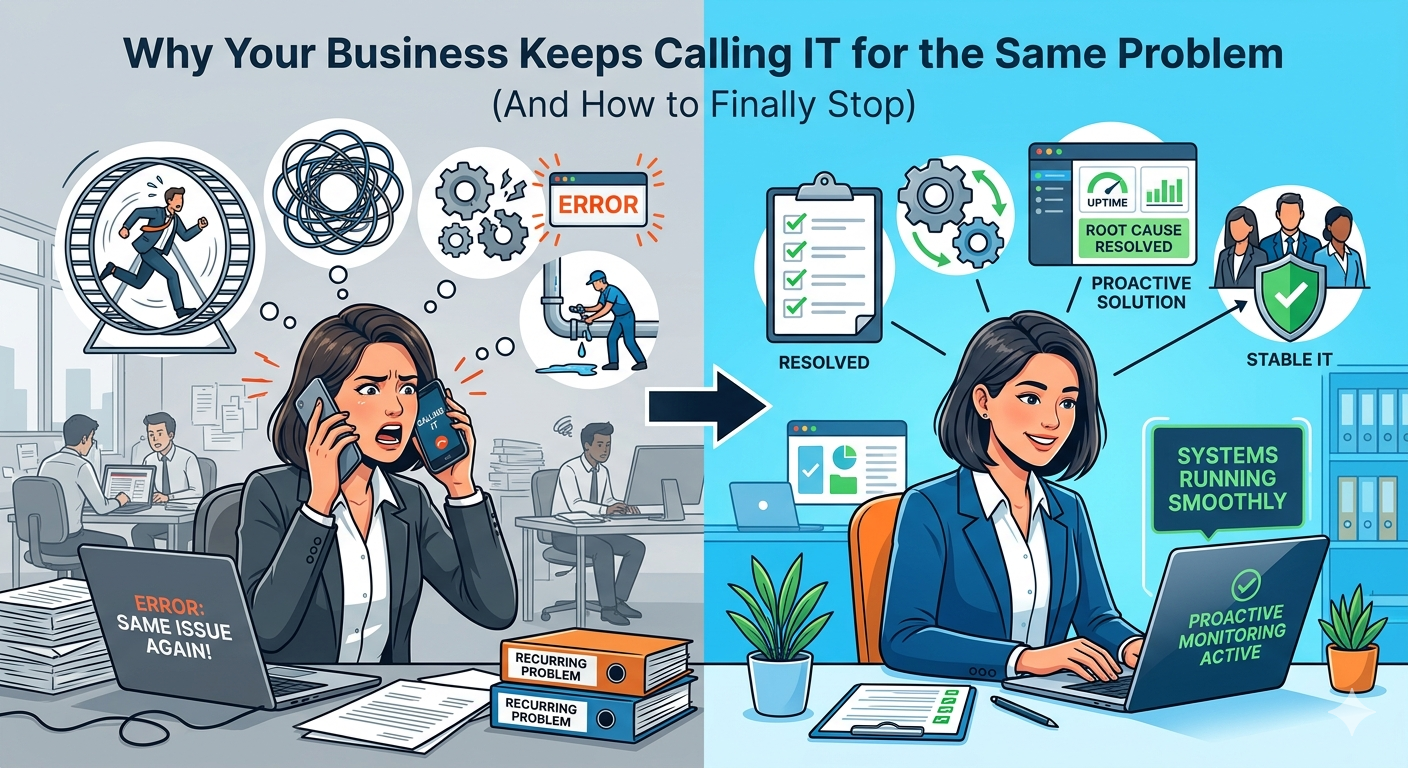
Here’s why. When you call IT reactively — meaning only when something breaks — you’re already behind. The damage is done. Your team has stopped working. Your clients may already be affected. And the “fix” only addresses the symptom, not the underlying issue that caused the break in the first place.
That’s why Mike kept calling about the same server. Each technician patched the surface problem and left. Nobody looked at why it kept happening.
This is what the industry calls break-fix IT. And it’s shockingly common — and shockingly expensive.
What It’s Actually Costing You
I know what you’re thinking. “We don’t call IT that often.” Maybe not. But let’s look at what actually happens every time your systems go down, even for a couple of hours.
Your team stops working. Or they work at reduced capacity, switching to manual workarounds, emailing from personal accounts, recreating files they can’t access. That lost productivity adds up fast.
Then there’s the ripple effect on your clients. Delayed responses. Missed deadlines. Proposals that didn’t go out on time. You might not see the damage immediately, but trust erodes quietly.
And then there’s the actual IT bill. Break-fix pricing is hourly, which means your provider has zero financial incentive to fix things permanently. Every recurring problem is billable. You’re literally paying for the same issue multiple times.
Research puts the average cost of IT downtime for a small business anywhere from $500 to over $5,000 per hour depending on your industry. Even at the low end, a few incidents per year add up to a number that would make most business owners wince.
Why This Keeps Happening
The break-fix cycle isn’t anyone’s fault, exactly. It’s just how most small businesses start out. You don’t need a full IT strategy when you have five employees and three laptops.
But businesses grow. Technology stacks get more complex. More devices. More software. Remote employees. Cloud tools. And suddenly, the informal “call someone when it breaks” approach is completely inadequate for what you’ve built.
The problem is that most business owners don’t notice the transition. They keep treating IT like a utility — something that should just work in the background until it doesn’t. And when it doesn’t, they pay to fix it and move on.
What they’re missing is the bigger picture. Technology isn’t just infrastructure anymore. For most businesses, it’s the backbone of every client interaction, every internal workflow, every piece of communication. When it fails, everything fails.
The Shift That Changes Everything
The businesses that stop having IT fires aren’t lucky. They’ve just made a fundamental shift in how they think about technology management.
Instead of waiting for things to break, they invest in preventing the break from happening at all.
This is what managed IT services is actually about. Not just having someone on call — having a team that’s actively watching your systems around the clock, applying patches before vulnerabilities become breaches, catching warning signs before they become outages.
Think about it like a car. You could drive it until the engine seizes and pay for a full rebuild. Or you could change the oil every few months and catch issues before they become catastrophic. The second approach costs less, causes less disruption, and extends the life of the whole system.
When we started working with Mike’s firm, we spent the first two weeks doing a proper infrastructure review. We found three recurring issues that had been causing his server problems — all preventable, none of which any of the previous technicians had flagged because they were only paid to fix what was immediately broken.
Within 90 days, his team hadn’t called IT once. Not because they got lucky. Because we were monitoring, patching, and maintaining proactively every single day.
Signs You’re Stuck in Break-Fix Mode
If any of these sound familiar, it might be time to rethink your IT approach:
You’ve dealt with the same issue more than once. If it’s happened before, it’ll happen again — and the next time might be worse.
Your IT support only contacts you when something’s wrong. A proactive IT partner should be sending you updates, reports, and recommendations — not just invoices.
You’re not sure what software is running on your systems or when it was last updated. Outdated software is one of the biggest security and stability risks for small businesses.
Your team has developed workarounds for IT problems. If people are emailing files to their personal accounts or keeping local copies of things that should be in the cloud, that’s a signal that your systems aren’t working the way they should.
What to Do Next
If you’re reading this and nodding along, you’re not alone. The break-fix cycle is the default for most SMBs — and the good news is that it’s entirely fixable.
The first step is an honest assessment of your current setup. Not a sales call. Not a pitch. Just a clear look at where your systems stand, where the recurring weak points are, and what it would realistically take to stabilize them.
At DoSystems, that’s exactly what we offer as a starting point — a free IT assessment with no obligation and no jargon. Just answers.
Because here’s the thing. The goal isn’t to have a great IT provider. The goal is to run a great business without technology getting in the way.
When IT just works — and keeps working — your team is more productive, your clients are happier, and you can spend your energy on the things that actually move the needle.
Mike put it well in a message he sent me a few months after we started working together: “I used to dread Monday mornings. Now I don’t even think about IT. That’s exactly how it should be.”
That’s the goal. And it’s more achievable than most business owners realize.
Ready to get out of the break-fix cycle?
Book a free IT assessment with the Do Systems team at www.dosystemsinc.com — no pressure, no sales pitch, just clarity.


Comments are closed