The AI project was approved in January. Budget confirmed, vendor selected, kick-off meeting scheduled. The first discovery session revealed that the core data source the project depended on had not been updated consistently for two years. The second discovery session revealed that the system the AI would integrate with was scheduled for replacement in eight months. The project was paused within six weeks of starting.
None of these issues were unknown to the organisation. They simply were not surfaced before the project was approved – because no one had done a readiness assessment.
AI readiness assessments are not bureaucratic overhead. They are the fastest way to find the problems that will stall your project – before those problems consume development budget and executive goodwill.
How Ready Are Most Businesses for AI?
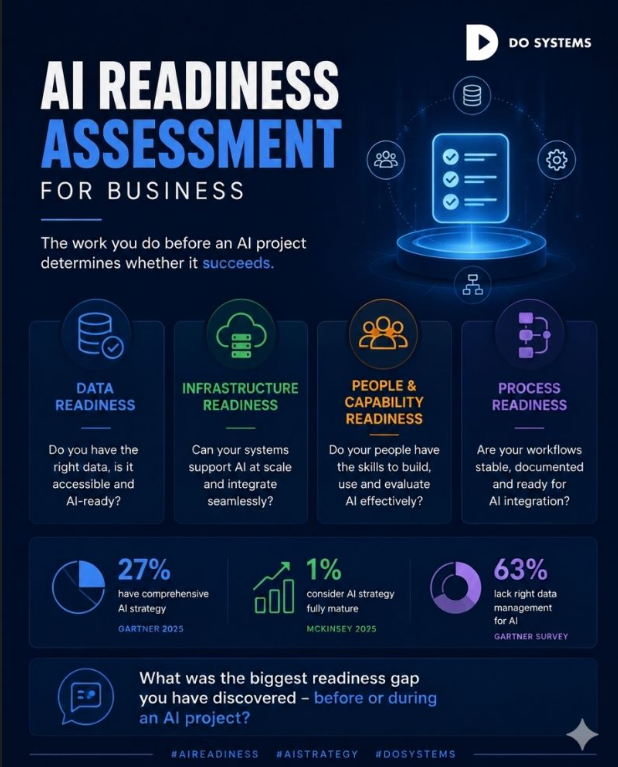
A December 2025 Gartner survey of 197 CxOs and senior business leaders found that only 27% of executives have a comprehensive AI strategy, and only 20% believe their workforce is truly AI-ready.
McKinsey’s 2025 State of AI research found that only 1% of organisations consider their AI strategies fully mature. Eighty-eight per cent of organisations are now using AI in at least one function, yet the vast majority are deploying tactical tools rather than operating with the strategic foundation needed to scale.
Gartner’s February 2025 research adds a critical data point: organisations will abandon 60% of AI projects due to lack of AI-ready data. In a separate Gartner survey of 248 data management leaders in Q3 2024, 63% of organisations either do not have or are not sure they have the right data management practices for AI.
These findings point to the same conclusion: the limiting factor in most AI implementations is not the technology. It is the readiness of the business to use it.
The Four Dimensions of AI Readiness
A structured readiness assessment evaluates four areas. Most organisations have significant gaps in at least two of them – and the assessment is the fastest way to find out which two.
1. Data Readiness
The most common readiness gap, and the hardest to close quickly. Data readiness covers whether the data the AI needs actually exists, whether the AI can access it, whether it is of sufficient quality and volume, and whether the organisation has the governance in place to use it for AI purposes.
The most frequent findings in a data readiness audit: availability problems (data exists in inaccessible legacy systems or unapproved formats), completeness problems (data covers only part of the range of conditions the AI will face – only successful transactions, only one business unit, only recent history), and governance problems (no clear policy on what data can be used for AI, who approved it, or what happens to it at the end of the engagement).
Clean data is not the same as AI-ready data. A database with consistent formatting and no duplicates can still be entirely unusable for a specific AI application if it lacks historical depth, covers the wrong time period, or excludes the outcomes the model needs to learn from.
2. Infrastructure Readiness
Can your current systems support AI deployment? This dimension covers compute capacity, cloud infrastructure, integration architecture, and security configuration.
The critical question is not whether you can run AI in isolation – it is whether your AI system can integrate with the existing operational environment at production scale. Integration failures are one of the most consistent sources of AI project delay, and they are almost always discoverable before development begins.
Infrastructure readiness also covers security: access controls, data encryption, model governance, and audit trail requirements. IBM’s 2025 Cost of a Data Breach Report found that 13% of organisations reported breaches involving AI models or applications, and 97% of those lacked proper AI access controls. Security configuration is not an afterthought in AI deployment.
3. People and Capability Readiness
Does your team have the capability to implement, maintain, and – critically – oversee an AI system? People readiness covers both technical capability and business capability.
On the technical side: do you have the data engineering, ML development, and DevOps skills to build and maintain the system? If not, which of these will you hire for, which will you partner for, and what does that change about the project timeline and cost?
On the business side: do the people who will use and oversee the AI system understand enough about how it works to evaluate its outputs responsibly? An AI system that produces outputs nobody can evaluate is an AI system waiting to produce an error that goes undetected.
4. Process Readiness
Is the business process that AI will integrate with sufficiently documented, stable, and understood? AI performs well on consistent, well-defined processes. It struggles with highly variable, poorly documented, or frequently changing workflows.
The most common process readiness finding: the workflow the AI is being built to improve is more variable in practice than it appears on paper. Edge cases that the AI is expected to handle are not accounted for in the process documentation because experienced staff handle them by exception and judgement.
Mapping the process in detail before AI development begins is not overhead – it is the input the AI developer needs to scope the system accurately.
What a Readiness Assessment Typically Reveals
Most organisations that complete a structured AI readiness assessment find significant gaps in data readiness and process documentation, moderate gaps in infrastructure, and variable gaps in people capability depending on whether the project is a buy or build decision.
The value of the assessment is not in the gap findings themselves – it is in the prioritisation they produce. Not all gaps need to be closed before development starts. Some can be closed in parallel. Some change the project scope. Some indicate that a different use case should be prioritised first.
An assessment that identifies a six-month data governance gap on day one of a project saves six months of development time that would otherwise be spent waiting for access that was never going to be granted.
FAQ: AI Readiness Assessments
How long does an AI readiness assessment take?
A focused assessment covering all four dimensions – data, infrastructure, people, and process – typically takes two to four weeks for a single use case. A broader organisational readiness assessment across multiple use cases or business units takes four to eight weeks. The investment is almost always returned in reduced project delay.
Who should be involved in an AI readiness assessment?
Data readiness requires input from data engineering and IT teams, plus the data owners for each required data source. Infrastructure requires IT architecture. People readiness requires HR and the line managers of the teams who will use and maintain the AI. Process readiness requires the business owners of the processes being automated – not just the process documentation.
Can a business run an AI readiness assessment internally?
Yes, though independent assessment typically surfaces gaps that internal teams overlook because the people doing the assessment are also responsible for the areas being assessed. An external assessment is particularly valuable for data readiness and process mapping, where organisational familiarity can create blind spots.
Comments are closed