
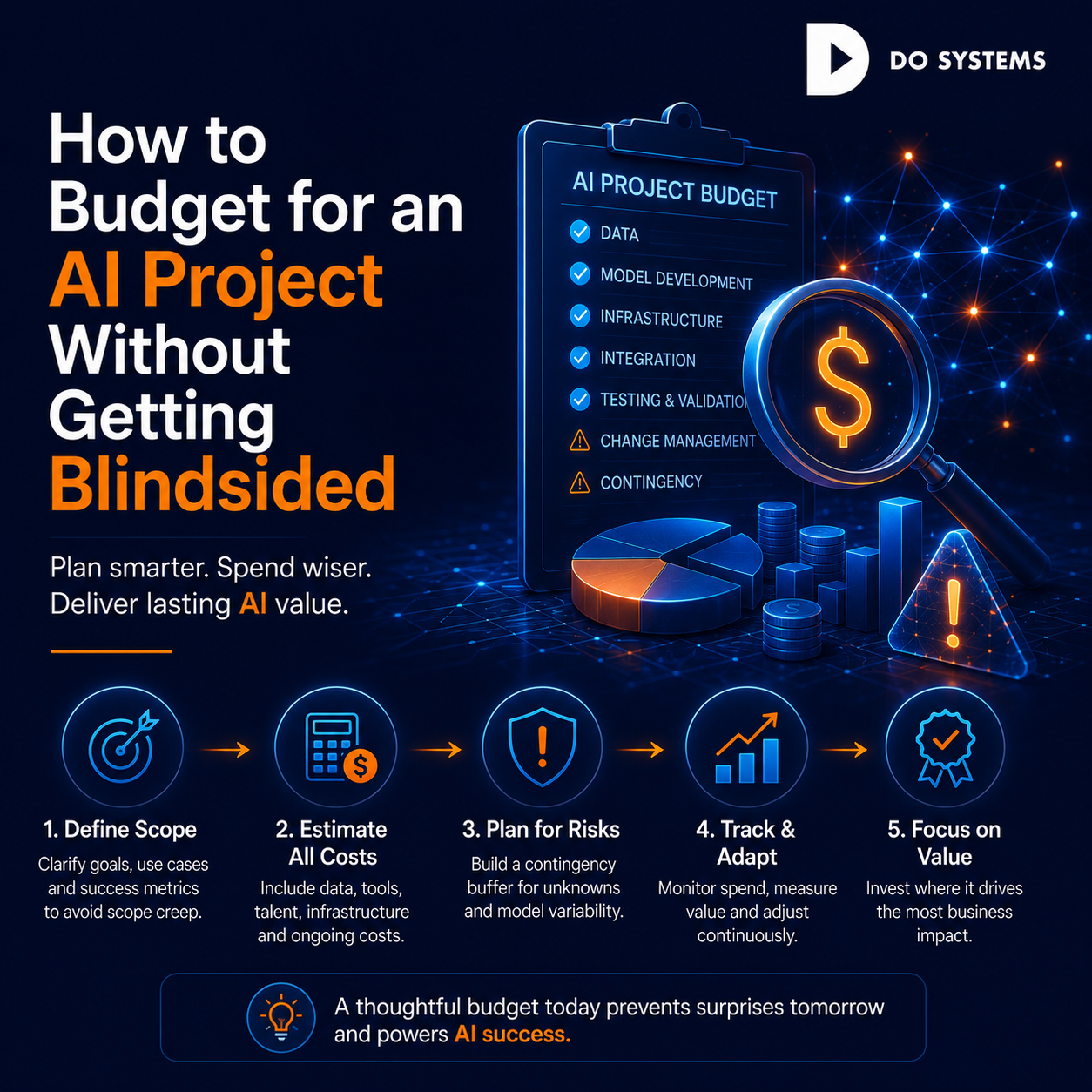
The initial budget proposal was thorough. Development cost, itemised by sprint. Vendor licence fees, monthly. Infrastructure, estimated by compute tier. The CFO approved it in a single review.
By month eight, the project was 60% over budget. Not because development had overrun – it had come in close to estimate. The overruns were in integration work that took four times longer than planned, change management that had not been budgeted at all, and monitoring infrastructure that nobody had scoped.
The AI development budget was accurate. The AI project budget was not. They are different things, and the gap between them is where most AI investments go wrong.
Why AI Budgets Consistently Underperform
Gartner’s May 2025 survey of over 500 CIOs found that 72% of organisations are breaking even or losing money on their AI investments. This is a striking statistic given the scale of AI investment happening simultaneously. The causes are complex, but one consistent thread is that the business case at approval does not reflect the full cost of the project.
Gartner’s analysis noted that for every AI tool or system an organisation deploys, there are typically ten categories of hidden costs that are not reflected in the initial proposal – including transition costs, change management, and ongoing maintenance. The development or licence cost that appears in the approval document is the starting point, not the total.
The Five Cost Categories a Complete AI Budget Must Include
1. Development or Licence Cost
This is the cost that almost always appears in the initial budget: custom development hours (or vendor fees), model training infrastructure, and initial testing.
For custom builds, development cost is relatively well-estimated for the first phase but consistently underestimated for integration and testing phases. Build your development estimate with a 20–30% contingency on the phases following initial model development.
For vendor solutions, licence cost is clear but typically does not include the full implementation effort. Vendor implementations almost always require internal resource time and often require external implementation support that the initial quote does not include.
2. Data Preparation and Infrastructure
Data preparation is consistently the most underestimated cost category in AI projects. Making data AI-ready – cleaning, structuring, labelling, resolving access permissions, and building the pipelines that keep the AI supplied with current data – frequently consumes as much effort as model development itself.
If your data readiness assessment has not been completed before budgeting, treat data preparation as a variable cost with a wide range. Projects that discover significant data issues after development starts face both cost overruns and timeline extensions.
Infrastructure costs also include compute – particularly at production scale. AI inference at production load is consistently more expensive than test environment estimates. Build compute costs from production throughput assumptions, not development environment usage.
3. Integration
Integration is the most reliable source of AI budget overruns. The time required to connect an AI system to existing operational systems – CRM, ERP, data warehouses, legacy platforms – almost always exceeds the estimate.
Plan integration at 2–3x your initial estimate if this is your first AI project. If your readiness assessment has identified complex integration dependencies, plan at the higher end. The organisations that budget integration accurately are the ones that have delivered integrations to similar systems before.
Integration also has ongoing costs: the systems your AI integrates with change over time, and those changes require AI integration updates. Budget for ongoing integration maintenance from year one.
4. Change Management and Training
Change management is the cost category most frequently excluded from AI project budgets entirely. It is also one of the most consequential – an AI system that the intended users do not adopt does not deliver ROI regardless of how well it performs technically.
Change management costs include: user research and workflow redesign (before development), training programme development and delivery, ongoing support resources for the first three to six months post-launch, and manager enablement. The last item is particularly important: managers who do not understand what the AI does and do not trust its outputs become passive adoption blockers.
A useful baseline: budget change management and training at 15–20% of total development cost for projects affecting more than 20 people.
5. Monitoring, Maintenance, and Retraining
AI systems are not static after deployment. They require active monitoring for output quality and data drift, periodic retraining as the data distribution shifts from what the model was trained on, and ongoing maintenance as the systems they integrate with evolve.
Monitoring infrastructure – the tooling, alerting, and review processes that catch performance degradation before it becomes a business problem – has a cost that must be budgeted before go-live, not discovered after.
A practical estimate: ongoing monitoring, maintenance, and retraining costs run at 15–25% of the initial development cost annually. For a custom AI system that cost £200,000 to build, budget £30,000–£50,000 per year for ongoing operations. If this budget does not exist, the system will degrade without anyone noticing.
How to Present an AI Budget That Will Hold Up
An AI budget that holds up through delivery presents total cost of ownership over three years, not year-one cost only. It breaks down each of the five cost categories with explicit assumptions. It includes a contingency that is larger for integration and data preparation than for development. And it ties each cost category to the business case – the ROI calculation should include all five cost categories, not just development.
A budget that only shows development cost is not a complete AI business case. It is the first line item of one.
FAQ: AI Project Budget Planning
What percentage of an AI project budget should go to development vs. other costs?
In a well-planned AI project, development typically accounts for 35–50% of total project cost. Data preparation and infrastructure, integration, change management, and first-year monitoring costs make up the remainder. Projects that allocate 80–90% of budget to development are underinvesting in the phases that determine whether the system actually gets used.
How should AI maintenance and monitoring costs be presented to the CFO?
Present monitoring and maintenance costs as a percentage of the asset value – similar to how physical asset maintenance is budgeted. An AI system that cost £500,000 to build carrying a £75,000–£125,000 annual maintenance budget is comparable to any other significant business system. Frame it as protecting the return on the development investment, not as an additional cost.
What is the most common cause of AI budget overruns?
Integration complexity is the most consistent source of overruns in projects that have done reasonable development planning. Data preparation is the most common source of overruns in projects that have not completed a data readiness assessment before budgeting. Both are discoverable before development starts.
#AIImplementation #AIStrategy #AIProjects #DoSystems #AIConsulting #AIRoadmap #BusinessAI

Comments are closed