He approved the budget for an off-the-shelf AI platform because it looked like exactly what the business needed. The demos were accurate. The reference customers were in adjacent industries. The integration timeline was eight weeks.
Fourteen months and two failed integration attempts later, the platform was live – for a single use case, in a single business unit, in a configuration so customised it bore almost no resemblance to the product he had purchased. The team was maintaining it as if they had built it from scratch. They had paid licence fees throughout.
The build vs. buy decision in AI is one of the most consequential choices in any project. It affects cost, timeline, ownership, strategic positioning, and what you can do with the system two years from now. It is also, frequently, made on the wrong criteria.
Why the Decision Is Harder Than It Looks
The conventional wisdom is that buying is faster and building is more powerful. Both claims are conditionally true and frequently wrong in practice.
Gartner’s May 2025 survey of over 500 CIOs found that 72% of organisations are breaking even or losing money on their AI investments. That figure spans both build and buy decisions – it reflects a systemic problem with how organisations evaluate AI investments before committing, not a failure of any particular approach.
Gartner’s April 2026 research adds important context: organisations with successful AI initiatives invest up to four times more in data and analytics foundations than average performers. The implication is that the build vs. buy choice matters less than the quality of the data and infrastructure underneath it. An organisation that buys a best-in-class AI product and puts it on poor data will underperform an organisation that builds a simpler solution on excellent data.
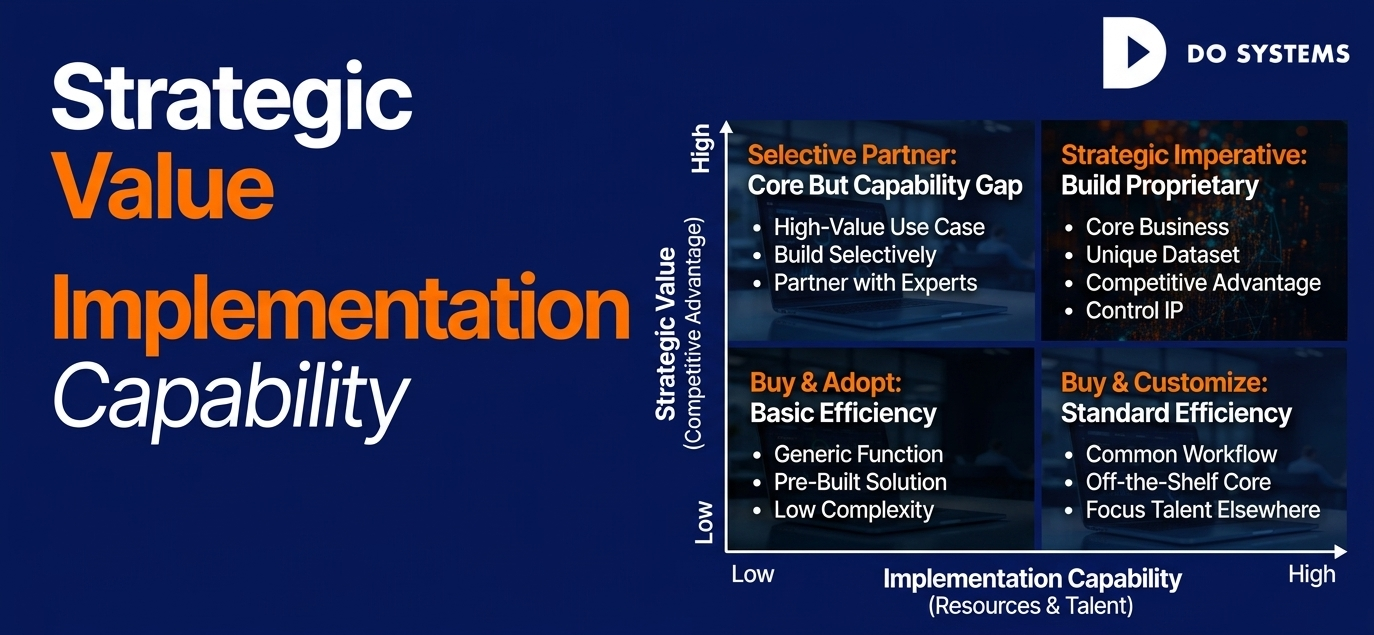
The decision framework, then, is not which option is better in the abstract. It is which option is better for this use case, with this data, in this organisation, over this time horizon.
When to Buy an Off-the-Shelf AI Solution
Buying makes sense when the use case is not a source of competitive differentiation. If other companies in your industry are solving the same problem in roughly the same way – document classification, invoice processing, customer service routing, email summarization – an off-the-shelf solution is almost always the right choice.
Four signals that buying is the right call:
- The use case is generic: the problem you are solving is solved similarly by dozens of vendors with proven deployments in your industry.
- Speed matters more than differentiation: you need the capability in weeks, not months, and the value is in having it rather than owning it.
- Your team lacks AI maintenance capacity: custom AI systems require ongoing monitoring, retraining, and support. If you do not have that capability internally, buying from a vendor who provides managed services reduces your operational risk.
- No proprietary data advantage: if your data is not meaningfully different from what a vendor’s model was trained on, you are unlikely to outperform a well-tuned commercial product by building from scratch.
The risk with buying is not the decision itself. It is the assumption that ‘off-the-shelf’ means ‘zero integration effort.’ Every AI product requires configuration, integration, and change management. Budget for it before committing.
When to Build Custom AI
Building makes sense when the use case is genuinely differentiated – when the AI needs domain knowledge, proprietary data, or decision logic that no commercially available product contains.
Four signals that building is the right call:
- Your data creates a competitive advantage: you have transaction history, customer behaviour patterns, or domain-specific labelled data that no vendor has access to and that trained on your data would outperform any generic model.
- The use case requires explainability or auditability: regulated industries – financial services, healthcare, legal – often require the ability to audit exactly how an AI reached a decision. This is difficult to achieve with black-box commercial products.
- Off-the-shelf products require extensive customisation: if every vendor you have evaluated requires significant modification to match your use case, you are effectively building anyway while paying a licence fee for the privilege.
- Long-term ownership is a strategic priority: building gives you full control over model behaviour, data handling, and future capability development. If AI is going to be a core differentiator in your business, owning the system is a strategic asset.
The risk with building is scope underestimation. Custom AI development consistently takes longer and costs more than initial estimates – particularly in integration, testing, and change management. Build your budget and timeline assumptions conservatively.
The Total Cost of Ownership Question
Most build vs. buy analyses compare the wrong number. Initial development cost or year-one licence fee is not the right variable. Total cost of ownership over three years is.
For a bought solution, TCO includes: licence fees (often increasing year over year), integration costs (frequently underestimated), customisation costs, vendor-managed pricing changes, and exit costs if you switch vendors or bring the capability in-house.
For a built solution, TCO includes: development cost (one-time but significant), integration (always longer than estimated), ongoing maintenance and retraining (typically 15–25% of initial development cost annually), compute infrastructure, and the talent cost to keep the system performing.
Neither option is inherently cheaper. The TCO analysis will depend heavily on use case complexity, data quality, integration depth, and internal capability. Run it over three years minimum before deciding.
A Four-Question Decision Framework
Before making the build vs. buy call, answer these four questions in order.
Question one: How differentiated is this use case? If competitors could use the same off-the-shelf solution and solve the same problem, differentiation is low. Low differentiation points to buying. High differentiation – where your data, domain, or decision logic is genuinely unique – points to building.
Question two: Do we have proprietary data that creates a competitive advantage here? If yes, and if the AI could capture that advantage in a way a commercial product cannot, that is a strong argument for building. If your data is similar to what a vendor’s training data already contains, that argument weakens significantly.
Question three: Can our team maintain a custom system post-deployment? AI systems are not static. They require monitoring, retraining as data drifts, and ongoing support. If that capability does not exist internally, a vendor-managed solution reduces operational risk – even if building would be technically superior.
Question four: What is the three-year total cost of ownership for each option? Build the numbers before the decision. A solution that looks cheaper to buy in year one may be significantly more expensive by year three when integration, licensing, and exit costs are included.
FAQ: Build vs. Buy AI
Is it cheaper to build or buy AI?
It depends on the use case and timeline. Off-the-shelf AI tools carry lower upfront costs but recurring licence fees and limited customisation headroom. Custom AI carries higher initial development cost but can deliver lower long-term operational cost if the use case is genuinely differentiated. Run a three-year total cost of ownership comparison before deciding.
What are the biggest risks of buying off-the-shelf AI?
Vendor lock-in, limited control over model updates, data handling risks, and inability to adapt the system to domain-specific requirements. Always review the data handling agreement and request SOC 2 Type II documentation before committing. Understand exactly how pricing can change over the contract period.
What makes a use case suitable for custom AI development?
Genuine differentiation (the off-the-shelf options don’t serve your domain adequately), proprietary data that provides competitive advantage, regulatory requirements for explainability or auditability, and sufficient internal capacity to maintain the system after deployment.
How long does it take to build custom AI vs. deploy an off-the-shelf solution?
A focused custom AI build with clean data and clear scope can reach a working pilot in 60–90 days. Off-the-shelf solutions often quote shorter timelines but consistently extend during integration. Plan for integration complexity in both cases – it is almost always the longest phase.
→ Next Step: DoSystems helps businesses make build vs. buy AI decisions with a structured analysis rather than vendor preference. If you are evaluating AI options for your business, start with a scoping conversation at DoSystemsInc.com.
AIStrategy #AIROI #AIImplementation #DoSystems #AIConsulting #BusinessAI #AIProjects
Comments are closed