The Question Before the Pilot Question
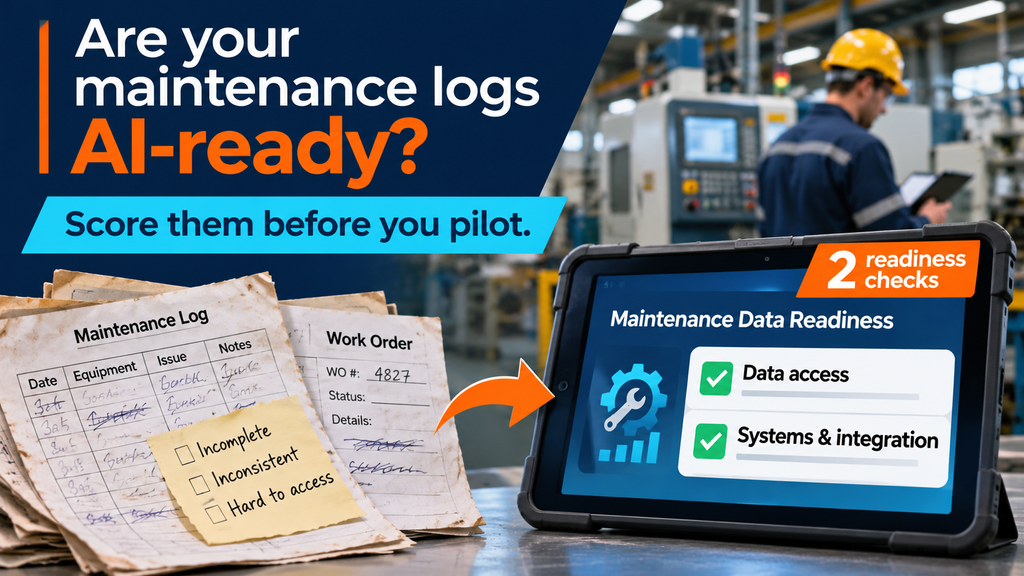
A generative AI tool can summarize text. It cannot summarize text that does not exist in a usable form. Before you evaluate a platform that promises to flag recurring equipment failures or summarize technician notes, answer a narrower question: can your maintenance log process pass the Data access and Systems & integration checks on the AI Readiness Checklist?
A vendor pitch for generative AI in maintenance operations can assume the input is clean. Treat that as a claim to verify, not a fact to accept. Pull your own logs and check them against two specific points before any proposal reaches a budget line.
What Data Access Means for Maintenance Logs
The checklist’s Data access point asks a plain question: can the team pull the data this process needs within a week, without starting a data project first? For maintenance logs, that means knowing exactly where the record of each repair, inspection, and failure lives, and whether that record is complete enough to summarize.
Name the system. Say it in one sentence: “Work order notes live in the CMMS, closed out by technicians at end of shift.” If the honest answer involves a binder in the supervisor’s office, a shared drive folder with inconsistent file names across three different habits, and a few technicians who keep their own notebooks, you do not have data access. You have data location, spread across formats that no single process has reconciled.
Pull a sample of recent entries and read them end to end. Ask whether a new hire, with no plant history, could understand the equipment, the failure mode, and the resolution from the text alone. A field that reads “fixed” or “ok now” tells a generative AI tool nothing worth summarizing. Reject any pilot plan that treats log content as a given rather than something to inspect first.
What Systems & Integration Means Here
The Systems & integration point asks whether you know which systems the AI output must write back to, and whether those systems expose an API or a supported integration path. For maintenance operations, this can span several systems. Logs may sit in a CMMS, failure codes in a separate SCADA export, parts history in an ERP module, and technician comments in a ticketing tool that was never connected to the rest.
A generative AI summary that lives in its own chat window, disconnected from the CMMS, is a demo, not an operational tool. A team that asks a technician to copy a flagged issue out of a chat window and paste it into a work order is asking for a step that can get skipped once the shift gets busy. Name the target system before you name the AI vendor. If the answer is “we’re not sure yet,” that is the integration work, and it belongs in the pilot scope, not left as a surprise after signing.
Score Your Logs Before You Score the Vendor
Use the checklist’s own scale: zero means not true or you don’t know, one means partly true, two means clearly true with evidence. A zero on Data access is a blocker on its own, regardless of how the rest of the pilot scores. A zero on Systems & integration is a gap to close before the pilot is scoped.
Ask these questions directly, in a room with the maintenance supervisor and whoever owns the CMMS:
– Where does every maintenance log entry live today, named specifically, not generally?
– Who can pull a complete export of recent entries without asking three people first?
– Do closed work orders contain enough free text to describe what actually happened, or do they contain status codes alone?
– Which system must receive a flagged pattern or summary for a technician to act on it?
– Does that system have an API, or will someone be copying and pasting by hand?
Write down the score for each answer. A team scoring zero on more than one of these should treat that as the actual project: get the logs into one place, in one format, before discussing summarization at all.
What Happens If You Skip This Step
A pilot scoped around clean sample data, handed over once by IT, looks successful in a demo. Production is a different test. Production means a generative AI tool reading whatever a technician writes at the end of a busy shift. A team that skips the Data access check can find this gap after the contract is signed, not before, and the cleanup becomes unscoped work the original budget didn’t cover.
This connects directly to the checklist’s Budget & timeline point: a pilot funded without a funded rollout stage is a pattern worth watching for, and it explains why a pilot can succeed in a lab and stall once it reaches the plant floor. Data cleanup after the fact is exactly the kind of rollout cost that surfaces late. It also connects to Build, buy or partner: fixing log structure and building an integration path are different skill sets, and deciding which to handle internally versus bring in help for is a decision worth making with real information, not assumptions made during a sales call.
Fix the Input Before You Buy the Output
None of this requires rejecting generative AI for maintenance operations. It requires sequencing the work correctly. Score the Data access and Systems & integration points honestly, using the questions above, before a vendor conversation goes further than a first call. A log system that passes both checks is a genuinely different starting point than one that doesn’t, and the difference shows up in whether the pilot produces something a technician actually uses or a chat window staff may stop opening.
Run the full ten-point check against your own maintenance process using the AI Readiness Checklist, and see exactly where your plant stands before a vendor tells you where they think you stand.
AI Readiness Checklist (10 points)
FAQ
What makes maintenance logs ready for generative AI?
Two checklist points matter most here: Data access and Systems & integration. Logs need to live in a known, pullable location with enough descriptive text to summarize, and the output needs a named system to write back into, with an API or supported integration path, not a separate chat window.
Can generative AI read handwritten maintenance logs directly?
Handwritten or scanned logs need a transcription or structured-entry step before a generative AI tool can use them reliably. Treat that conversion as part of the project scope, not an assumption the AI vendor will absorb for free.
What’s the first step before piloting generative AI on maintenance data?
Score the process against the AI Readiness Checklist, focusing first on Data access and Systems & integration. A zero on Data access is a blocker on its own; a zero on Systems & integration is a gap to close before a pilot is scoped or budgeted.
Comments are closed