
Quick answer: Returns reconciliation should be scored for AI readiness before a business adds seasonal headcount. Evaluate the process against 10 readiness points, each worth 0, 1, or 2. A total under 12, or a zero on data access, security, or ownership, means the process needs preparation rather than an immediate AI pilot. A high score supports a tightly scoped test; it does not automatically rule out hiring. Score the process before the budget conversation.
For ecommerce businesses managing seasonal spikes, returns reconciliation can become a major operational bottleneck, increasing processing time, costs, and the risk of errors. Evaluating AI readiness before expanding the team helps leaders identify automation opportunities, improve efficiency, and make informed staffing decisions based on measurable business outcomes.
Table of Contents
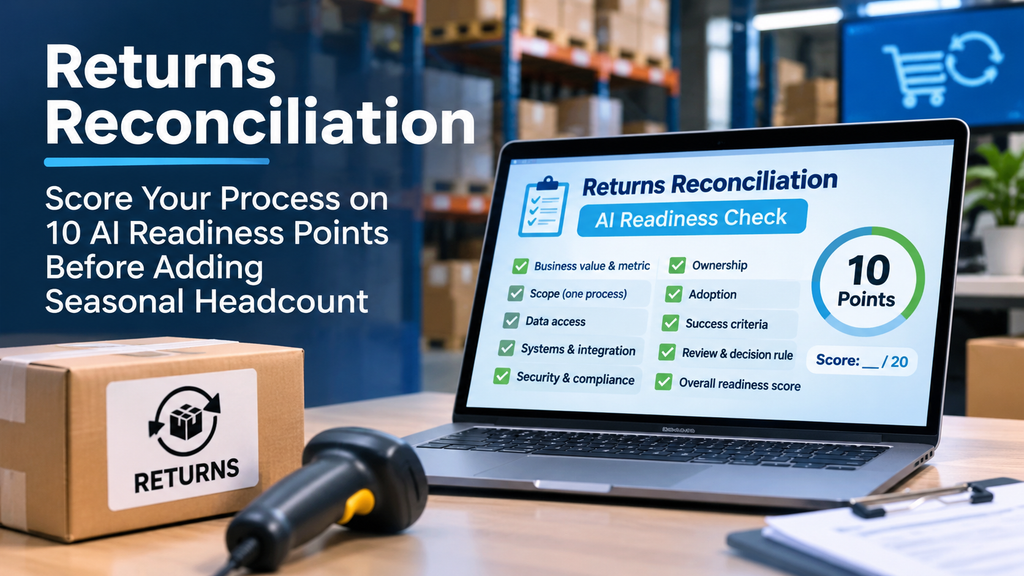
Ten Points, Twenty Possible, One Decision
Ten points. Twenty possible. That’s the structure that separates a returns reconciliation process ready for an AI pilot from one that still relies on people to absorb every seasonal spike.
Score each point 0, 1, or 2: zero if it is not true or no one knows, one if it is partly true, and two if it is clearly true with evidence.
Add the points. Seventeen to twenty means ready to pilot. Twelve to sixteen means nearly ready. Six to eleven means prepare first. Zero to five means not yet. A zero on data access, security and compliance, or ownership is a blocker regardless of the total.
That score is a decision tool for the head of ecommerce operations before approving another seasonal hire for returns. Not instead of the headcount conversation. Before it.
Headcount might still be right this quarter. The checklist does not argue against hiring; it argues against making the choice without testing whether a focused AI pilot could change the economics of returns reconciliation.
A structured assessment helps operations leaders identify whether returns reconciliation challenges stem from inefficient workflows, disconnected systems, or insufficient resources. Rather than investing in automation without clear expectations, businesses can use readiness scores to prioritize improvements that deliver measurable value.
This approach also reduces the risk of launching AI initiatives that lack proper data, ownership, or success criteria. By identifying these gaps early, organizations can make more informed decisions about automation investments, operational efficiency, and seasonal workforce planning.
Headcount Is One Answer. Readiness Is the Question Underneath It.
When returns and inventory reconciliation volume grows each season, that is a demand problem. Adding people is one supply response.
Neither answer tells the team whether returns reconciliation is structured well enough for an AI pilot to handle part of the work, or whether manual judgment is still essential. That is a readiness question, not a staffing question.
Run the first two points against the process specifically.
Point one: state the value in one sentence with a number attached. Name the process, choose a metric such as hours per case, cost per reconciliation, or exception rate, and capture today’s baseline.
“We want to use AI for returns” is not a business case.
“Reduce manual match time for refund-to-inventory records from its measured baseline” is a better starting point.
Point two: pick one process, not a portfolio.
A team that combines returns, restocking, and customer messaging into one AI initiative is already weakening its scope.
Returns reconciliation alone, with repetitive steps, clear inputs and outputs, and a named manager, is easier to evaluate. It gives the team a specific workflow to improve and a clear boundary for the pilot.
Point 8: Why a Pilot Can Run Without Ever Getting a Verdict
If a past GenAI experiment on customer messaging was never evaluated against a pass/fail metric, it did not necessarily fail. It may never have been judged.
That is a different problem, and it traces to point eight: success criteria defined before the pilot begins.
A ready pilot has a target metric, a minimum threshold, a review date, and a decision rule: scale, fix, or stop.
A pilot that ends when the demo looks good, with success decided afterward, scores zero on this point no matter how promising the demonstration was.
That gap must close before another pilot is approved. Reject proposals that do not attach a number and a date to the word “done.”
A demonstration is evidence that something can run. It is not evidence that the workflow has improved.
Apply that standard to returns reconciliation before the pilot starts.
Name an owner. Define the baseline. Set an improvement threshold. Choose a review date. Specify the conditions that would stop the test, such as unacceptable errors or privacy concerns.
Without those elements, the business cannot make a defensible decision about investing more in the system.
The NIST AI Risk Management Framework Playbook offers additional guidance on governance, measuring risks, and managing AI systems. It is not the same as this 10-point business checklist, but its approach reinforces why evaluation and accountability belong in the plan from the beginning.
What the Rest of the Score Tells You
Points three through seven help determine whether a returns reconciliation pilot can run reliably, not just whether the idea sounds useful.
They surface questions that are easy to overlook when an AI tool looks impressive in a demonstration.
Data access
Can the team retrieve returns, refund, and inventory records within a week, without starting a separate data project?
If returns data sits in a ticketing platform, inventory in the ERP, and refund status in a manually maintained spreadsheet, the first challenge may be connecting records accurately.
Incomplete identifiers, missing fields, and delayed updates can undermine the results before a model is even involved.
Systems and integration
Does the proposed output need to write back to the ERP or returns-management system, or will staff copy information from a chat window?
If employees still reconcile every record by hand after reading an AI suggestion, the projected time savings may disappear.
Map the full workflow, including approvals, audit trails, and exception handling, before estimating benefits.
Security and compliance
Has the team classified the data involved and confirmed which systems and people can access it?
Returns reconciliation may include order details, payment references, and customer information.
Data access should follow approved policies rather than the convenience of a pilot.
The joint AI data security guidance published by the NSA and partner agencies describes practical measures for protecting information used to operate AI systems.
A zero in security is a reason to pause, not a problem to fix after launch.
Ownership and adoption
Is there a named business owner with time allocated to the project?
Have the people doing reconciliation helped define the new workflow?
A pilot announced without employee input can miss important exceptions or create resistance.
Staff should be able to explain where the work slows down, which errors matter, and what a useful AI recommendation would look like.
A strong returns reconciliation assessment distinguishes technical possibility from operational readiness.
Teams should not award high scores because software exists or a vendor claims integration is simple.
They should award them because the evidence is available, the risks are understood, and the owner can explain how the workflow would actually change.
What to Measure Before You Approve the Pilot
The most useful returns reconciliation metrics are the ones an operations leader already cares about.
Begin with a baseline: average time to match a refund to an inventory event, number of unresolved exceptions, rate of incorrect matches, and time spent reviewing disputed cases.
Choose one primary measure and a small set of safeguards instead of promising improvements everywhere at once.
Then compare a limited pilot against the existing process using comparable cases.
Track the cases that still need human review, not just the cases the tool handles easily.
Ask whether the system reduces work for the team or merely moves the work to someone checking its outputs.
Measure accuracy as well as speed. A faster match that introduces costly refund errors does not represent a useful gain.
Returns reconciliation becomes more effective when businesses can identify exactly where delays, mismatches, and repetitive tasks occur. Instead of automating the entire workflow immediately, operations teams should start with one measurable bottleneck.
AI can help identify discrepancies between returned items, refund records, and inventory updates, while employees review exceptions that require judgment.
This approach makes it easier to measure potential time savings, maintain accountability, and identify problems before expanding automation.
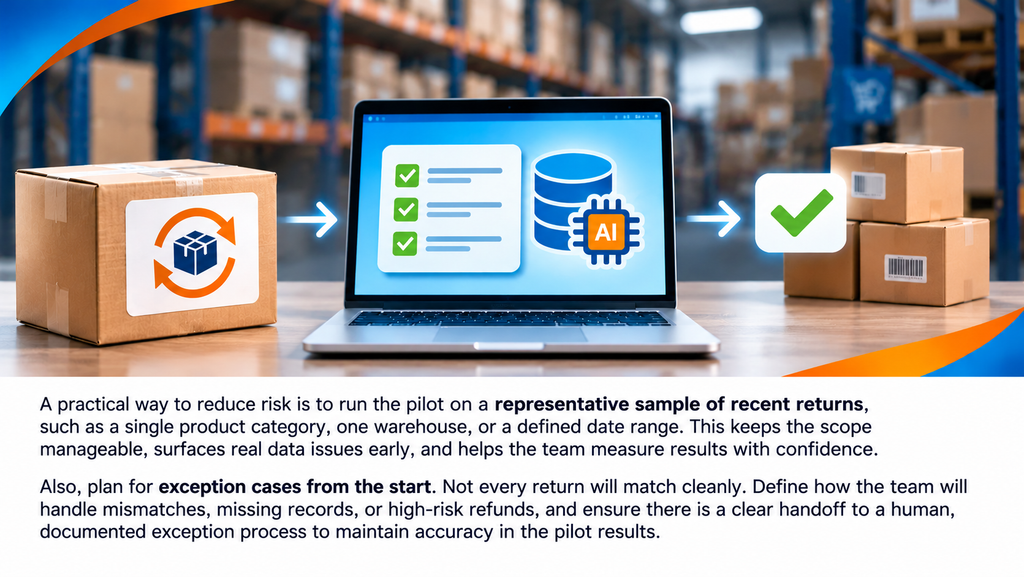
A well-structured returns reconciliation pilot should demonstrate measurable operational improvements without compromising accuracy, customer experience, or data security.
Define a decision rule in advance. For a practical guide to structuring the next stage, explore how to run an AI pilot that actually reaches production.
For instance, the pilot might need to reduce average handling time while keeping error rates within an approved limit.
The business must set its own thresholds using current performance and risk tolerance; an illustrative number should never be presented as a guaranteed return.
This gives the returns reconciliation project a business outcome rather than a technology milestone.
Score It This Week, Then Decide on Headcount
Bring the operations lead and IT lead together to score returns reconciliation this week.
Include security or compliance colleagues where data access and approvals are involved.
Ask each participant to support their score with a document, system record, owner assignment, or observable workflow.
Record disagreements rather than averaging them away. A low score can identify work worth completing before the next seasonal peak.
If the total is seventeen to twenty, scope a small pilot with a hard threshold and review date before the next hiring cycle.
At twelve to sixteen, fix the low-scoring points and rescore.
At six to eleven, prepare the process first.
At zero to five, the foundation is not ready.
Any zero on data access, security, or ownership should pause the pilot even when the overall total appears strong.
Seasonal staffing may still be necessary for service levels, unpredictable peaks, or cases that require judgment.
The point is to compare options on evidence.
A scored returns reconciliation workflow gives leaders a better basis for deciding where to automate, where to improve processes, and where additional people will genuinely help.
The AI Readiness Checklist includes the full ten points, scoring bands, and descriptions of what “ready” versus “red flag” looks like, so your team can run this exercise before the next budget cycle locks in another seasonal hire.
AI Readiness Checklist (10 points)
FAQ
How do we score our returns reconciliation process for AI readiness?
Score returns reconciliation against 10 points covering business value, scope, data access, integration, security, ownership, adoption, and success criteria.
Give each point 0, 1, or 2.
A total of 17–20 means ready to pilot; 12–16 means nearly ready; 6–11 means prepare first; and 0–5 means not yet.
A zero on data access, security, or ownership blocks the pilot regardless of the total.
Why didn’t our past GenAI pilot get evaluated as a win or a loss?
It may have skipped success criteria before launch.
Without a target metric, minimum threshold, review date, and decision rule, it is difficult to judge whether the pilot made a business difference.
Define those requirements before testing any new use case, including returns reconciliation.
Should we add seasonal headcount or run an AI pilot for returns?
Treat that as a decision to test, not assume.
Score the returns reconciliation workflow first.
A high score supports a carefully scoped pilot; a low score means preparation is needed before piloting.
Staffing decisions should also reflect demand forecasts, service obligations, and how much human review the work requires.
Comments are closed