
Quick answer: An AI readiness assessment for construction project controls checks ownership before it checks data. A change-order or RFI pilot can fail when three people can edit the workflow, and no one owns the outcome. Name one owner, pick one process, and set a pass/fail threshold before scoping any AI pilot.
Table of Contents
The Data Excuse Is Easier to Accept
When a construction AI pilot goes quiet after the demo, a team reviewing the stall will point at data first: the model data lives in three formats, the ERP export runs behind, or the RFI log was never fully reconciled. Data problems are real. They are also comfortable to blame, because fixing them is a technical task with an obvious owner: IT or a data vendor.
An AI readiness assessment for construction project controls should test that assumption rather than accept it. The checklist asks whether the team can pull the data this process needs within a week, without a data project first. On active jobs, change-order and RFI data generally lives in known systems: the project management platform, estimating system, or field reporting tool. The blocker may not be “we cannot find the data.” It may be “we have not agreed on who approves what, in what order, before the AI touches it.”
That distinction matters. An AI readiness assessment for construction project controls checks the approval path alongside data access, so the team knows whether it needs an integration fix or a clear decision owner.
Three Editors, Zero Owners
Picture a change-order workflow at a mid-market general contractor: a superintendent flags the condition, a project engineer drafts the cost impact, and a project manager negotiates it with the owner’s representative. Each one can edit the record. None of them answers for the outcome: cycle time, accuracy, or whether the change order holds up when it is disputed. For more context on managing change orders, Procore’s guide to construction change management explains the importance of documentation, review, and approval workflows.
This is what the ownership checkpoint in an AI readiness assessment for construction project controls is built to catch. A named accountable owner, with time set aside each week, plus an executive sponsor who can remove blockers, is what separates a pilot that gets built from one that never gets touched after the demo. A project that belongs to “operations” or “the PM team” in the abstract has no owner. Name one person. Put their name on the scope document before a single requirement gets written.
The output of an AI readiness assessment for construction project controls should therefore include a real name and an escalation route, not just a department on an organizational chart.
Reject the Portfolio, Pick the Process
A pilot proposal with fifteen use cases attached to a dashboard is not a pilot. It is a wish list wearing a pilot’s clothes. An AI readiness assessment for construction project controls should narrow that list to one high-value use case: a repetitive, high-volume process with clear inputs and outputs, owned by a named manager.
Change-order tracking qualifies. RFI routing qualifies. A combined “project controls intelligence platform” covering both plus submittals, daily logs, and safety incidents does not, because no single person can own that scope and no pilot that wide produces a clean pass/fail result in a short window. Reject any pilot scope that needs three departments to agree before it starts. Treat that requirement as a warning sign of a stalled rollout.
In practice, use the AI readiness assessment for construction project controls to choose a single workflow and document its owner, inputs, outputs, and measurable result before discussing a broader platform.
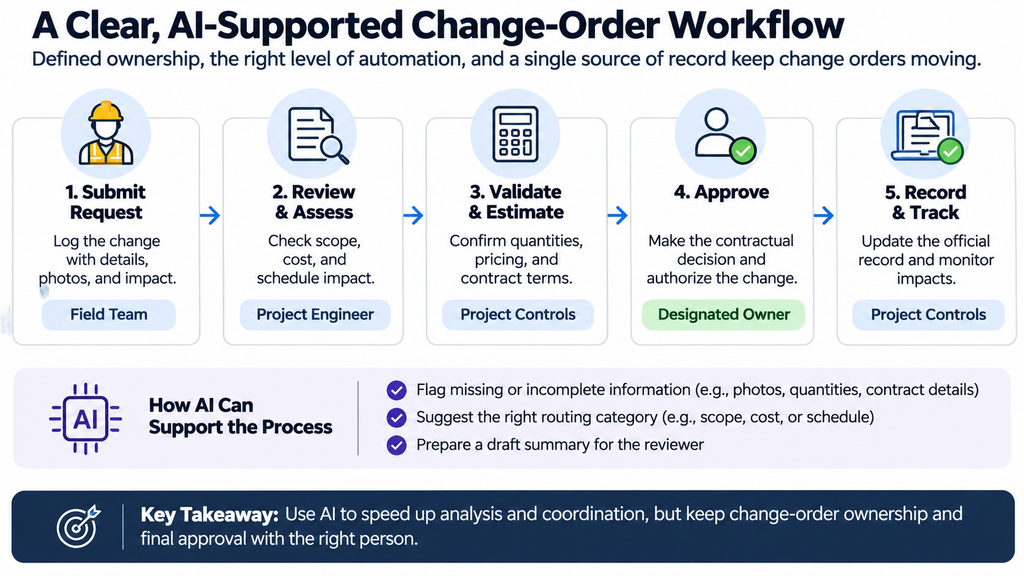
Before selecting a vendor, map one change order from the first field observation to the final recorded decision. Note who supplies evidence, who verifies cost and schedule effects, who can approve a change, and where disagreements are escalated. This exercise can reveal handoffs that a product demonstration cannot show. It also creates a baseline for deciding whether automation would remove work or simply move it to another team.
In an AI readiness assessment for construction project controls, that workflow map should become a short pilot charter. Identify the accountable owner, participating field roles, approved data sources, and the specific activities an AI assistant may support. For example, the assistant could flag missing documents or draft a review summary while the designated approver retains authority over cost and contract decisions. Record what happens when the system produces an uncertain or incorrect recommendation, including who reviews and corrects it.
Finally, agree on how the team will evaluate the pilot. Compare performance against the existing process, gather feedback from the superintendent and project engineer, and hold a scheduled decision meeting. An AI readiness assessment for construction project controls is most useful when it leads to a clear action: proceed with a narrow test, resolve a readiness gap first, or stop until ownership and approvals are defined. That makes the assessment a practical management tool rather than another document filed after the demo.
Ask the Field Before You Build
A tool that lives in a separate chat window the field has to copy from is not an integration. It is extra work disguised as help. The adoption-plan checkpoint asks whether the people who will use the tool have been asked, and whether they helped define the workflow. A superintendent who was not consulted on how AI will flag change-order discrepancies may treat the tool as surveillance, not assistance, when it arrives by announcement instead of by involvement.
An AI readiness assessment for construction project controls should include the superintendent and project engineer before the vendor conversation, not after the contract is signed. Ask what changes for them specifically, and build the training and feedback loop around their answer, not around the vendor’s default rollout plan.
Set the Pass/Fail Line Before Day One
A pilot without a defined failure condition cannot fail, which means it cannot succeed either. It just lingers. An AI readiness assessment for construction project controls should specify a target metric, a minimum threshold, a review date, and a decision rule for what happens if it misses: scale, fix, or stop.
Pick a metric tied to the one process named above: change-order cycle time, RFI response time, or error rate on cost coding. Set the threshold and the review date before the pilot starts, not after the demo looks good. Reject any pilot without a pass/fail threshold written down in advance. When no one can state today what “it worked” means as a number, the pilot is not ready regardless of how clean the data is.
That is the difference between a technical demonstration and an AI readiness assessment for construction project controls: the assessment defines what operational success must look like before work begins.
Before configuring the pilot, ask the field team to walk through a recent change order from submission to approval. Identify which details arrive late, where employees switch between systems, and which exceptions require a supervisor’s judgment. An AI readiness assessment for construction project controls helps connect technical requirements with the actual responsibilities of project managers, engineers, and field teams. Document where automation could reduce repetitive work and where human approval must remain essential.
Next, test the proposed workflow with a small group of users before expanding it across projects. Ask whether the suggested routing is understandable, whether mistakes can be corrected easily, and whether every decision has a clear record. An AI readiness assessment for construction project controls should capture this feedback alongside measurable performance indicators. If employees cannot explain who reviews AI-generated recommendations or how to escalate disputed changes, those gaps should be resolved before implementation. This helps construction leaders evaluate adoption readiness while maintaining accountability throughout the project.
Score Ownership Before You Score Data
Data cleanup is a real project. It may not be the reason a construction AI pilot for change orders or RFIs stalls after a promising demo. The reason may sit further up the list: no named owner, no adoption plan, no pass/fail line. Score those checkpoints honestly before anyone touches the ERP export again.
An AI readiness assessment for construction project controls scores ownership, adoption, and success criteria alongside data and security. That gives a project controls lead a concrete result instead of a hunch. Run the change-order or RFI process you are about to pilot through all ten readiness points, not just the three that feel technical.
Before scoping another pilot, use an AI readiness assessment for construction project controls to check all ten points, including the ownership and adoption items that a data-only audit tends to skip. Download the AI Readiness Checklist and find out where your pilot actually stands.
AI Readiness Checklist (10 points)
FAQ
Why do construction AI pilots for change orders stall after a successful demo?
One cause to check first is that no single person owns the workflow end to end. The checklist’s ownership point calls for a named accountable owner with dedicated time and an executive sponsor. An AI readiness assessment for construction project controls makes that responsibility explicit so the project has someone to push it past the demo stage.
Is messy BIM or ERP data really the reason construction AI pilots fail?
Not on its own. The readiness checklist asks whether the team can pull needed data within a week without a separate data project. If it can, data may not be the blocker, and unclear approval ownership is the next thing to check.
What should a project controls lead pick as the first AI use case?
One repetitive, high-volume process with clear inputs and outputs and a named manager, such as change-order tracking or RFI routing. An AI readiness assessment for construction project controls can help reject proposals that bundle multiple processes or need several departments to agree before starting.
Comments are closed